
WordPress Content Practitioner Publishes Workflow Rejecting Complete AI Drafts in Favor of Incremental Assistance
A WordPress content practitioner published a workflow methodology on August 16, 2026 that rejects complete AI-generated drafts in favor of incremental assistance paired with manual review checkpoints, countering the industry's dominant one-click publishing approach. Victoria, writing on TopTut.

WordPress Content Practitioner Publishes Workflow Rejecting Complete AI Drafts in Favor of Incremental Assistance
A WordPress content practitioner published a workflow methodology on August 16, 2026 that rejects complete AI-generated drafts in favor of incremental assistance paired with manual review checkpoints, countering the industry's dominant one-click publishing approach. Victoria, writing on TopTut.com, outlined a five-stage process that requests limited outputs—revised intros, comparison tables, or section rewrites—rather than full articles, arguing complete drafts obscure quality problems until late-stage editing.
The methodology centers on verifying search intent before editing begins, a departure from the publish-first optimization workflows that have proliferated since large language models became widely available in content marketing. Victoria's framework separates three distinct approaches—manual planning, AI assistance, and automation—each assigned specific tasks rather than treated as competing alternatives.
The Incremental Output Method
The published workflow prohibits requesting complete articles as first outputs, according to the TopTut guide. Instead, the practitioner requests "a revised intro, a comparison table, a draft outline, a short list of missing objections, or a cleaner explanation of one section," treating each component as a discrete judgment point.
The method requires defining "the one thing the finished post has to help the reader do" before engaging AI tools, Victoria wrote. That constraint prevents what the guide describes as drift into broad advice disconnected from the reader's actual decision context. For comparison-focused posts, the reader needs a decision framework; for workflow tutorials, a copyable process; for warning articles, explicit risk identification.
This approach differs from the workflow audit framework published by another practitioner in recent months, which emphasized systemic process review over individual tool selection but did not prescribe incremental output staging.
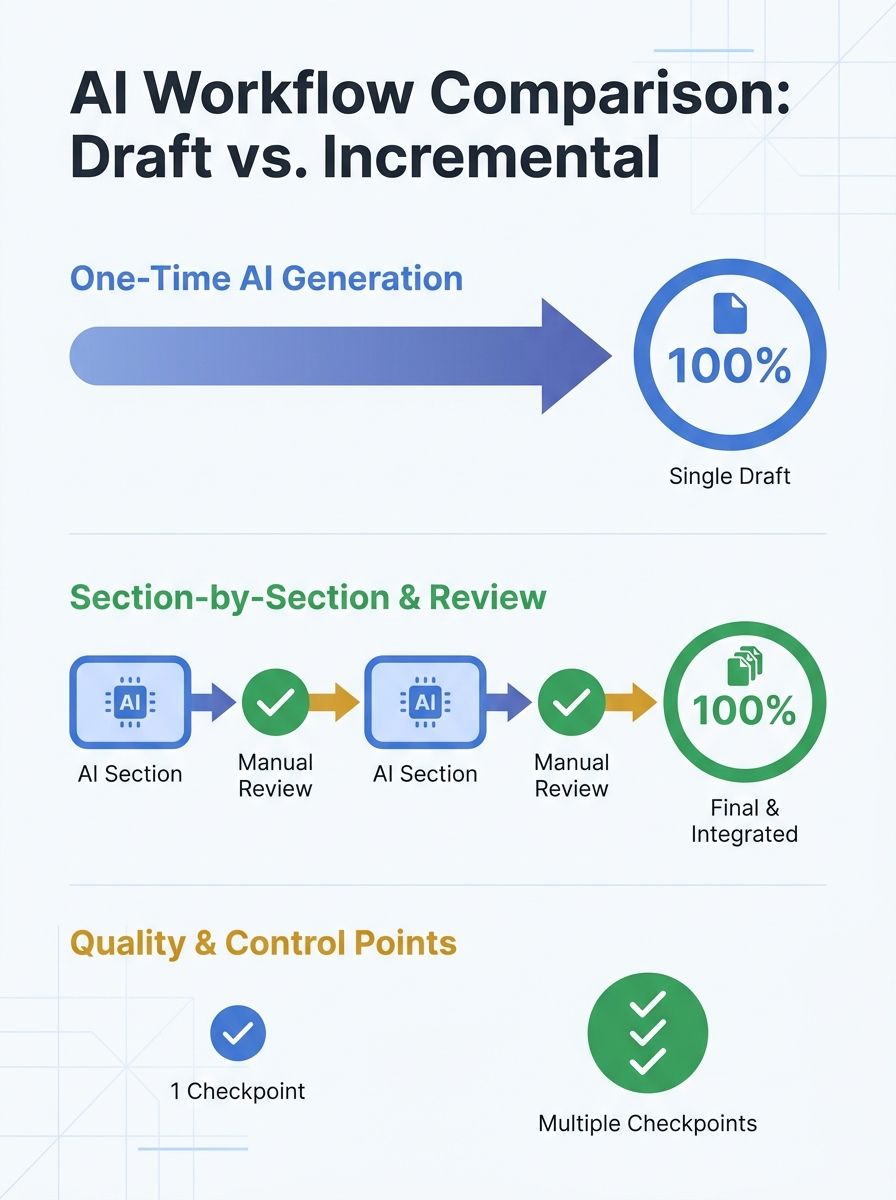
The TopTut guide identifies "complete drafts are seductive because they feel efficient, but they are harder to judge" as the central quality-control trap. Victoria argues smaller outputs surface problems faster than editing full 1,500-word AI generations where generic filler blends with useful content.
Measurement Framework and Quality Signals
The published methodology includes a four-metric evaluation table comparing good signals against bad signals for time savings, specificity, reader value, and editorial control. A good time-saved signal occurs when "the tool shortens setup or revision without creating a second cleanup job," while a bad signal appears when the practitioner spends "more time correcting vague sections than writing them myself," according to the comparison table.
For specificity measurement, Victoria defines success as output that "clearly supports checking search intent before editing" versus failure when "the same paragraph could fit several unrelated AI posts." That metric directly addresses the fundamental SEO concern that AI-generated content often lacks topic-specific depth, a challenge multiple practitioners have identified as the primary differentiator between citable and generic content.
The framework assigns each of three approaches—manual planning, AI assistance, and automation—to distinct workflow stages rather than treating them as substitutes. Manual planning handles "defining checking search intent before editing before tools enter the workflow," AI assistance creates "options, alternate wording, and rough structure," and automation moves "approved pieces into WordPress and reducing admin work," the comparison table shows.
Victoria identifies editorial control as the critical failure point, noting when "the tool pushes the article toward safe neutrality" rather than supporting a clear recommendation. That observation aligns with recent warnings that AI content tools default to hedge language and balanced perspectives that weaken decisional content.
User Type Suitability
The TopTut guide segments four user types by workflow fit. Solo WordPress bloggers receive a "yes" rating because the method "reduces blank-page friction while keeping final edits manageable," while beginners expecting one-click publishing receive a "no" rating because "the workflow still needs judgment, examples, and manual cleanup," according to the published user-type matrix.
Site owners managing multiple drafts receive a qualified "yes, carefully" rating contingent on maintaining "a visible review habit." Agencies and portfolio operators receive "yes" ratings when "each draft has a clear purpose and approval point," Victoria wrote.
The methodology explicitly flags two common mistakes: "treating checking search intent before editing as a generic AI task instead of a specific WordPress publishing problem" and "letting the tool add sections just because the draft feels short." Both errors stem from optimizing word count or keyword density before verifying the content answers the searcher's actual query type—informational, transactional, navigational, or commercial investigation.
Victoria includes a concrete example scenario: "Imagine I have a draft that might be a guide, comparison, review, or tutorial. The weak approach is to ask AI for a complete post and then lightly polish the result. The stronger approach is to ask for one useful piece at a time."
The Takeaway
The published workflow represents a middle path between rejecting AI tools entirely and surrendering editorial judgment to automated generation. By staging AI assistance as incremental suggestion rather than complete draft production, the methodology preserves the practitioner's ability to reject weak examples, remove generic sections, and maintain search intent alignment—the quality signals that differentiate citable content from aggregated rewrites in both traditional search and generative engine results.
For content teams already using AI writing tools, the framework offers a practical audit structure: measure whether each tool interaction saves more editing time than it creates, whether output remains specific to the topic rather than generically applicable, and whether final recommendations remain clear rather than drifting toward safe neutrality. The approach won't eliminate AI-content quality problems, but it surfaces them at the section level rather than after publishing, when traffic data reveals misalignment between content format and searcher intent.

Sarah Chen
SEO strategist and web analytics expert with over 10 years of experience helping businesses improve their organic search visibility. Sarah covers keyword tracking, site audits, and data-driven growth strategies.
Related Articles

AI Content Production Guide Published Emphasizing Workflow Audit Over Tool Selection
TrySight.ai published a three-step framework on August 2, 2026, for scaling content operations with AI tools, positioning workflow auditing and strategic oversight ahead of technology implementation, according to the 2,400-word guide targeting marketing directors, solo founders, and agency teams.

HubSpot Publishes Content Automation Workflow Guide Mapping Five-Stage Lifecycle Implementation
Content automation workflows now span five distinct lifecycle stages—research, drafting, optimization, distribution, and measurement—replacing manual handoffs with programmatic pipelines, according to a workflow guide HubSpot published July 1. The guide, authored by Kenny Lee, documents how marketin

Readers Perform at Chance Level Identifying AI-Generated Content, PNAS Study Finds
Readers shown AI-generated personal introductions performed at or near chance when identifying which text came from GPT-3, according to a study published in PNAS. Separate experiments across academic writing, marketing copy, and general-interest articles produced similar results, with participants u
Explore more topics