
The AI Visibility Audit: Why 76% of Brands Disappear From ChatGPT and Gemini Recommendations
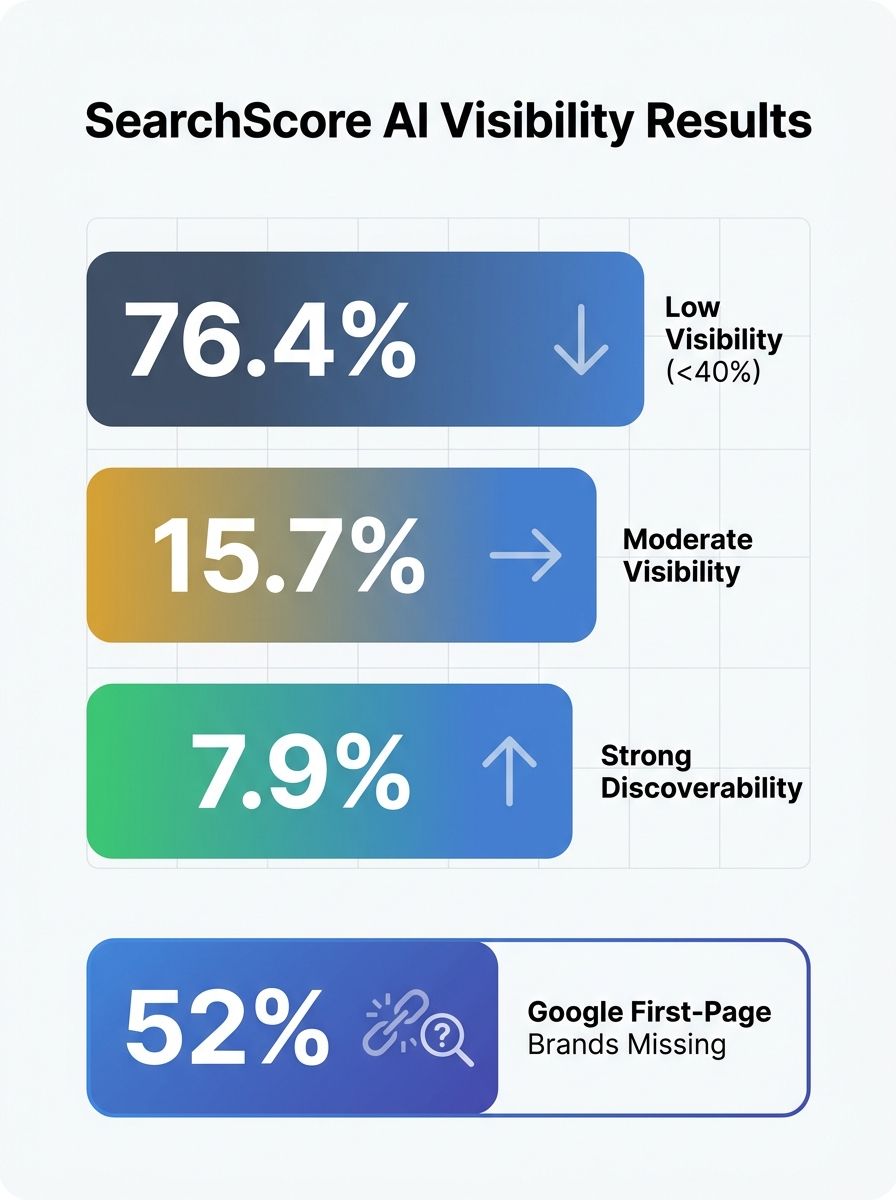
The SearchScore AI Visibility Study, released June 1, 2026, analyzed 254 websites across ChatGPT, Gemini, and other generative AI search platforms and found that 76.4% of brands scored below 40% in AI visibility. Only 7.

The AI Visibility Audit: Why 76% of Brands Disappear From ChatGPT and Gemini Recommendations
The SearchScore AI Visibility Study, released June 1, 2026, analyzed 254 websites across ChatGPT, Gemini, and other generative AI search platforms and found that 76.4% of brands scored below 40% in AI visibility. Only 7.9% demonstrated strong discoverability, even when many held first-page Google rankings for their target keywords.
June 1, 2026: DareAISearch Publishes the Scores
The study landed with a specific and uncomfortable finding. DareAISearch, the research firm behind the SearchScore methodology, evaluated 254 unique websites against a composite AI visibility metric that measured citation frequency, recommendation position, and sentiment across multiple generative AI platforms. The 76.4% failure rate wasn't based on obscure brands. It included companies with established Google rankings, active content strategies, and significant marketing budgets.
The breakdown told a sharper story. 52% of brands ranking on Google's first page for their primary keywords failed to surface in AI-generated recommendations at all. A brand could hold positions 1-3 in traditional SERPs and still be invisible when a buyer asked ChatGPT or Gemini "what's the best tool for X." The correlation between Google rank and AI citation that many marketers assumed existed turned out to be weak to nonexistent.
This aligns with what I've been seeing in client audits since early 2026. A brand's traditional SEO health and its AI platform discoverability are governed by different signal sets. Google rewards backlink profiles, page speed, and keyword relevance. AI models weigh entity recognition, source authority clustering, and how clearly content answers conversational intent patterns. The overlap between those two signal sets is smaller than the industry assumed.
Two Days Later, EMGI Confirmed the Decoupling
On June 2, a separate study from EMGI landed in Markets Insider and reinforced the SearchScore data from a different angle. The EMGI research found that 81% of brands cited by ChatGPT don't rank in Google's top 10 for the same queries. That number flipped the conversation entirely. The decoupling runs in both directions: Google winners lose in AI, and AI winners often aren't Google winners.
Dr. Matthew Lynch, professor and author who covered the disconnect, wrote that "the brand that dominates page one of Google may be functionally invisible in the conversational layer where an increasing share of purchase research happens." His framing captures the strategic problem precisely. Two separate discovery ecosystems now exist, and optimizing for one provides almost no guarantee in the other.
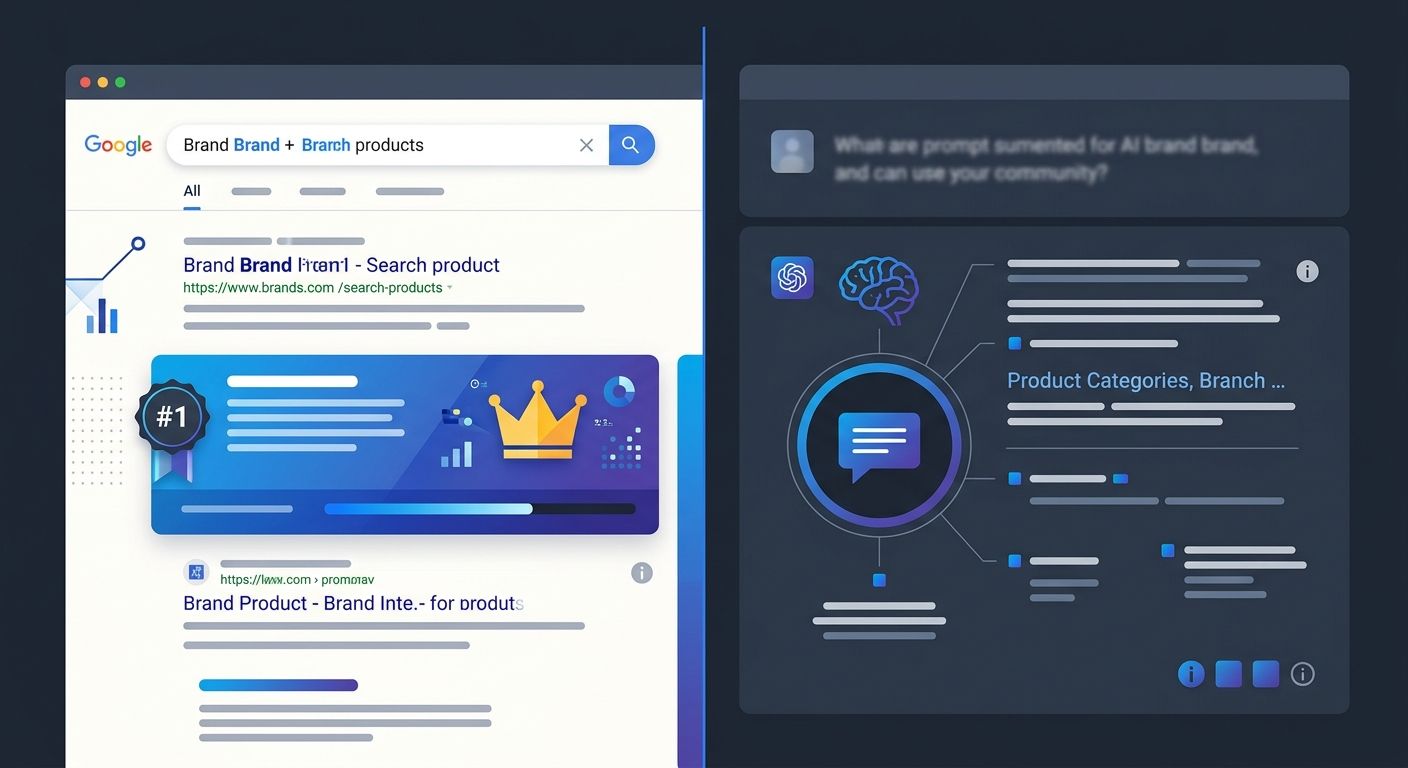
This means any serious ChatGPT brand citation strategy needs to be treated as a parallel workstream, not an extension of existing SEO efforts. The traditional SEO tools many teams rely on were built to track rankings on a stable results page for a static query. AI citation tracking measures something fundamentally different: how often, in what context, and how favorably these models reference your brand when synthesizing answers.
How the Audit Methodology Actually Works
The practical question that followed both studies was immediate: how do you measure your own AI visibility with enough rigor to act on? The methodology published alongside the SearchScore study and corroborated by audit walkthroughs from agencies like MyWebAudit follows a structured approach.
An AI search visibility audit begins with prompt selection. According to the Passionfruit audit framework, 30 prompts is the minimum for a statistically useful baseline. Below 20, random variance dominates. Above 60, the marginal insight per additional prompt declines rapidly. The 30-prompt threshold is the practical sweet spot for monthly re-auditing.
Those prompts need to span intent clusters, and this is where most early audits failed. A practitioner on r/GEO_optimization documented the problem after testing brand queries across ChatGPT, Claude, Perplexity, and Gemini: "Brand X might dominate informational prompts and disappear on comparative prompts. The aggregate hides this. Share of voice per model per intent cluster is the closest thing to a unified KPI."
That insight is critical for defining your answer engine optimization metrics correctly. You're tracking four variables per prompt: whether the brand appears, its position in the recommendation list, the sentiment of the mention, and which competitors appear alongside it. Lillian Pierson of Data-Mania, after testing AI search visibility tools for six months, concluded that "most tools answer 'are you cited?' That's the wrong question. The right one is who you're cited alongside and what that reveals about your competitive position."
The resulting audit framework evaluates brands across three axes that I've been refining with clients:
Audit Dimension | What It Measures | Primary Data Source |
|---|---|---|
Citation Frequency | How often the brand appears in AI responses per intent cluster | 30+ prompts across ChatGPT, Gemini, Perplexity |
Recommendation Position | Where the brand falls in ordered AI suggestions (1st, 2nd, 3rd+) | Manual or tool-assisted prompt logging |
Competitive Co-citation | Which brands appear alongside yours in the same responses | Side-by-side prompt comparison |
Sentiment Quality | Whether mentions are neutral, positive, or include caveats | Qualitative scoring per citation |
Structured Content Moved the Needle Fastest
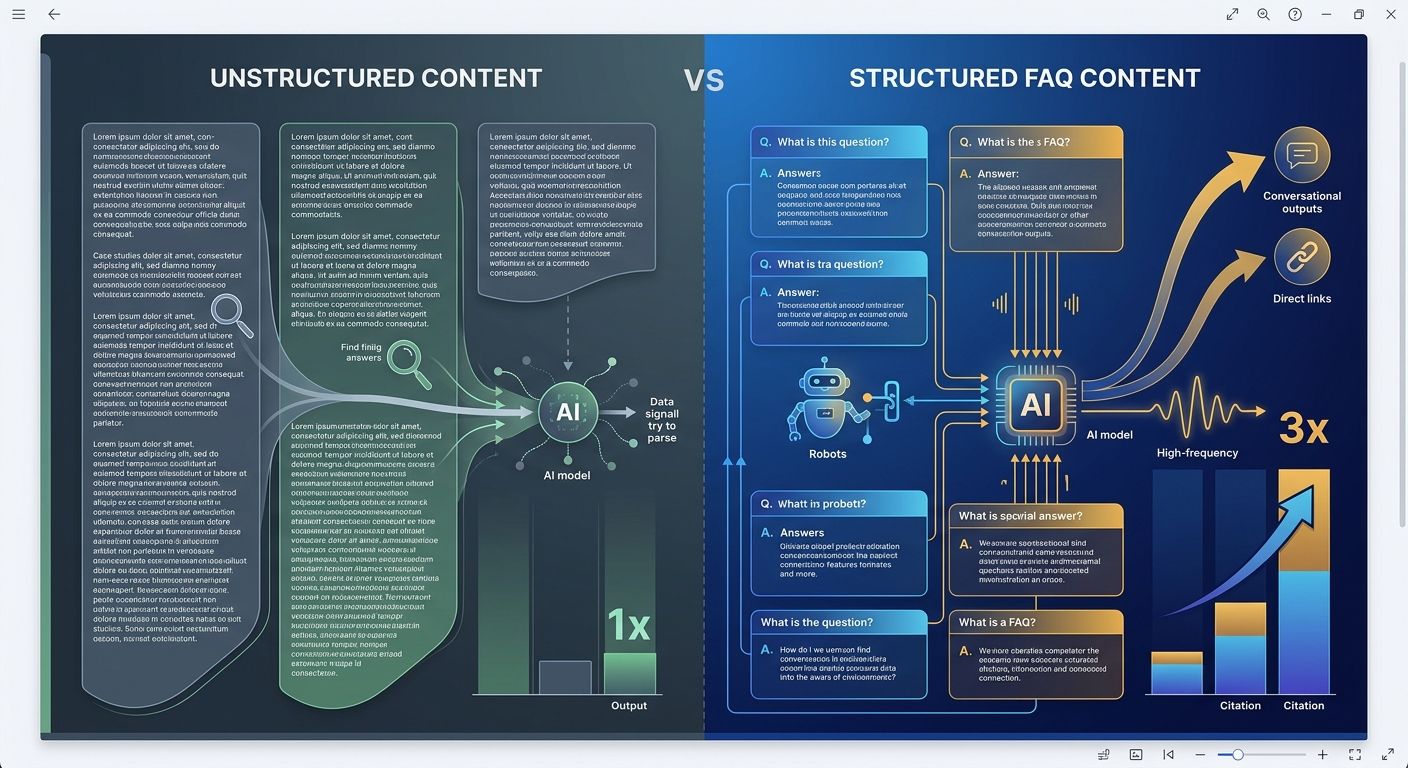
The SearchScore study didn't just diagnose the problem. It identified what separated the 7.9% of brands with strong AI discoverability from the 76.4% that failed. The single strongest predictor was structured FAQ content. Brands with dedicated FAQ sections received nearly 3x more AI mentions than those without, according to the study data.
This makes mechanical sense. Generative AI models synthesize answers from training data and retrieval-augmented sources. Content formatted as direct question-answer pairs maps cleanly to the conversational query patterns these models process. A 2,000-word essay about "enterprise project management" gives the model raw material. A structured FAQ with "What is the best enterprise project management tool for teams over 500?" gives the model a pre-formatted answer it can excerpt or paraphrase with minimal transformation.
The study also found that search-led brands outperformed social-media-reliant brands by 61% in AI visibility. Brands building their authority through indexed, crawlable, structured web content accumulate the kind of entity signals AI models trust. Social-first brands often have strong audience engagement but weak structured data footprints. Their brand mentions live in closed platforms that AI training pipelines can't always access or weight appropriately.
This connects directly to what I covered on building site architecture that signals topic authority. The same structural principles that help Google understand your content hierarchy help AI models identify your brand as an authoritative entity in a specific category. Schema markup, consistent entity naming across pages, and clear topical clustering all feed the authority signals that generative AI SEO optimization depends on.
ZTS, a search optimization firm specializing in AI visibility, stated the dynamic plainly: "If ChatGPT knows your brand exists but doesn't perceive you as an authority, it won't recommend you." Authority perception in AI models is built from citation density in trusted sources, consistency of entity information across the web, and the presence of structured credentials like author bios with verifiable qualifications.
5W's IPO Visibility Index Added Urgency
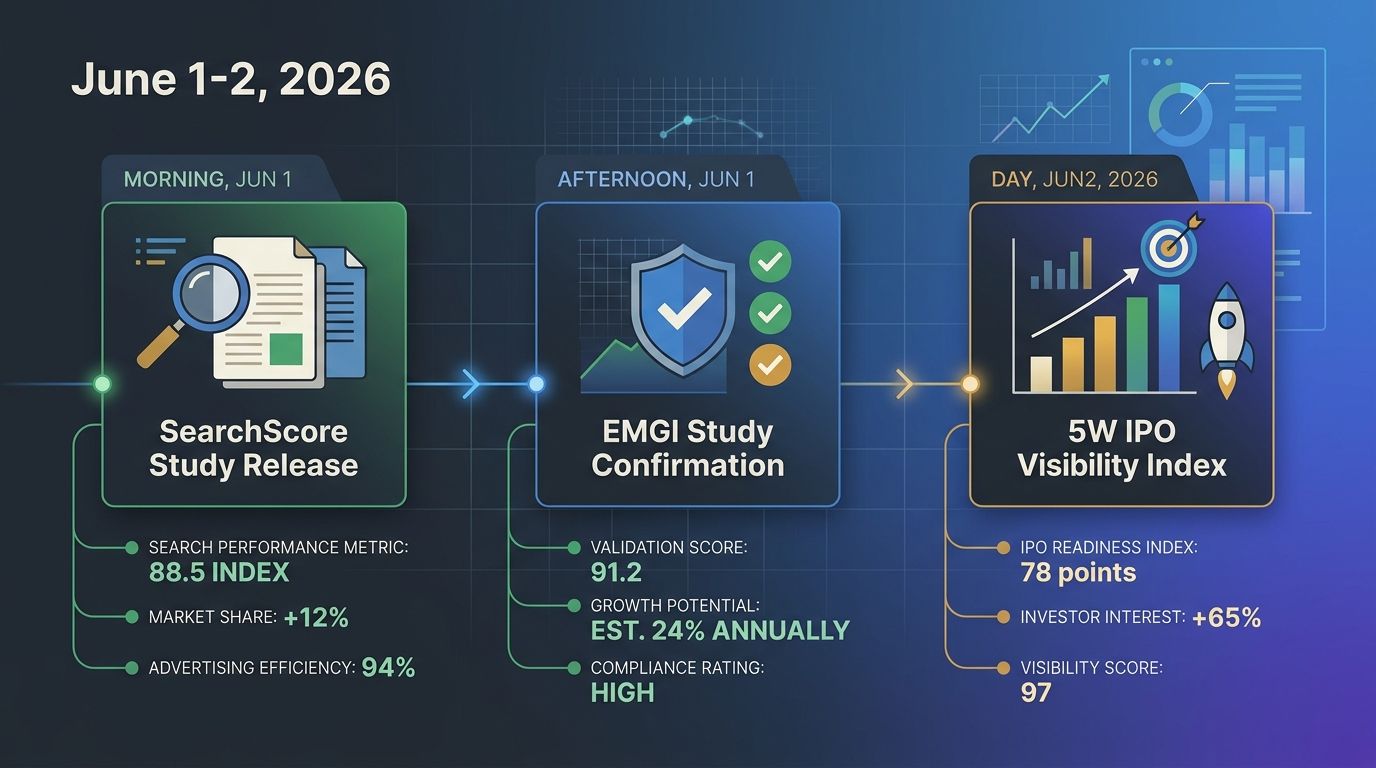
Within hours of the SearchScore study gaining traction, 5W AI Communications released the IPO AI Visibility Index on June 2. The study examined how companies preparing for IPOs performed in AI search environments, and the findings carried financial implications. Companies going public were losing visibility on the first question institutional buyers and retail investors ask AI platforms about them.
The timing of these three studies hitting within 48 hours of each other signals that AI platform discoverability has crossed from a marketing curiosity into a measurable business risk. When the question "tell me about [Company X]" returns thin or absent results in ChatGPT and Gemini, every stakeholder interaction that starts with an AI query begins at a disadvantage.
Meanwhile, the agency market is already responding. According to The AI Journal's review of generative AI SEO agencies in 2026, firms like GenOptima now treat citation share and recommendation position as primary KPIs, replacing traditional traffic metrics with AI-native performance measurement. The shift from "how many clicks did we get" to "how often does ChatGPT recommend us" represents a fundamental change in how marketing teams define discoverability. And it requires a unified search strategy that treats AI citation and traditional rankings as parallel tracks.
The State of Play
Three datasets in 48 hours established a baseline that the industry will be measured against for the rest of 2026. The 76.4% failure rate from SearchScore, the 81% decoupling figure from EMGI, and the IPO-specific findings from 5W collectively confirm that AI visibility is a discrete problem requiring discrete measurement and strategy.
The brands in the winning 7.9% share common traits: structured FAQ content, consistent entity markup, high citation density in trusted third-party sources, and visible author credentials. None of these are exotic. All of them fall within the scope of work that most marketing and SEO teams can execute within existing budgets. The gap between the 7.9% and the 76.4% is largely a gap of awareness and prioritization, not resources.
For teams starting an AI search visibility audit this week, the minimum viable approach is clear. Select 30 prompts spanning informational, comparative, and transactional intent for your category. Run them across ChatGPT, Gemini, and Perplexity. Log citation presence, position, sentiment, and competitive co-citation for each. The AI Overviews data already reshaping organic CTR makes this doubly urgent: the traditional search channel is compressing at the same time the AI channel is expanding, and brands invisible in both face a compounding visibility crisis.
The 76.4% number is a snapshot from June 1, 2026. By the time the next quarterly audit cycle runs, brands that moved on structured content, entity consistency, and citation-building will have separated further from those still treating AI visibility as someone else's problem. The window between "early mover" and "baseline expectation" is closing fast.

Sarah Chen
SEO strategist and web analytics expert with over 10 years of experience helping businesses improve their organic search visibility. Sarah covers keyword tracking, site audits, and data-driven growth strategies.
Related Articles
The Corporate Silo Problem in AI Search: How to Align Teams for Visibility in 2026
Internal departmental silos cause 37% of brands to appear less frequently than competitors in AI-generated answers, and 30% to be described inaccurately.
Brands Ranking #1 on Google Missing 62% of AI Overview Citations, Adweek Analysis Shows
Brands holding first-page Google rankings are absent from 62% of citations in AI-generated search answers, according to a July 22 analysis by Adweek examining generative engine optimization adoption patterns, as only 38% of pages cited in Google's AI Overviews come from URLs in the top ten tradition

The AI Visibility Blind Spot: Why Your SEO Rankings Don't Matter If ChatGPT Doesn't Know You Exist
Ahrefs data shows Google AI Overviews reduce position-1 click-through rates by 58%, while a SimilarWeb study found that visitors arriving through ChatGPT recommendations view 12 pages per session and spend 11.8 minutes on site, compared to 6.5 pages and 5.6 minutes for other traffic sources.
Explore more topics