
Ranking #1 on Google Now Delivers 58% Fewer Clicks Than It Used To, Gravitate Analysis Finds
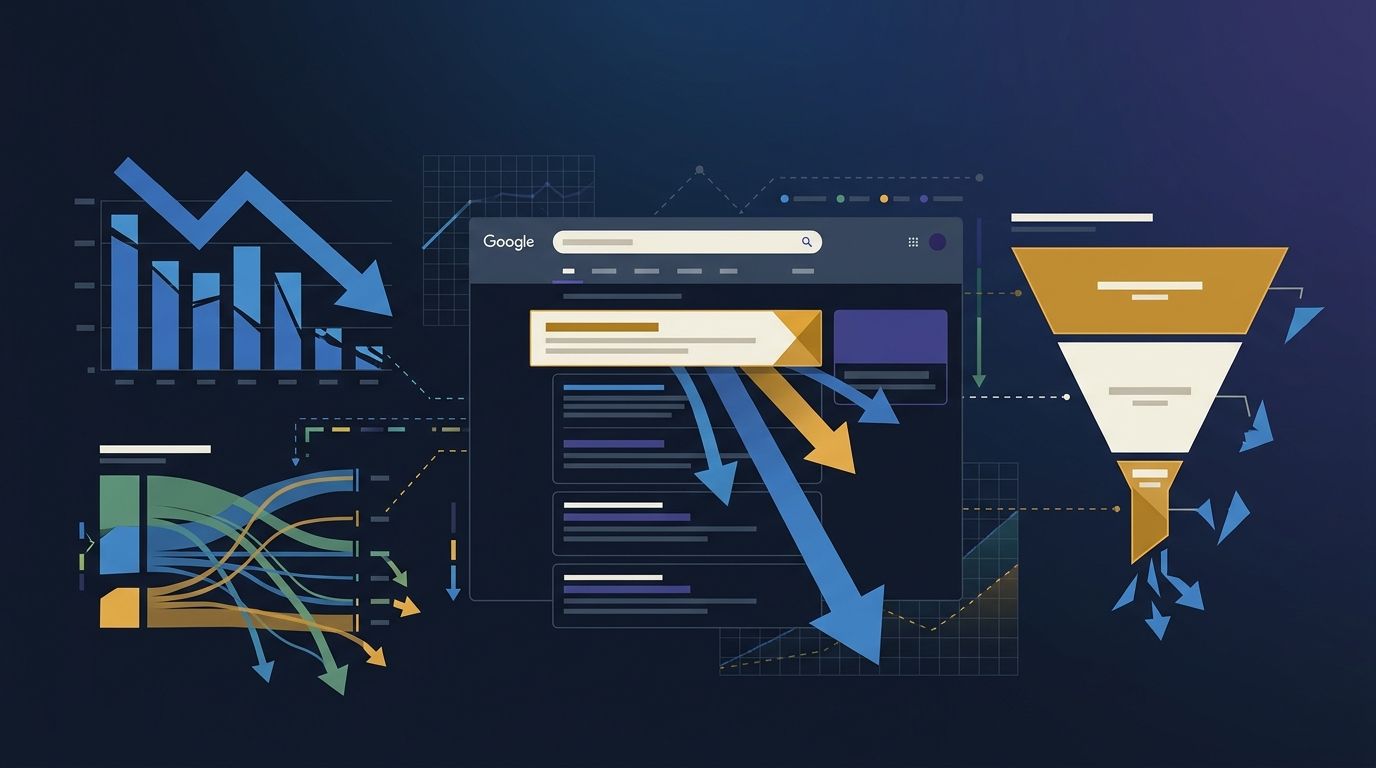
First-position organic search results on Google now generate 58% fewer clicks when AI Overviews appear on the page compared to traditional search results, according to an analysis released July 9 by Gravitate, a Vancouver-based digital marketing agency.
Ranking #1 on Google Now Delivers 58% Fewer Clicks Than It Used To, Gravitate Analysis Finds
First-position organic search results on Google now generate 58% fewer clicks when AI Overviews appear on the page compared to traditional search results, according to an analysis released July 9 by Gravitate, a Vancouver-based digital marketing agency. The finding, which draws on December 2025 data from Ahrefs covering 300,000 keywords, shows that the click-through penalty for top-ranked pages has nearly doubled since April 2025, when the drop stood at 34.5%.
Gravitate's analysis combines public data from Ahrefs, Pew Research Center, SparkToro, Gartner, and Press Gazette to document what the agency describes as "an accelerant to a decade-long structural shift away from click-through traffic." The analysis addresses a problem digital marketers have reported with increasing frequency: businesses achieve strong organic rankings but watch website traffic decline regardless of position.
Zero-Click Search Behavior Reaches Record High
Google searches that conclude without a user clicking any external link reached 68% in the United States during 2026, according to a SparkToro study conducted in collaboration with Similarweb. That figure represents a seven-percentage-point increase in two years, up from approximately 60.45% in 2024 and an estimated 45% a decade ago. For every 1,000 searches on Google, fewer than 320 now result in external web traffic, according to the analysis.
The zero-click pattern predates AI Overviews. A 2024 SparkToro study using Datos clickstream panel data showed 58.5% of U.S. Google searches ended without a click, and 59.7% in Europe. Users already ended sessions on the search results page, either because they found answers or continued searching within Google's interface.
Behavioral Data Confirms the Click-Through Drop
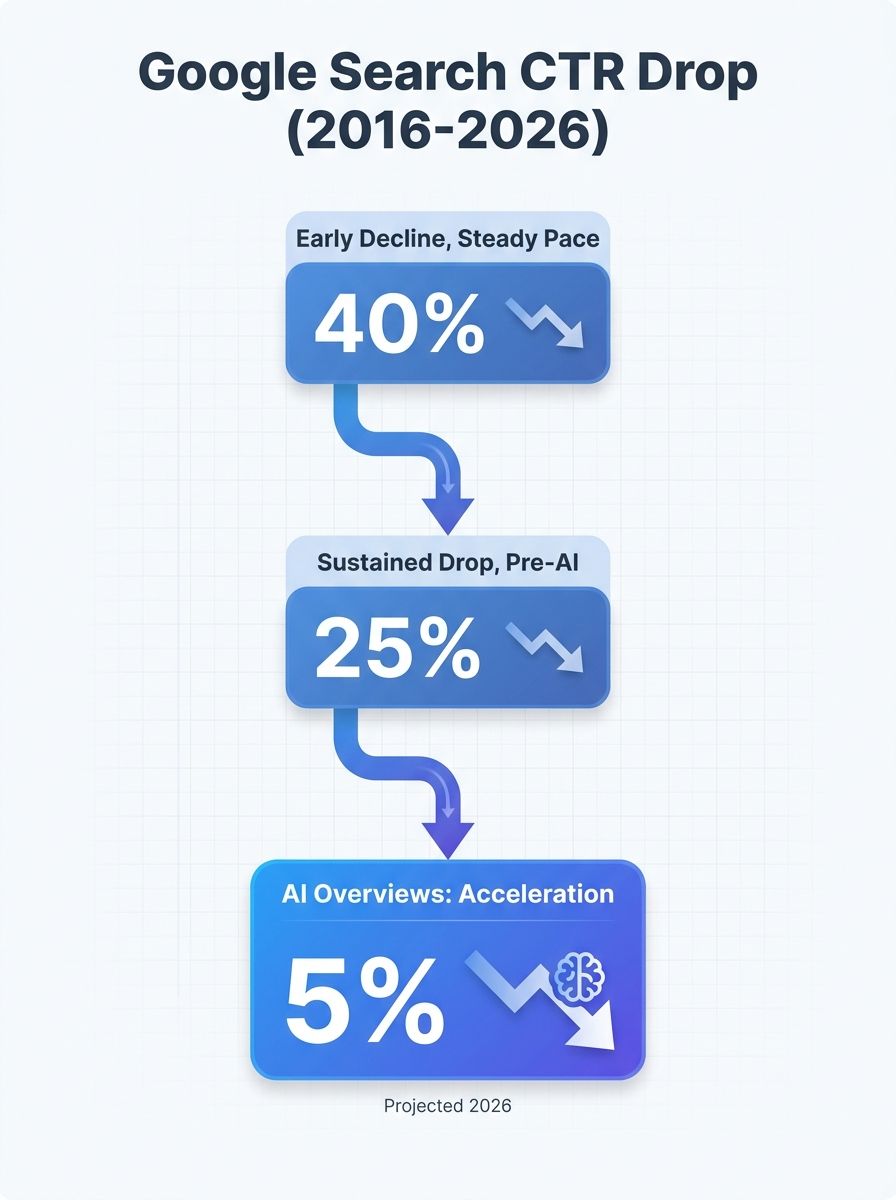
Pew Research Center's March 2025 study observed 900 U.S. adults navigating 68,879 Google searches and tracked actual link clicks and website visits. On queries that surfaced an AI Overview, 8% of search sessions resulted in a user clicking a traditional organic link, compared to 15% on searches without an AI Overview—a 47% reduction in click likelihood, according to the research. Links embedded within AI Overviews themselves captured only 1% of clicks.
The Ahrefs data measures aggregate click-rate changes when AI Overviews appear at scale, while Pew Research captured individual user behavior on the search page. Both studies point to the same outcome: AI Overviews displace organic traffic without redirecting it to cited sources. The 58% click-rate penalty applies specifically to the first organic result appearing directly beneath an AI Overview, based on Google Search Console data averaged across Ahrefs' keyword sample.
Publisher Referral Traffic Drops 33% Globally
Total publisher referral traffic from Google search declined 33% globally in 2025, according to aggregated data from Press Gazette, Chartbeat, and the Society of News Editors. U.S. publishers saw a 38% drop; European publishers experienced a 17% decline. Business Insider lost 55% of its Google referral traffic; Forbes and HuffPost each lost approximately 50%, the analysis shows.
The decline affected established editorial sites with strong domain authority, not marginal content farms targeted by spam policies. Gravitate's analysis attributes the losses to Google's strategy of satisfying more queries within its own ecosystem rather than directing users to external publishers. The shift represents a structural change in how search traffic flows across the web, extending patterns documented in earlier research on AI visibility gaps.
Core Algorithm Updates Compound the Decline
AI Overviews represent one factor in the traffic decline, but not the only one. Google's March 2024 core update removed what the company classified as low-value content from search results at a 45% rate, one of the largest algorithmic purges in recent years. Many websites lost rankings or saw entire sections de-indexed overnight, according to the analysis.
The combination of AI Overviews, zero-click behavior, and core algorithm updates creates compounding pressure on organic traffic. Businesses that focus solely on traditional ranking metrics without accounting for click-through changes now face a structural mismatch between visibility and actual visitor volume. Multi-channel SEO visibility audits have emerged as one response to the ranking-traffic disconnect.
The Gravitate analysis notes that Google processes more searches than at any previous point in history, but directs a shrinking percentage of that activity to the open web. Open web traffic stands at its lowest point in a decade, according to the data sources the agency compiled.
The Takeaway
The 58% click-through penalty for top-ranked pages appearing beneath AI Overviews fundamentally changes SEO ROI calculations. Ranking first on Google no longer guarantees proportional traffic, and the gap between visibility and visitors continues to widen. The finding carries immediate implications for budget allocation: businesses paying for traditional SEO services based on ranking improvements may need to renegotiate success metrics around actual traffic and conversions rather than position alone.
The acceleration from a 34.5% penalty in April 2025 to 58% by December 2025 suggests the effect will continue worsening as Google expands AI Overview deployment. Marketing teams that treat this as a temporary algorithmic fluctuation rather than a structural shift risk missing the adaptation window. Optimizing for both traditional search and AI answer engines has moved from experimental tactic to operational necessity for organizations that rely on organic search as a primary acquisition channel.
For publishers and content-driven businesses, the 33% global traffic drop from Google referrals in 2025 represents lost audience reach that advertising revenue and subscription models may not fully replace. The data shows established, authoritative sites suffered comparable losses to marginal operators, meaning content quality alone provides no insulation from the traffic shift. The market is now divided between organizations that have already adapted their measurement frameworks and those still optimizing for a click-through environment that no longer exists at scale.

Alex Chen
Alex Chen is a digital marketing strategist with over 8 years of experience helping enterprise brands and agencies scale their online presence through data-driven campaigns. He has led marketing teams at two successful SaaS startups and specializes in conversion optimization and multi-channel attribution modeling. Alex combines technical expertise with strategic thinking to deliver actionable insights for marketing professionals looking to improve their ROI.
Related Articles
AI Overviews Now Trigger on 48% of Google Searches, Slashing Organic CTR Up to 61%
AI Overviews now appear on 48 percent of all Google search queries—a 58 percent increase over the past three months—and zero-click searches have climbed to 83 percent on queries that trigger the feature, according to data published by Quasa on May 24. The shift has driven organic click-through rate
Marketing Teams Report Organic Traffic as Primary KPI Despite 48% AI Overview Coverage and 68% Zero-Click Search Rate
Marketing teams continue to structure quarterly search performance reports around organic traffic and click-through metrics even as Google's AI Overviews now generate answers for 48 percent of all queries without requiring users to click any result, according to June 2026 research published by Spark

Google's May 2026 Search Redesign Cuts Publisher Traffic by 70% to 89% as AI Answers Replace Click-Through Results
Google announced the largest redesign of its search interface in 25 years at its May 2026 developer conference, introducing a conversational search box that accepts text, images, video, and file uploads while deploying automated information agents that monitor topics and push updates without user qu
Explore more topics