
The Search Intent Mismatch Audit: Why Your Content Ranks but Doesn't Convert
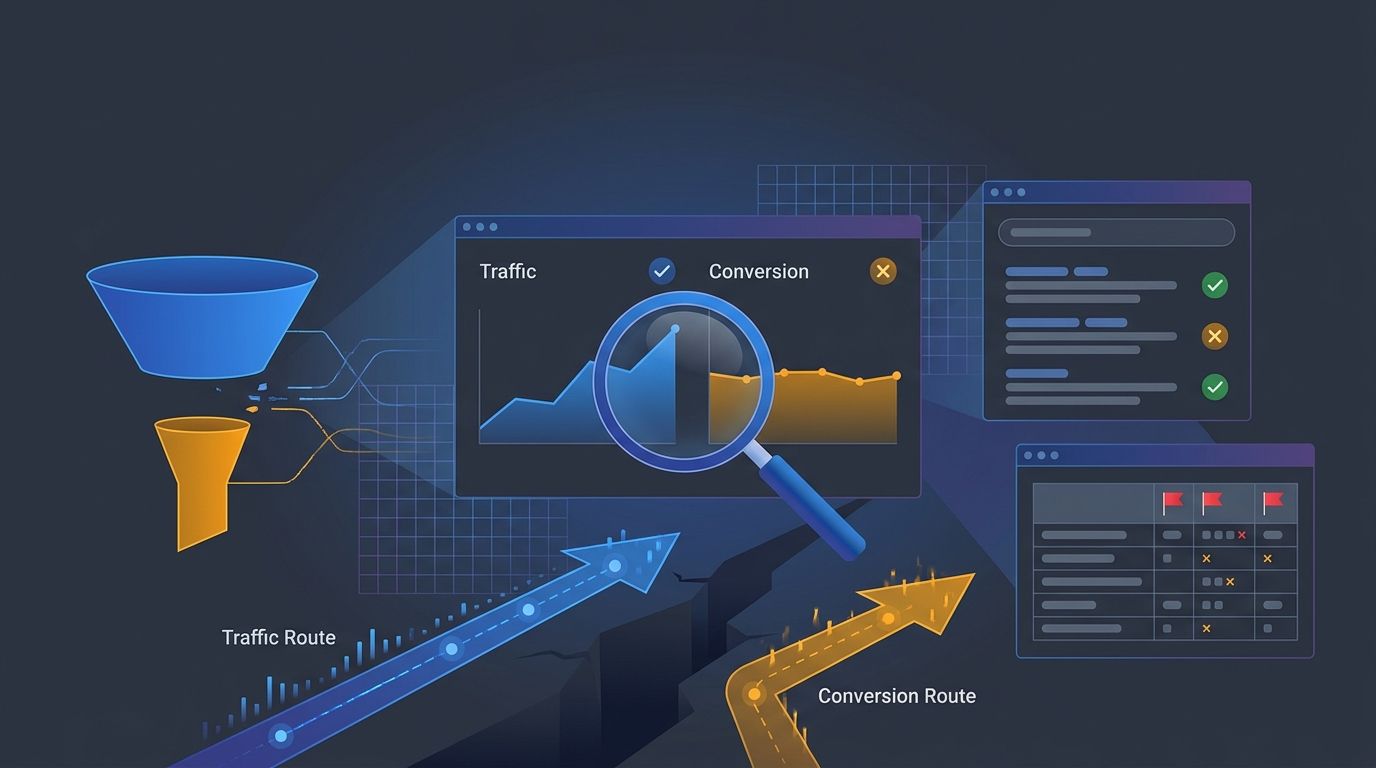
Pages that rank on page one but convert below 1% don't have a CRO problem. They have a content classification problem, where the page answers the wrong type of question for the person searching.
The Search Intent Mismatch Audit: Why Your Content Ranks but Doesn't Convert
Pages that rank on page one but convert below 1% don't have a CRO problem. They have a content classification problem, where the page answers the wrong type of question for the person searching. Fixing this requires auditing what Google's SERP already reveals about buyer intent, then rebuilding content to match that signal.
High-Volume Keywords Are a Conversion Trap
Targeting keywords based primarily on monthly search volume produces pages that attract the wrong audience at the wrong buying stage. Data from Grow and Convert's analysis of SEO conversion rates shows that typical blog posts targeting high-volume keywords convert at a rate of 1% or less, while keywords with high buying intent return conversion rates of 5% or higher. That 5x gap is created entirely by keyword selection, before a single word of copy gets written.
The problem compounds because content teams celebrate ranking improvements without tracking what happens after the click. A page ranking position 3 for "project management software" (44,000 monthly searches) looks like a win in every SEO dashboard. But if that page is a 3,000-word informational guide and the searcher wants to compare pricing plans, the visit ends in under 10 seconds. Google's ranking systems read that short dwell time as a relevance failure, and the page eventually drops.
As Backlinko's research team puts it in their keyword analysis guidance, "Traffic without conversions is just a vanity metric." That framing is useful because it reframes the metric itself. Your keyword relevance analysis shouldn't stop at ranking position; it needs to extend through to the conversion event, whether that's a demo request, a purchase, or a qualified lead form submission.
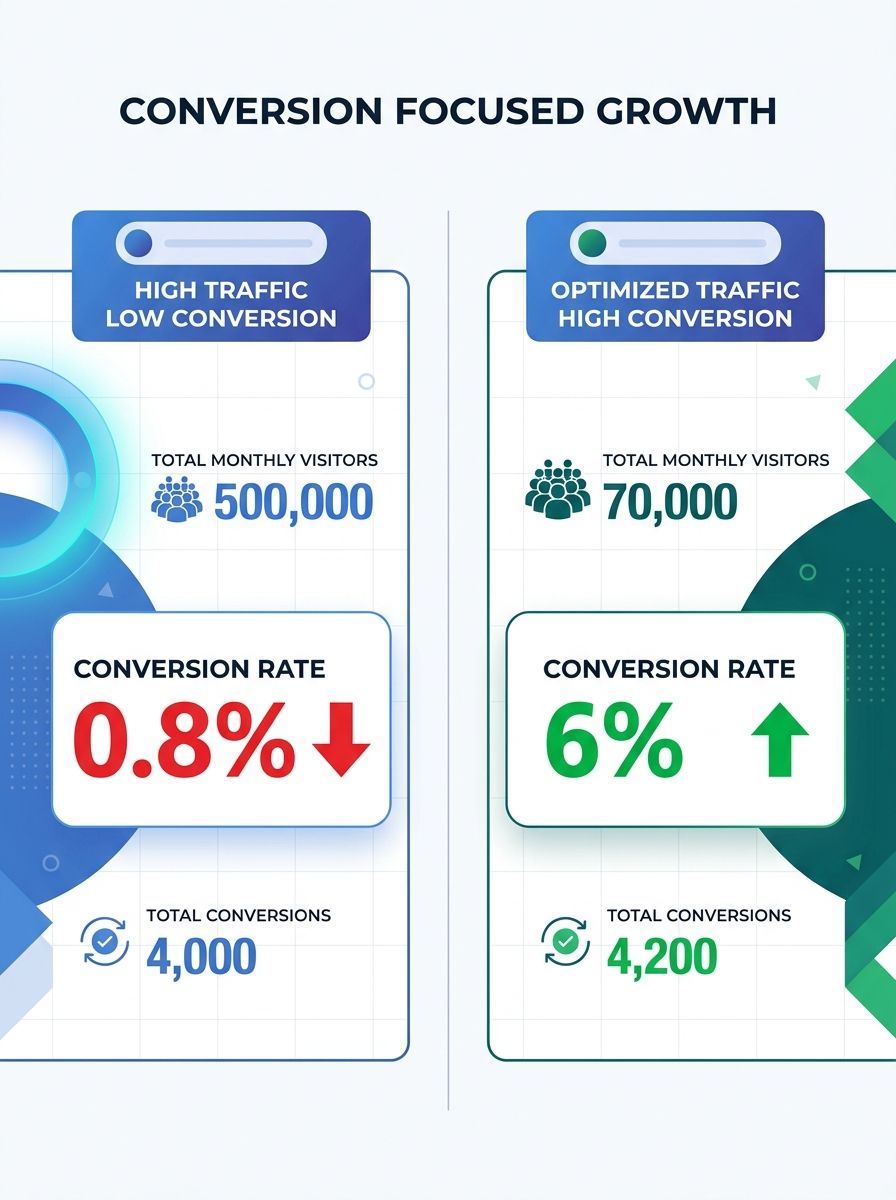
The math tells the story clearly. Consider a page getting 8,000 organic visits per month at a 0.8% conversion rate: 64 conversions. A different page pulling 1,200 visits per month from a buying-intent keyword at a 6% rate converts 72 times. The lower-traffic page generates more revenue. This is the core arithmetic that search intent optimization rewrites when you stop optimizing for volume and start optimizing for buyer alignment.
Average homepages convert at about 3%, which sits neatly between the informational floor (under 1%) and the transactional ceiling (5%+). That middle-ground number is what many teams unconsciously benchmark against, mistaking a mediocre conversion rate for an acceptable one. For teams already rebuilding measurement around first-party data, intent classification becomes the variable that explains why some organic traffic produces pipeline and some produces nothing.
Google's SERP Already Shows You What to Build
Why do SEO teams spend hours debating content formats when Google has already published the answer on page one? The SERP itself is a decoded intent signal. Every featured snippet, product carousel, comparison table, and People Also Ask box tells you exactly what content type Google has determined satisfies the query.
Incremys's 2026 SERP intent analysis framework addresses this directly: "The goal is to align the promise (title/meta), structure and CTAs with what the SERP already rewards, then measure CTR, engagement, conversions." This checklist-driven approach to SERP intent matching eliminates the guesswork that produces misaligned content.
Content Queen Mariah's "3 Cs framework," documented in a case study published through Single Grain, systematizes this analysis into three dimensions: Content Type (blog post, product page, landing page), Content Format (how-to, listicle, comparison, review), and Content Angle (the dominant perspective, like "best for beginners" or "most affordable"). When your page misaligns on any of these three dimensions, conversion suffers even when rankings hold steady.
Here's what a practical SERP read looks like for intent classification:
SERP Signal | Likely Intent | Recommended Page Type | Conversion Potential |
|---|---|---|---|
Product carousels, shopping ads | Transactional | Product/pricing page | High (5%+) |
Featured snippets, PAA boxes | Informational | Guide/explainer | Low (0.5–1%) |
Comparison tables, review snippets | Commercial investigation | Comparison/review page | Medium-high (3–5%) |
Brand sitelinks, knowledge panel | Navigational | Homepage/brand page | Medium (2–3%) |
AI Overview with full answer | Zero-click informational | Must be cited source or pivot keyword | Near-zero direct |
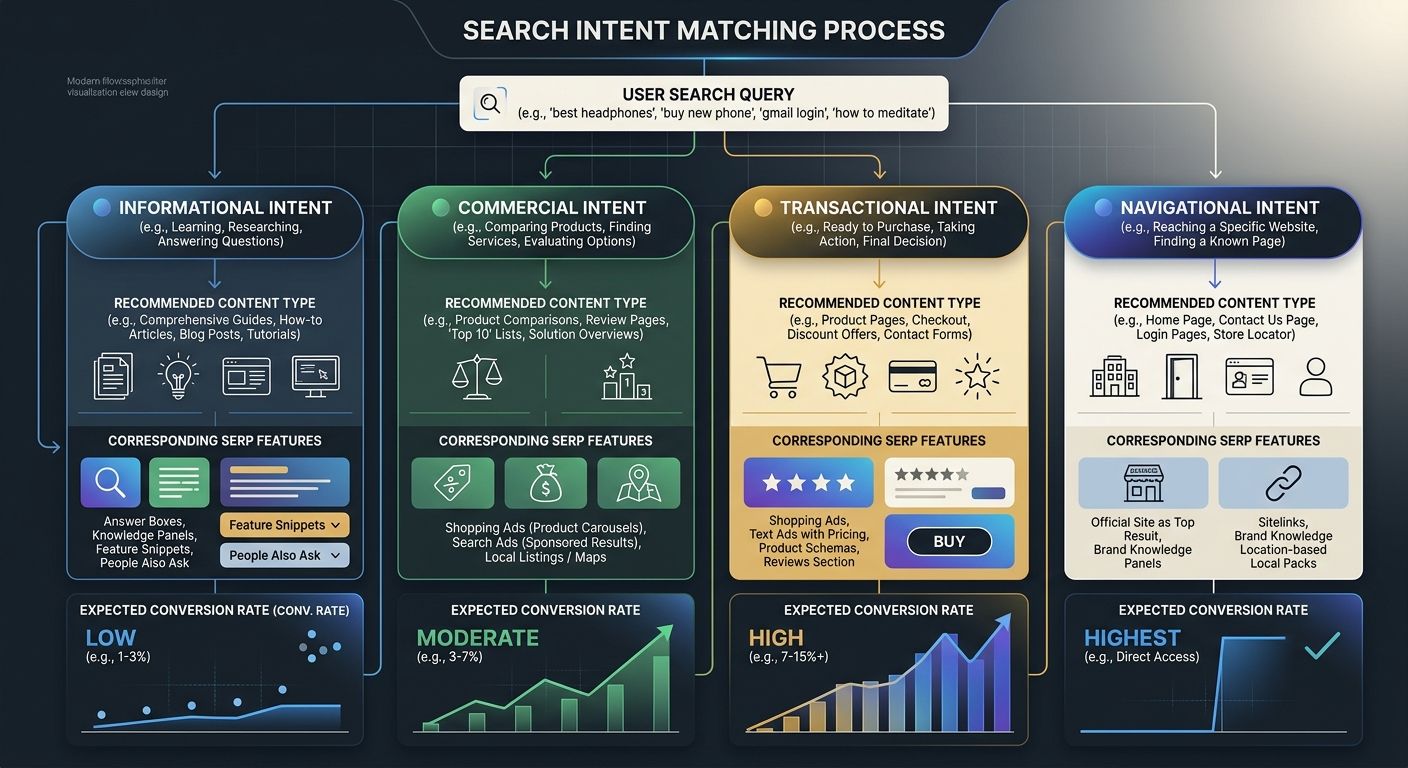
This table reflects the conversion-driven SEO principle that page architecture must match the buyer stage encoded in the SERP. When AI Overviews satisfy basic informational intent entirely on the results page, resulting in zero clicks, the strategy has to shift. According to CONTADU's SERP intent research, you either optimize to become the cited source within that AI Overview, or you pivot your keyword targeting toward complex queries that AI can't fully resolve.
Zero-click searches now account for 69% of certain query categories, up from 56% in prior measurements. For teams still pouring resources into informational content for queries Google answers directly on the results page, the conversion math has collapsed. This connects directly to why building topic authority for AI search requires a fundamentally different content architecture than the traditional blog-first model.
When Page Architecture Contradicts the Query
Even when a page targets the right keyword with the correct intent classification, the page itself can sabotage conversion through architectural mismatch. This happens when the content body signals one intent while the CTA assumes another.
Siteimprove's enterprise content strategy guide defines proper intent optimization as "matching user queries to page archetypes, UX, and offers to convert demand into a pipeline." The word "pipeline" matters here. Each page should move the visitor one step forward in their decision process, and that step needs to correspond to where they already are.
I've run this audit across dozens of enterprise sites, and the pattern repeats. A SaaS company ranks position 2 for "best CRM for small business" with a page that opens with 1,500 words of feature descriptions before reaching a pricing comparison. The searcher wanted the comparison first, above the fold, in a scannable table, with a clear next action. By the time they scroll past the feature narrative, 75% have already bounced. That 75% figure aligns with broader research showing that 75% of users never scroll past the first page of search results, and the same impatience governs behavior within a page.
The fix requires what I call the Three-Layer Intent Audit, a diagnostic framework that scores each ranking page across three dimensions:
Layer 1: Query Classification Accuracy. Is the target keyword genuinely informational, commercial, transactional, or navigational? Run the keyword through a live SERP analysis instead of relying on your original assumptions. A keyword you classified as informational 18 months ago may now trigger product carousels and shopping ads, making it functionally transactional. Google's March 2026 core update shifted 79.5% of top-three results, so classifications decay faster than most teams realize.
Layer 2: SERP Format Alignment. Does your page type match what Google currently rewards for this query? If the top 5 results are all comparison tables and your page is a narrative blog post, you have a format mismatch. Your content might be well-written, but the container is wrong for the searcher's expectations.
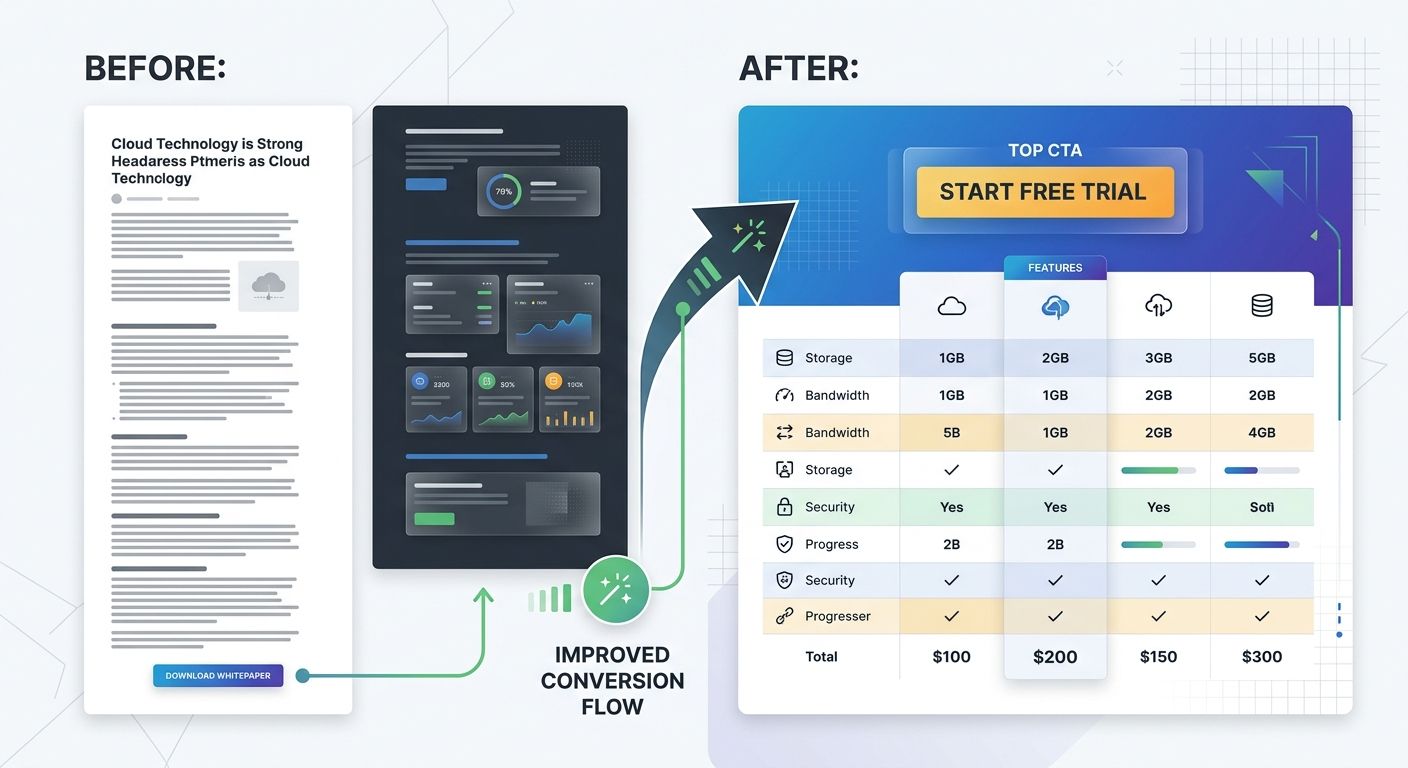
Layer 3: Conversion Path Coherence. Does the page's primary CTA correspond to the searcher's likely next action? A user searching "project management software pricing" doesn't want a whitepaper download gate. They want a pricing table with a "start free trial" button. Misaligned CTAs are the most common failure at this layer, affecting an estimated 40–50% of pages in a typical audit.
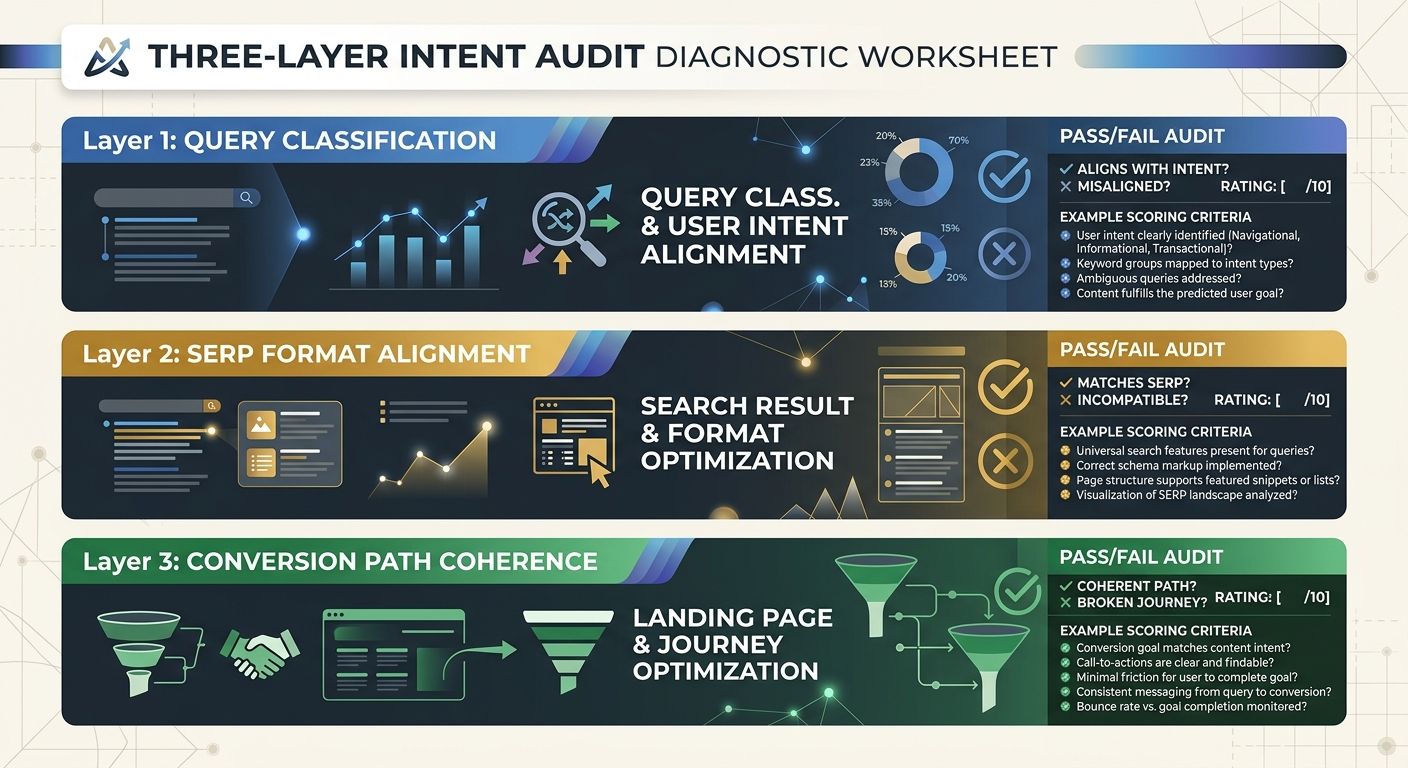
When I've applied this framework to client sites, the results follow a predictable distribution: roughly 30% of pages need minor CTA adjustments, 40–50% need structural reformatting (changing a blog post into a comparison page, for instance), and 15–25% need complete rewrites where the existing content serves the entirely wrong intent category. SEO Locale's analysis of missed-intent issues confirms this range, noting that "some pages require minor tweaks while others need complete structural overhauls to rank."
The willingness to scrap and rebuild, rather than patch, separates sites that fix their conversion gap from those that keep celebrating traffic numbers while revenue stagnates. If you're struggling with which pages to fix first, the SEO triage approach based on revenue impact applies here too: sort by potential conversion value, not by current traffic volume. And if your content production workflow doesn't include an intent-matching review before publication, every new article risks becoming another high-ranking, low-converting page that wastes your team's time.
Where This Leaves the Traffic-First Playbook
The conventional SEO playbook, built around keyword volume, topical coverage, and ranking position, produces exactly the outcome described throughout this article: pages that perform well in search dashboards and poorly in revenue reports. The claim that ranking without converting reflects a classification problem holds up across every data point examined here.
Blog posts targeting high-volume keywords converting at 1% versus buying-intent keywords converting at 5% or higher. SERP features encoding intent signals that most content teams ignore entirely. Page architectures designed around what the writer wanted to communicate rather than what the searcher needed to do next. Each failure traces back to the same root cause: treating search as a traffic channel instead of a demand-qualification channel.
The Three-Layer Intent Audit provides a systematic diagnostic for identifying which pages are worth restructuring and which need to be replaced. Applying it means accepting that some of your best-ranking content is your worst-performing content from a revenue perspective, and that the appropriate response is architectural change, not incremental CRO tweaks. The sites I've watched recover from intent mismatch share one characteristic above all others: they stopped measuring SEO success by rankings and started measuring it by what happened in the 90 seconds after the click.

Sarah Chen
SEO strategist and web analytics expert with over 10 years of experience helping businesses improve their organic search visibility. Sarah covers keyword tracking, site audits, and data-driven growth strategies.
Related Articles
The Search Intent Audit Framework: Recovering Revenue From Pages That Rank But Don't Convert
Backlinko's keyword research guide sat in Google's top three results for months, pulling thousands of impressions per week, while its conversion rate stayed pinned below 1%.

Beyond Crawlability: Why Google Understands Your Pages But Refuses to Rank Them in 2026
Crawlability has been a solved problem on most commercial websites for years, and yet Google's March 2026 core update still hit 55% of tracked sites with traffic drops averaging 20 to 35 percent. The pages affected were already indexed, already rendering, already discoverable.
8 SEO Mistakes to Avoid That Tank Your Website Traffic
Traffic drops from SEO mistakes share a single underlying mechanism: each failure breaks a specific step in the pipeline Google uses to crawl, evaluate, rank, and serve your pages to users ready to convert.
Explore more topics