
Long-Tail Comparison SEO: Finding Uncontested Niches Before Your Competitors Do
Long-tail comparison keywords — queries containing "vs," "for [specific audience]," or "alternative to" — sit in the lowest competition bands of search while attracting decision-stage buyers.

Long-Tail Comparison SEO: Finding Uncontested Niches Before Your Competitors Do
Long-tail comparison keywords — queries containing "vs," "for [specific audience]," or "alternative to" — sit in the lowest competition bands of search while attracting decision-stage buyers. A niche comparison SEO strategy built around these modifiers consistently outperforms head-term targeting on conversion rate, cost per acquisition, and time to first-page ranking.
The six rules below form the system I use with every client running comparison content ranking campaigns. Each one addresses a specific failure mode I've seen repeatedly: chasing volume instead of intent, publishing orphan pages instead of clusters, and measuring success by sessions instead of revenue. BrightEdge's research identifies queries like "CRM for remote SaaS teams" and "email automation tools for nonprofits with under $10M budget" as textbook examples of low-competition product comparisons that signal precise purchase readiness. The rules below help you find, validate, and capture hundreds more like them.
Target the modifiers your competitors dismiss as too small
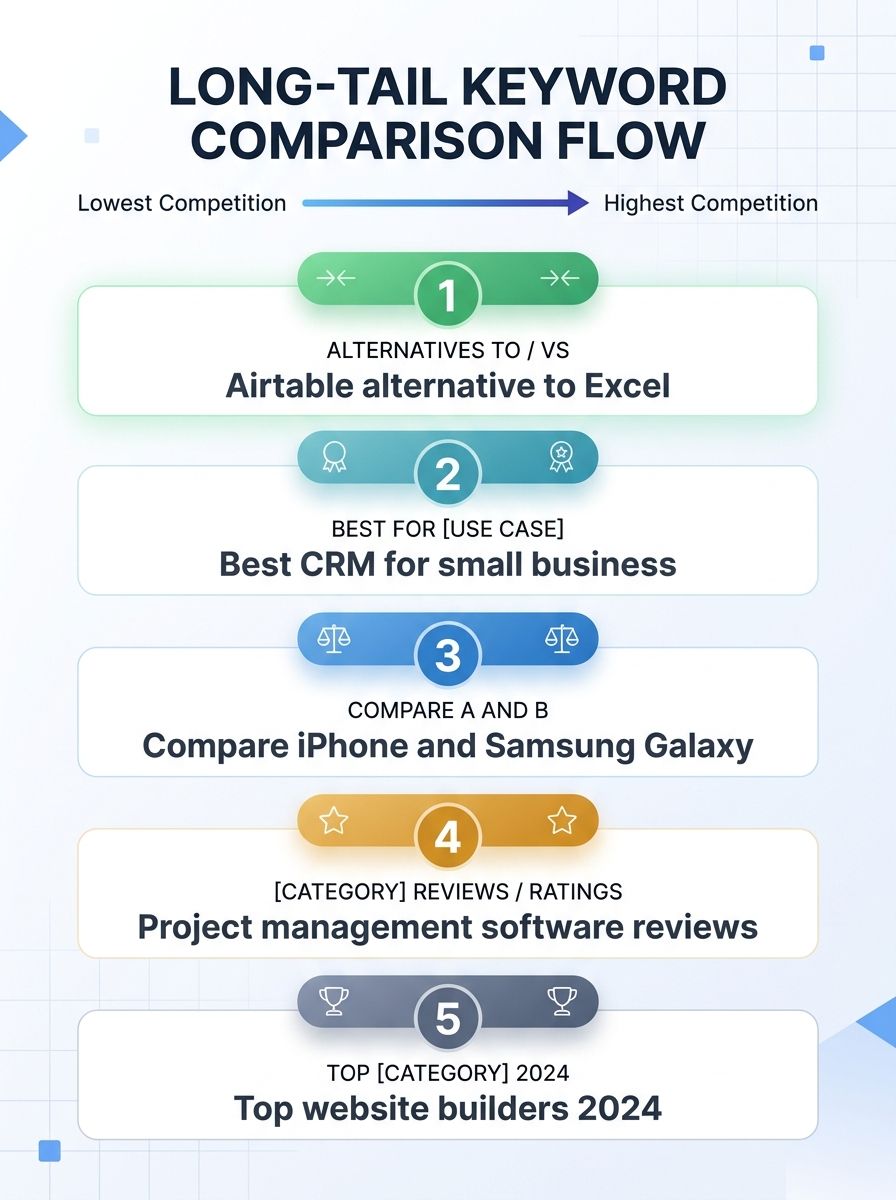
The modifier attached to a comparison keyword determines both its competition level and the searcher's proximity to a purchase decision. Five modifier categories dominate comparison search, and they differ sharply in keyword difficulty, intent signal, and ideal content format. Instead of "best investing apps" (which is saturated with DR 80+ domains), a query like "best investing app for beginners with no minimum deposit" speaks directly to a niche concern and attracts a searcher who has already eliminated broad options.
Here's how these modifier types compare:
Modifier Type | Example Query | Typical KD Range | Intent Signal | Best Content Format |
|---|---|---|---|---|
"vs" | "Notion vs Obsidian for project management" | Low (5-20) | Decision | Side-by-side breakdown |
"for [audience]" | "CRM for remote SaaS teams" | Very Low (0-15) | Consideration | Curated list with criteria |
"alternative to" | "Slack alternative for async teams" | Low-Medium (15-30) | Decision | Feature comparison |
"comparison for [use case]" | "email automation comparison for nonprofits" | Very Low (0-10) | Decision | Matrix or table format |
"review for [context]" | "Shopify review for handmade sellers" | Low (5-20) | Consideration | Experience-based analysis |
The "for [audience]" and "comparison for [use case]" columns carry the lowest difficulty scores and the clearest buying intent. When I run audits, I typically find that 60-70% of a client's comparison content targets the "vs" column exclusively, leaving the other four completely unaddressed.
Validate intent through the SERP, not the keyword tool
Why does keyword difficulty score mislead on comparison terms? Because the score measures backlink competition for current ranking pages, and many comparison SERPs have thin content that accumulated links for unrelated reasons. The actual validation step is simpler: search the query yourself. As Ati4Group's research on long-tail conversion strategy documents, someone searching "CRM software comparison for SMEs" is already in the decision-making phase, looking for concrete information and proof.
When you type a long-tail comparison query into Google, look for three signals:
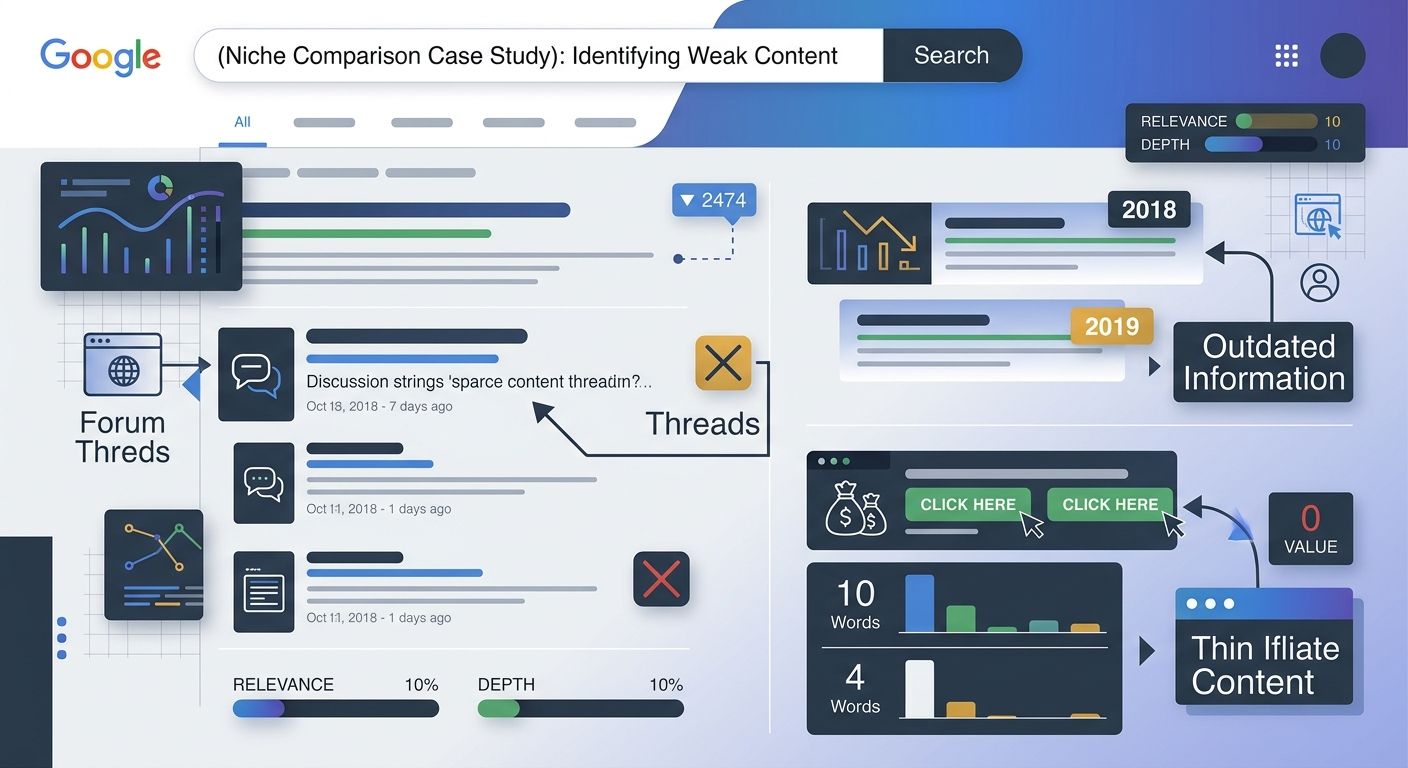
Weak-authority results on page one. If you see forum threads, outdated blog posts from 2022, or aggregator pages with no original analysis, the SERP is undefended. I've watched clients rank on page one within 45 days for comparison terms where the top three results were Reddit threads and a two-paragraph affiliate post.
Mismatch between query intent and ranking content. If the query asks for a comparison and the top results serve informational how-to guides, Google hasn't found a good match yet. Your well-structured comparison page fills that gap immediately.
Absence of brand-owned pages. When the products being compared haven't published their own "vs" or "alternative to" pages, the competitive landscape is wide open. If you're building a repeatable SEO workflow system, SERP validation should be a required checkpoint before any comparison brief moves to drafting.
Build comparison clusters around a pillar, not isolated pages
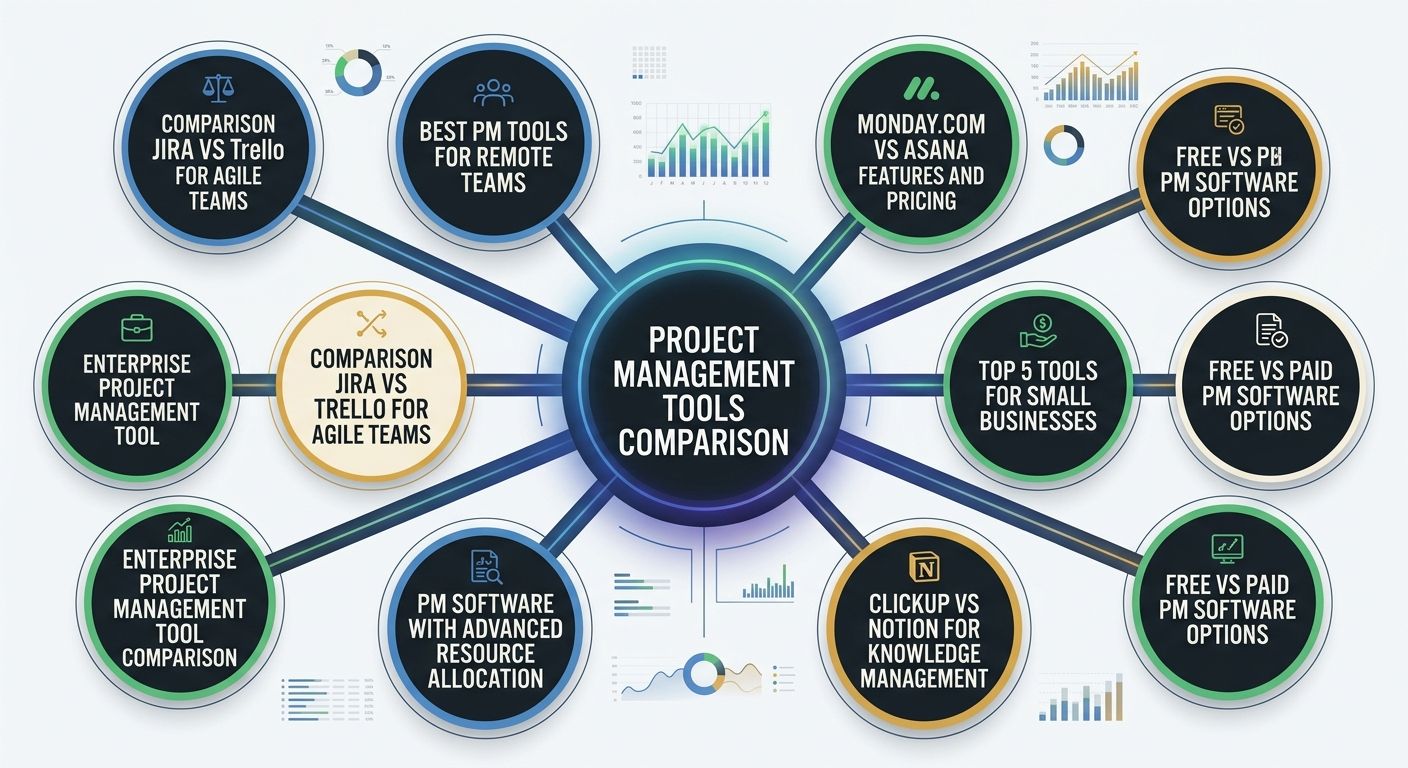
Publishing one-off comparison pages without connecting them to a broader topic architecture wastes the authority those pages earn. The topic cluster model, as documented in Yotpo's long-tail keywords guide, involves creating a central pillar page covering the broad comparison topic and linking it to cluster pages that address specific long-tail variations. This structure helps search engines map your site's depth on a subject.
A practical example: if you sell project management software, your pillar page might target "project management tools comparison." Cluster pages branch into "Asana vs Monday for marketing teams," "best project management tool for agencies under 20 people," "Trello alternative for engineering sprints," and twelve more specific queries. Each cluster page links back to the pillar. Each pillar link pushes authority into the clusters. The compound effect means your 15-page cluster outranks a competitor's single comparison post, even if their domain authority is 30 points higher than yours.
This is where your site architecture decisions directly affect comparison content ranking performance. I've seen clients double their indexed comparison pages within 90 days simply by reorganizing isolated posts into proper cluster structures with consistent internal linking patterns.
Write for the decision phase, not the awareness phase
The conversion advantage of long-tail comparison keywords comes from matching the searcher's stage in the buying process. Awareness-stage content ("what is a CRM") attracts researchers. Decision-stage content ("CRM comparison for SMEs with Salesforce integration") attracts buyers. The content format needs to reflect this difference.
Decision-phase comparison pages should include pricing tables (even if approximate ranges), feature matrices with checkmarks for specific capabilities, and explicit recommendations with qualifying criteria. Avoid the trap of writing a 3,000-word informational essay when the searcher wants a 1,200-word structured comparison they can scan in three minutes.
Niche Ranger's analysis of competitive niches confirms that "clarity + depth + structure now outperform brute force authority far more often than in previous years," and that Google and AI models detect patterned, derivative content. Your comparison page needs original evaluation criteria, real testing data where possible, and a stated methodology for how you assessed each option. Generic feature lists scraped from vendor websites won't rank and won't convert.
When you tie comparison page performance back to pipeline revenue using a content attribution framework, decision-phase comparison pages consistently generate 3-5x more qualified leads per session than awareness-stage posts.
Measure conversion per keyword, not traffic totals
The fatal error in comparison SEO is reporting success by sessions. A "vs" page that gets 400 monthly visits and converts 8% of them into trials produces 32 conversions per month. A head-term page that gets 4,000 visits at 0.5% conversion produces 20. The comparison page wins on the metric that pays your salary, and it cost a fraction of the effort to rank.
Set up keyword-level conversion tracking in GA4 by creating custom exploration reports that filter organic landing pages by URL pattern (your comparison content subfolder) and measure goal completions per session. If your analytics infrastructure lacks proper benchmarking context, you'll misread comparison page performance by comparing it to site-wide averages that are diluted by informational traffic.
Three metrics matter for comparison content specifically:
Conversion rate per comparison page (target: 3-8% for B2B SaaS, 5-12% for e-commerce product comparisons)
Assisted conversions from comparison pages that aren't the last touch but appear in the conversion path
Revenue per session broken out by comparison modifier type ("vs" pages vs. "for [audience]" pages vs. "alternative to" pages)
Track these monthly. You'll discover that certain modifier types outperform others for your specific product and audience, which tells you where to invest your next cluster expansion.
Refresh comparison content before it ages out
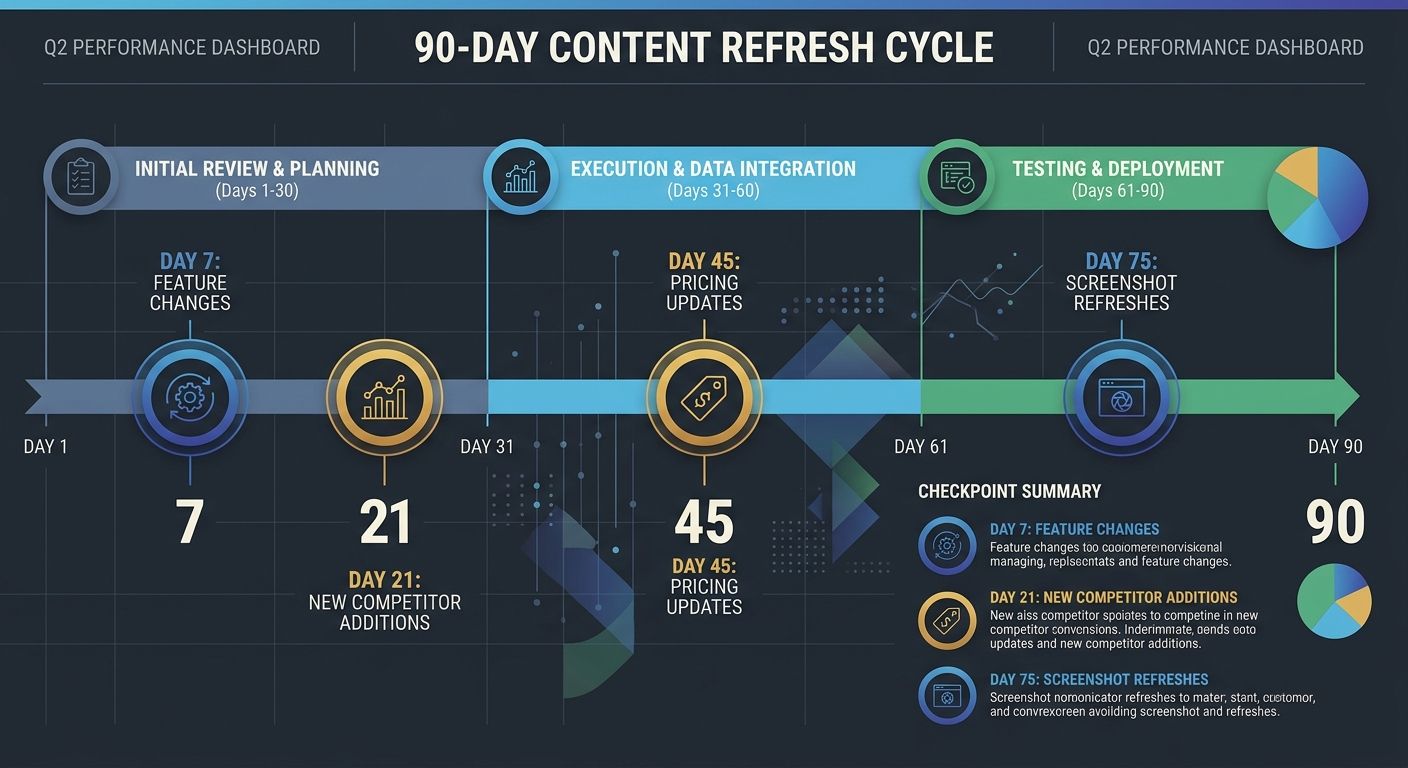
Comparison pages have a shelf life. Product features change, pricing shifts, new competitors launch, and a page comparing "Notion vs Coda" from 2024 becomes inaccurate by mid-2025. Stale comparison content loses rankings faster than other content types because Google treats freshness as a stronger signal for commercial queries.
Set a 90-day review cycle for every comparison page in your cluster. During each review, update pricing data, check for new features released by compared products, add any new competitors that have entered the niche, and refresh screenshots. This 45-minute maintenance task per page preserves rankings that took months to earn.
The February 2026 Search Engine Land analysis noted that LLMs rely on traditional web search to answer complex queries, effectively shifting demand into the long tail. AI search engines like ChatGPT and Perplexity pull from comparison pages when users ask product evaluation questions. If your comparison content is outdated, the AI answer cites your competitor's fresher page instead. For context on how AI citation dynamics work, the data on brands disappearing from AI recommendations reinforces why freshness matters even more now.
When These Rules Break Down
These six rules assume you're operating in a market where comparison intent exists and the competitive landscape has gaps. Three situations break that assumption.
Brand-new categories. If the product category is so new that nobody searches "X vs Y" yet, comparison content targets demand that doesn't exist. Build awareness-stage content first. Comparison clusters come second, once search volume for "vs" and "alternative to" queries starts appearing in your keyword tools.
Winner-take-all SERPs. Some comparison queries are locked down by a single high-authority review site (Wirecutter, G2, Capterra) with thousands of backlinks and constant freshness updates. If the top three results are all DR 85+ review aggregators, the SERP is defended, and your time is better spent finding a different modifier or adding a qualifier that narrows the query further.
Commoditized products. When every option in a category is functionally identical (think basic USB cables or generic supplements), comparison content produces thin pages because there's nothing meaningful to compare. The conversion benefit of comparison SEO depends on genuine differentiators between options that matter to the searcher's specific use case.
Outside these three scenarios, the long-tail comparison playbook remains the highest-conversion, lowest-competition content strategy available in organic search. The work isn't glamorous. You won't brag about traffic numbers at conferences. But when your 400-visit comparison page generates more revenue than your competitor's 40,000-visit listicle, the math speaks for itself.

Sarah Chen
SEO strategist and web analytics expert with over 10 years of experience helping businesses improve their organic search visibility. Sarah covers keyword tracking, site audits, and data-driven growth strategies.
Related Articles

The Long-Tail Comparison Content Strategy: How to Rank in Niches Where 'Obvious' Comparisons Don't Work
The standard "Tool A vs. Tool B" comparison page template breaks in specialized markets where head-to-head brand queries generate fewer than 10 monthly searches. Niche industries need a different comparison architecture.

The Search Intent Mismatch Audit: Why Your Content Ranks but Doesn't Convert
Pages that rank on page one but convert below 1% don't have a CRO problem. They have a content classification problem, where the page answers the wrong type of question for the person searching.

The Search Intent Audit Framework: Recovering Revenue From Pages That Rank But Don't Convert
Backlinko's keyword research guide sat in Google's top three results for months, pulling thousands of impressions per week, while its conversion rate stayed pinned below 1%.
Explore more topics