
The Content Production Bottleneck: Why Your Publishing Timeline Kills SEO Performance
Inefficient content production workflows reduce marketing team productivity by up to 40%, and 45% of teams report they can't keep pace with their own publishing targets in 2026.

The Content Production Bottleneck: Why Your Publishing Timeline Kills SEO Performance
Inefficient content production workflows reduce marketing team productivity by up to 40%, and 45% of teams report they can't keep pace with their own publishing targets in 2026. The damage compounds when email marketing and SEO content share the same writers, editors, and approval chains, because email's constant deadline pressure systematically starves the SEO pipeline of the resources it needs to maintain content calendar velocity.
Email Urgency Eats Your SEO Publishing Schedule
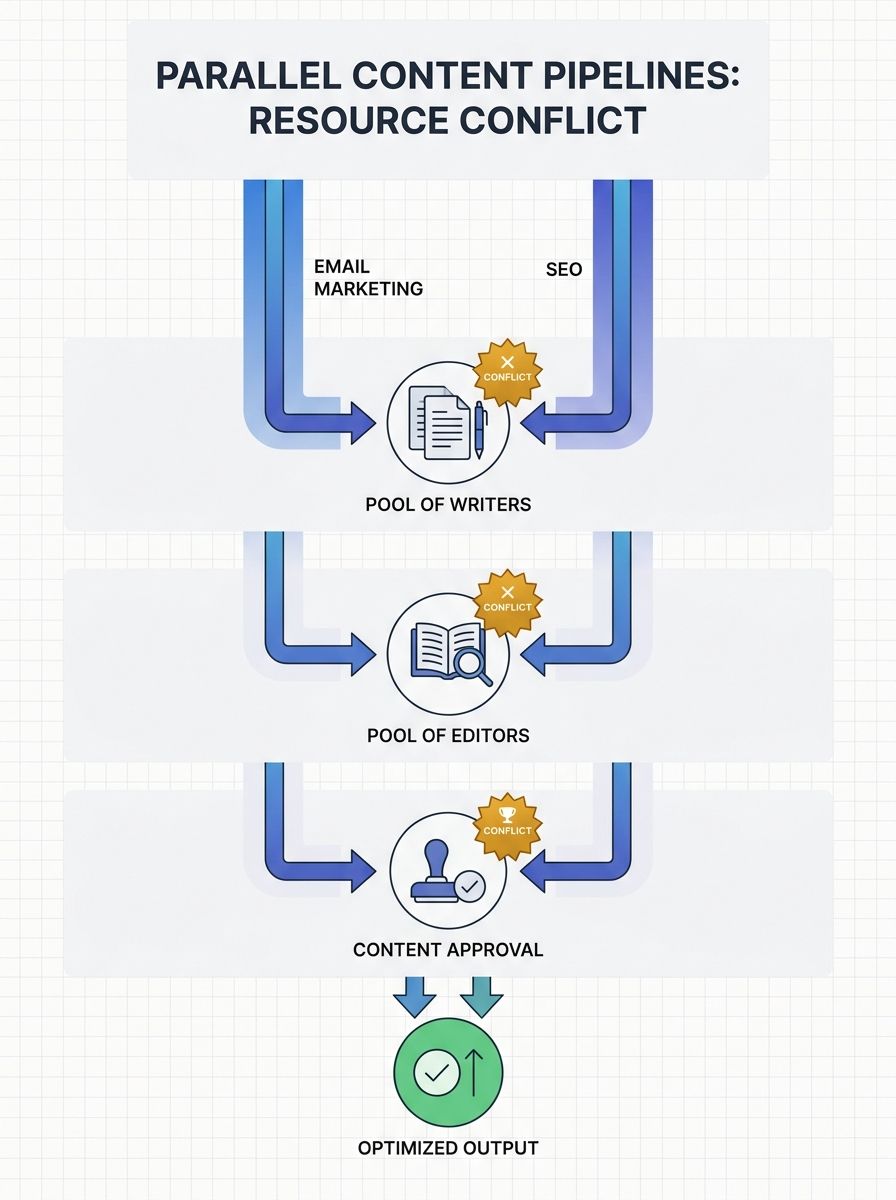
Why does the SEO content calendar slip week after week? Because email campaigns carry hard deadlines: a product launch, a flash sale, a nurture sequence trigger. Those deadlines always win the resource fight against "we should publish that blog post soon." The email team needs copy reviewed and approved by Tuesday. The blog post can wait until next week. That "next week" becomes next month.
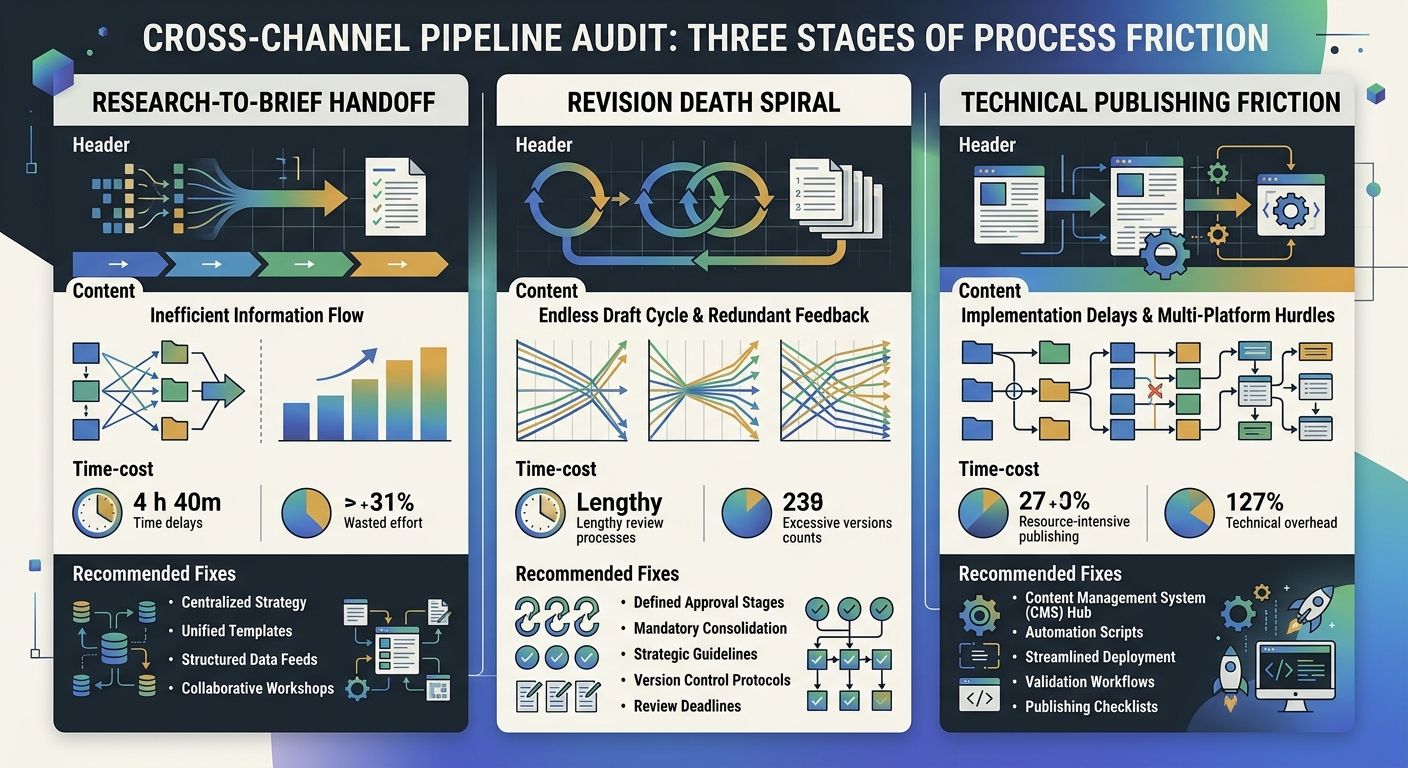
This is where content production workflow SEO problems start for most organizations. According to Sight AI's analysis of content pipeline failures, the bottleneck rarely comes from a shortage of ideas or even writers. It comes from operational friction at three specific stages: the research-to-brief transition, the revision death spiral caused by unclear review protocols, and technical publishing friction that delays indexing after content is approved.
When you overlay email marketing production onto that same pipeline, each stage deteriorates. The brief that was supposed to go to the SEO writer gets reassigned because the email campaign brief is more urgent. The editor who needs to review the blog post is revising tomorrow's newsletter instead. The CMS upload for the SEO article sits in a queue behind three email landing pages.
The Revenue Math on Delayed Publishing
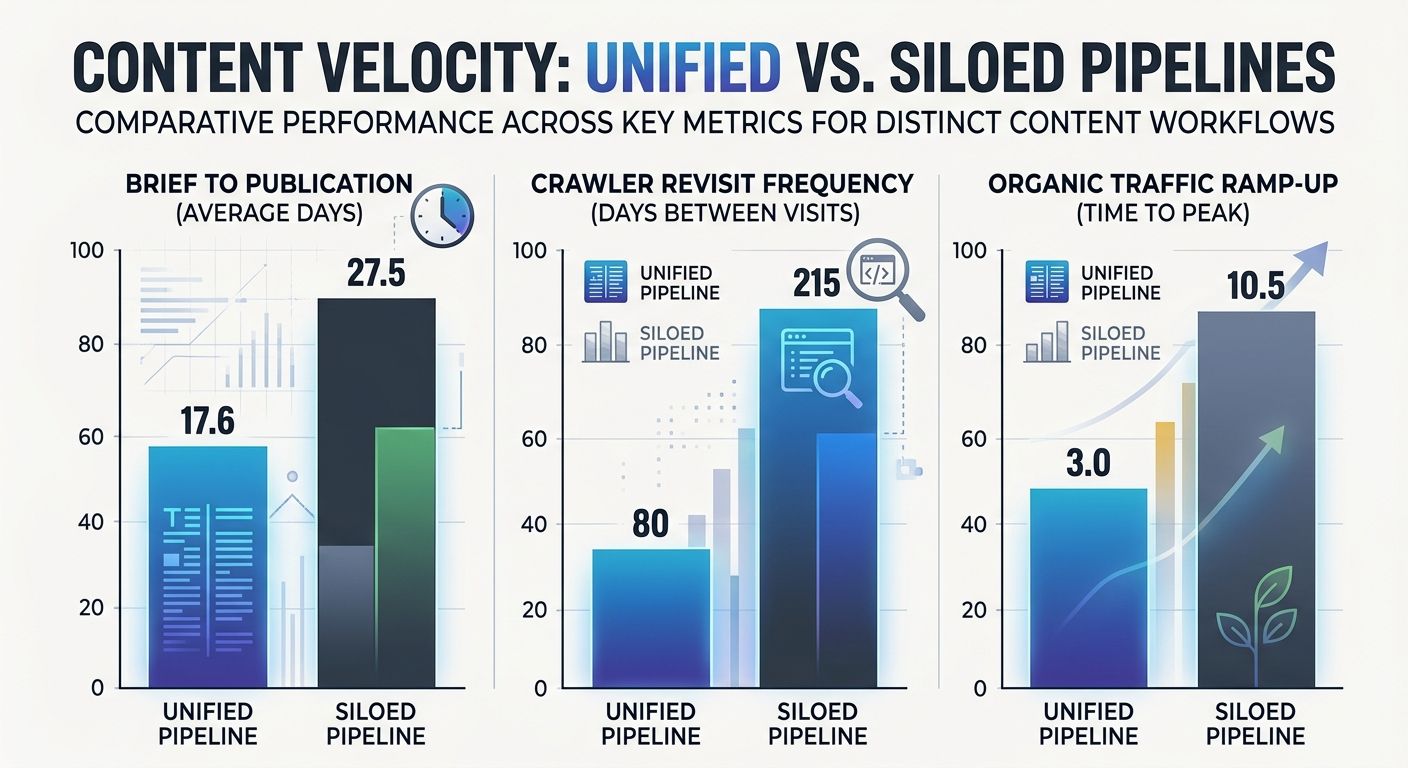
A content piece that takes 6 weeks from brief to publication instead of 2 weeks doesn't lose 4 weeks of ranking potential. It loses compounding organic traffic over the entire life of that page. If a well-optimized article generates 500 monthly organic visits within 90 days of indexing, a 4-week delay means roughly 500 visits that never happened, along with the downstream email subscribers, lead captures, and conversions those visits would have produced.
Research from Ocean Marketing on content velocity confirms that consistent publishing activity "keeps search engine crawlers coming back to your site more frequently to index new pages, which can lead to faster ranking opportunities." Irregular publishing, the kind caused by bottlenecked pipelines, trains crawlers to check your site less often. Your next piece of content sits undiscovered longer even after you hit publish.
And the email marketing team feels the pain too. Every unpublished blog post is a piece of content that can't be linked in a newsletter, referenced in a drip sequence, or used as a landing destination for a promotional email. The content production bottleneck starves both channels simultaneously.
Three-Stage Pipeline Audit for Cross-Channel Teams
Content teams that produce both email campaigns and SEO assets need to diagnose bottlenecks differently than single-channel operations. I've been using a framework I call the Cross-Channel Pipeline Audit, which evaluates three friction zones where email and SEO production conflict most severely.
Stage 1: The Research-to-Brief Handoff
The brief is where publishing timeline optimization either works or falls apart. For SEO content, briefs require keyword research, competitor analysis, and search intent mapping. For email content, briefs require audience segmentation data, CTA objectives, and send-time optimization context. When one writer handles both, neither brief gets the depth it needs.
The fix: separate the briefing function from the writing function. A dedicated brief writer (or well-built brief template system) produces complete briefs for both channels before any writing starts. Teams that implement this consistently report cutting their research-to-brief stage from 5 days to 2. If you've already built a repeatable sprint cadence for SEO execution, the brief template slots directly into your sprint planning.
Stage 2: The Revision Death Spiral
Approval workflows are where content goes to die slowly. Sight AI's analysis found that moving from manual approval processes to automated routing can reduce workflow steps from 8 to 5, cutting process complexity by over a third. But most email-and-SEO teams run duplicate approval chains: one for email compliance review, another for SEO quality review, with different stakeholders and different turnaround expectations.
Unified approval means one reviewer handles both brand voice consistency and SEO quality checks in a single pass. The email compliance review (CAN-SPAM requirements, unsubscribe functionality, promotional language) stays separate because it has to, but everything else collapses into one stage.
Stage 3: Technical Publishing Friction
A piece of content approved on Wednesday shouldn't publish the following Monday because someone needs to "find time" for the CMS upload. Technical publishing friction includes formatting, image optimization, internal link insertion, schema markup, and XML sitemap updates that signal crawl priority. When these steps are manual, they add 2-3 days to every piece.
For email content, the equivalent friction is list segmentation setup, dynamic content block configuration, and A/B test variant creation. Both channels benefit from templatized publishing workflows where 80% of the technical work is pre-configured.
Agile Content Operations Across Email and SEO
The Conductor Academy defines agile content development as "a technology-supported method to develop and continuously optimize competitive content". The key word is "continuously." Traditional content calendars plan 30-90 days ahead and treat the plan as fixed. Agile content operations treat the calendar as a prioritization queue that rebalances weekly based on performance data and resource availability.
For teams managing both email and SEO pipelines, agile content operations look like this:
Weekly sprint planning allocates writer and editor capacity across both channels at the same time. If the email team needs 3 pieces this week and the SEO team needs 2, those 5 assignments get staffed together, not in two separate meetings where each team assumes full access to shared resources.
Content velocity tracking measures time-to-publish separately for email and SEO but reports both to the same dashboard. As monday.com's SEO workflow research notes, monitoring time-to-publish and quality scores across content stages identifies bottlenecks before they compound. When email time-to-publish stays flat but SEO time-to-publish climbs, you've found your resource allocation problem.
Repurposing protocols ensure SEO content feeds email campaigns and vice versa. A blog post published Tuesday becomes a newsletter feature Thursday. An email-exclusive data point gets expanded into a blog post the following week. This multiplier effect is where scaling content without losing rankings becomes practical: you're publishing more frequently to both channels without proportionally increasing production effort.
If your internal linking strategy is already underperforming due to thin content coverage, the velocity gains from unified production directly address that gap by filling out your topic clusters faster.
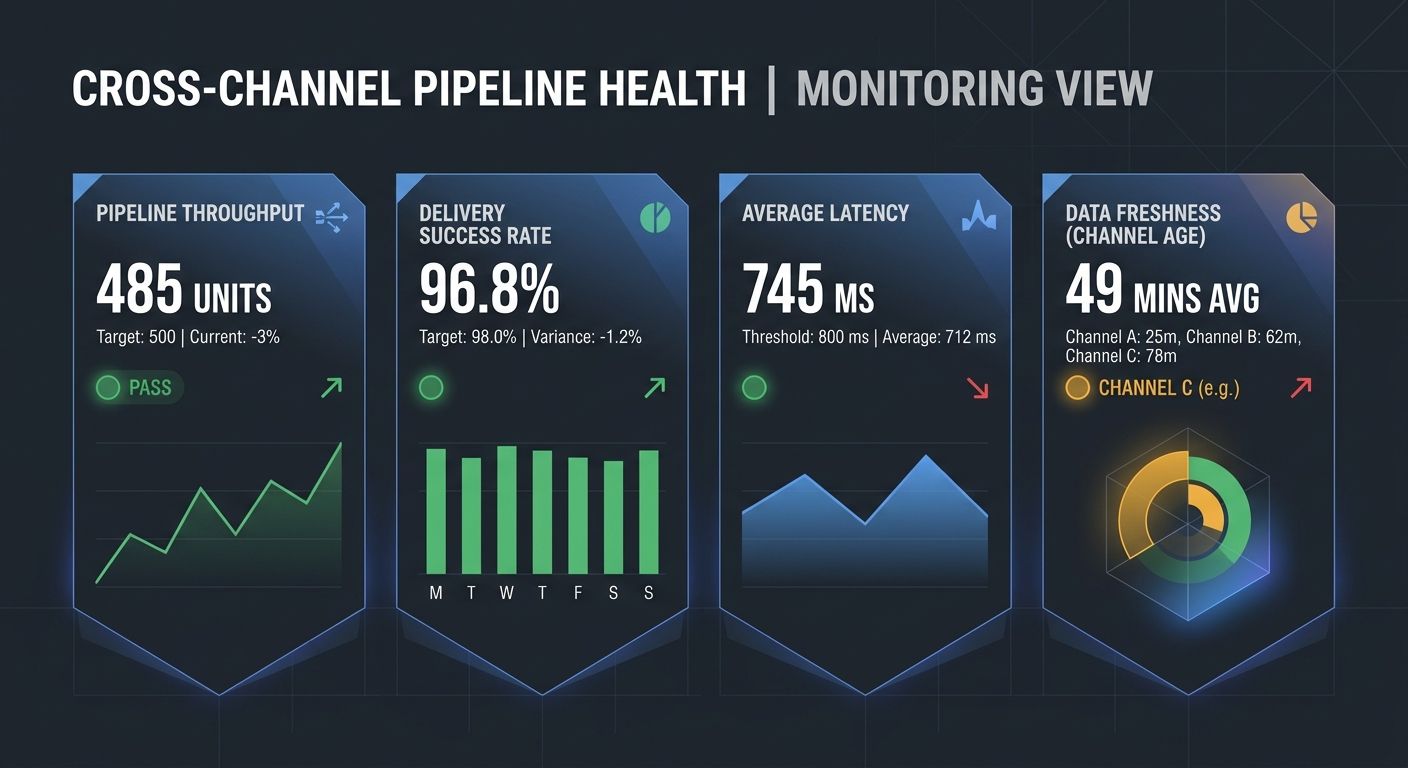
Measuring Cross-Channel Pipeline Health
Four metrics reveal whether your content production workflow is actually improving or just feels faster:
Metric | Email Benchmark | SEO Benchmark | Red Flag Threshold |
|---|---|---|---|
Brief-to-Publish Time | 3-5 days | 7-14 days | 2x+ benchmark |
Approval Dwell Time | < 24 hours | < 48 hours | > 72 hours |
Content Repurposing Rate | 40%+ of SEO content referenced in emails | 20%+ of email insights expanded to blog | < 10% either direction |
Publishing Cadence Consistency | Weekly ± 1 day | Weekly ± 2 days | Missed weeks |
Teams that have already confronted the AI content demand challenge recognize that the bottleneck was never about generating raw content. The constraint is always workflow throughput: how fast content moves from idea to indexed page to distributed email asset.
What the Numbers Don't Account For
The 45% figure for teams that can't meet content demands tells us the problem is widespread. The 40% productivity drain from workflow inefficiency tells us the cause is operational. But neither number tells us what the right content velocity target actually is for a given domain, audience, or competitive set.
Publishing 10 pieces per week with unified email-and-SEO workflows will outperform 3 pieces per week from siloed teams, up to a point. Google's March 2024 Core Update penalized mass-produced content without genuine expertise, and that penalty applies regardless of how efficient your pipeline is. Solving the production bottleneck creates a new risk: overproduction without strategic depth, where topic authority gets diluted across too many surface-level articles.
The data also can't account for team-specific variables like writer expertise, subject matter complexity, or the regulatory review overhead that financial services, healthcare, and legal email marketing teams carry. A 14-day brief-to-publish benchmark is aggressive for a fintech company where legal review alone takes 5 business days.
What the numbers do confirm is a pattern. The teams winning in both organic search and email engagement stopped running two separate content operations and started running one. The bottleneck is coordination between channels, and it's almost always fixable with structural changes to how work gets assigned and approved rather than with additional headcount.

Alex Chen
Alex Chen is a digital marketing strategist with over 8 years of experience helping enterprise brands and agencies scale their online presence through data-driven campaigns. He has led marketing teams at two successful SaaS startups and specializes in conversion optimization and multi-channel attribution modeling. Alex combines technical expertise with strategic thinking to deliver actionable insights for marketing professionals looking to improve their ROI.
Related Articles

The SEO Workflow Breakdown: Building a Repeatable System That Scales With Your Team
Switching from ad-hoc SEO execution to a structured workflow system reduced time-to-publish from over two weeks to three to five days per content asset, while cutting brief creation time from two to three hours down to 30 minutes. These gains compound across every piece of content a team produces.

The SEO Planning Breakdown: Why Your Strategy Fails at Scale (And How Enterprise Teams Fix It)
Enterprise SEO planning fails at scale because channel teams—email marketing, paid media, product—generate landing pages, redirect chains, and content independently, compounding technical debt faster than any SEO team can remediate.

The Content Production Bottleneck: Why Your Marketing Team Can't Keep Up With AI Content Demand
Paid media campaigns running across Google, Meta, TikTok, and LinkedIn collectively demand somewhere between 50 and 200 unique creative assets per month from a typical mid-market marketing team.
Explore more topics