
From Blue Links to Business Outcomes: Rebuilding Your SEO Strategy Around First-Party Data in 2026
Businesses using first-party data for marketing measurement saw a 2.9x increase in revenue lift compared to those relying on third-party tracking, per Google's aggregate advertiser data. That gap keeps widening as cookie deprecation accelerates.

From Blue Links to Business Outcomes: Rebuilding Your SEO Strategy Around First-Party Data in 2026
Businesses using first-party data for marketing measurement saw a 2.9x increase in revenue lift compared to those relying on third-party tracking, per Google's aggregate advertiser data. That gap keeps widening as cookie deprecation accelerates. Your first-party data SEO strategy determines whether organic search generates attributable revenue or disappears into a dashboard nobody trusts.
The playbook that worked from 2015 through 2023 followed a clean sequence: research keywords, publish content, track rankings, report traffic. Each step produced a tidy metric. And each metric became progressively less useful as zero-click search rates climbed to 83% for AI Overview queries, as Google's May 2026 redesign cut publisher traffic by 70% to 89%, and as third-party cookies lost their ability to connect visits to outcomes.
The rules below come from rebuilding measurement stacks for enterprise clients over the past 18 months. The consistent finding has been the same across every engagement: teams that shifted to first-party data earlier recovered faster from every algorithm change, every AI Overview expansion, and every attribution breakdown.
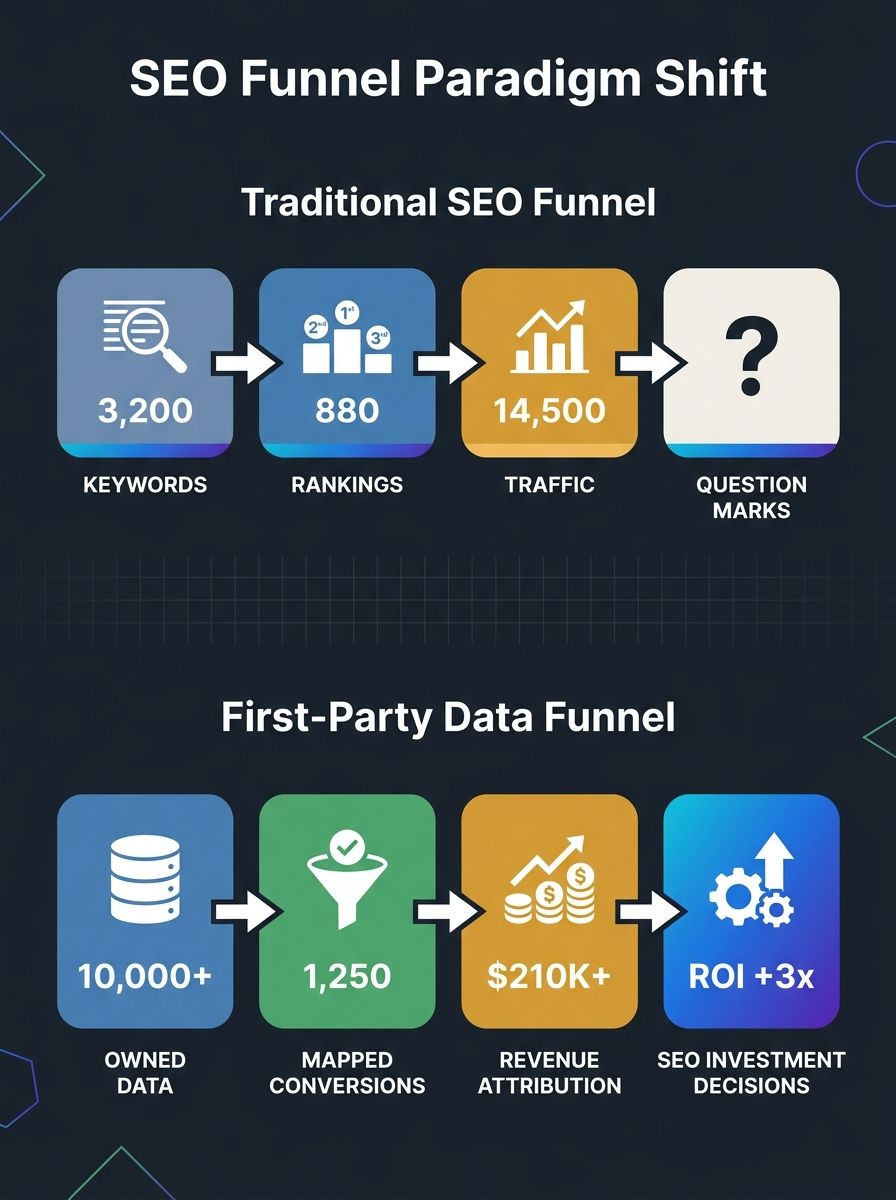
Measure revenue before you measure rankings
The formula for SEO ROI is straightforward: (Revenue - Spend) / Spend × 100, calculated monthly, quarterly, or annually. And 49% of marketers already report that organic search delivers the highest returns of any channel. The disconnect is that most SEO teams can't prove it for their own business because they're reporting keyword positions instead of pipeline contribution.
Your first-party data makes this calculable. When you own the conversion tracking from first touch through closed deal, you can assign actual dollar values to organic landing pages. A B2B company I worked with tracked 1,247 organic sessions per month to a single product comparison page. Rankings data said "position 3 for [product category]." First-party CRM data said "$412,000 in influenced pipeline over two quarters." Those are different stories told to different budgets.
Build your first-party collection layer before scaling content
Content volume without a data collection infrastructure wastes effort. Before publishing another blog post, confirm that every page capable of attracting organic traffic has at least one first-party data capture mechanism: an email signup, a gated resource, a quiz, an account creation prompt, or an on-site search bar that logs queries.
IM Applied SEO's 2026 analysis frames the urgency directly: "Unlike third-party data, which is becoming less reliable as third-party cookies are phased out, first-party data is collected directly from your customers, giving small businesses a powerful, tailored approach to marketing." This applies at enterprise scale too. A mid-market SaaS client added progressive profiling forms to their top 30 organic pages and increased identified visitor rate from 2.1% to 11.8% within 90 days, giving their SEO reporting actual user-level data instead of anonymous session counts.
The infrastructure matters because data-driven SEO in 2026 depends on connecting behavior to identity. Without that connection, you're optimizing against incomplete information.
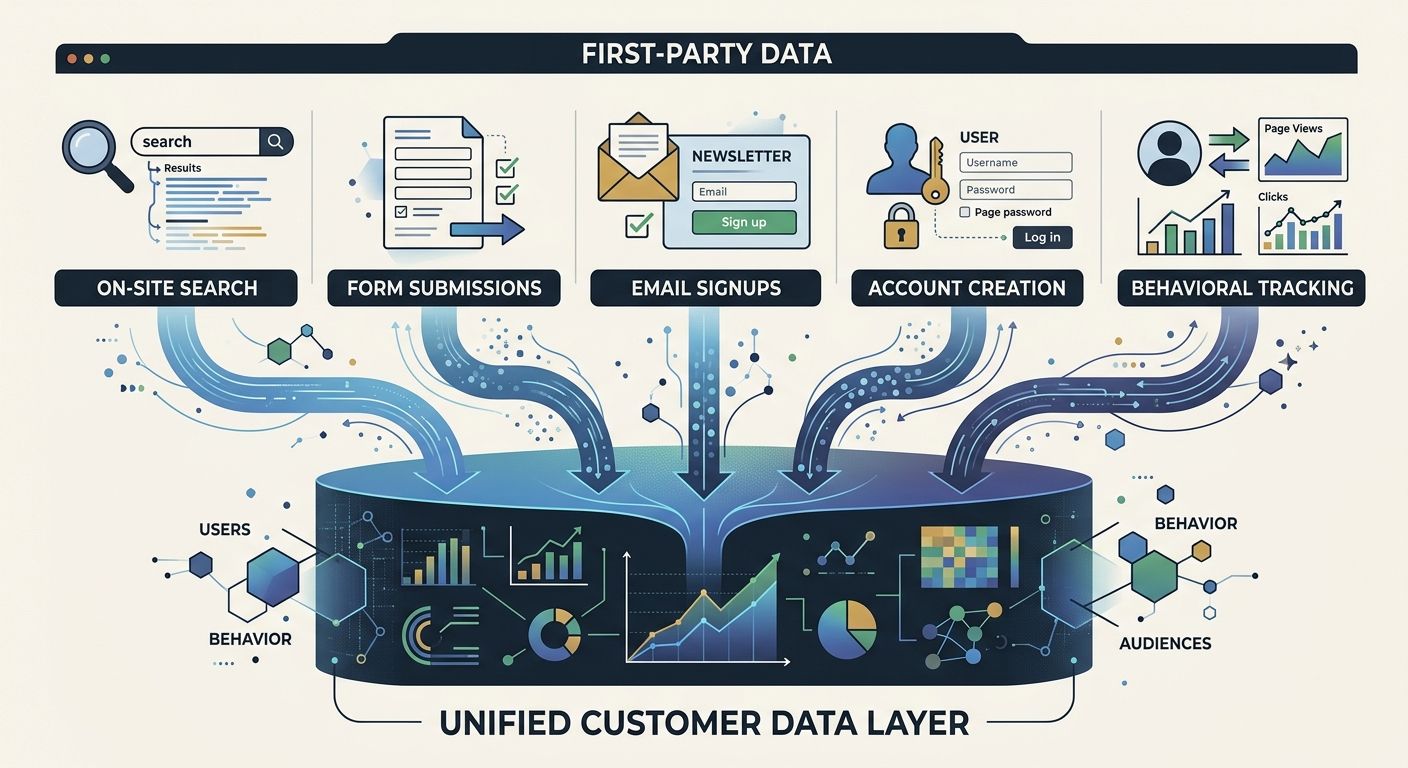
Map every landing page to a conversion event, not a keyword cluster
Keyword clusters organize your editorial calendar. Conversion events organize your business. These are different organizing principles, and when your site architecture only reflects the first one, you end up with dozens of ranking pages that contribute nothing measurable to pipeline.
Hashmeta's measurement guide frames the shift well: "Rather than obsessing over position changes for individual keywords, focus on metrics that directly connect to business outcomes: qualified traffic growth, user engagement, conversion rates, and revenue impact." The practical implementation is a spreadsheet or database view where every indexed URL has a designated conversion event and a first-party tracking tag that fires when that event completes.
I maintain this mapping for every client using a four-column structure:
URL Pattern | Primary Keyword Cluster | Designated Conversion Event | First-Party Tracking Method |
|---|---|---|---|
/product/comparison | [Category] vs [Category] | Demo request | CRM form with UTM passthrough |
/guides/implementation | How to implement [Product] | Gated PDF download | Email capture with progressive profile |
/pricing | [Product] pricing | Pricing scroll + contact click | Behavioral event + form tag |
/blog/[topic] | Informational cluster | Newsletter signup | Email with source attribution |
/case-studies/[name] | Brand + outcome queries | Sales call booking | Calendar integration with referral data |
This conversion mapping doubles as your SEO business outcomes metrics dashboard. When the March 2026 core update shifted 79.5% of top-three results, teams with this structure could immediately see which conversion events lost volume and reallocate budget accordingly. Teams tracking only rankings saw numbers move without knowing what it cost them.
Feed on-site search data back into your content strategy
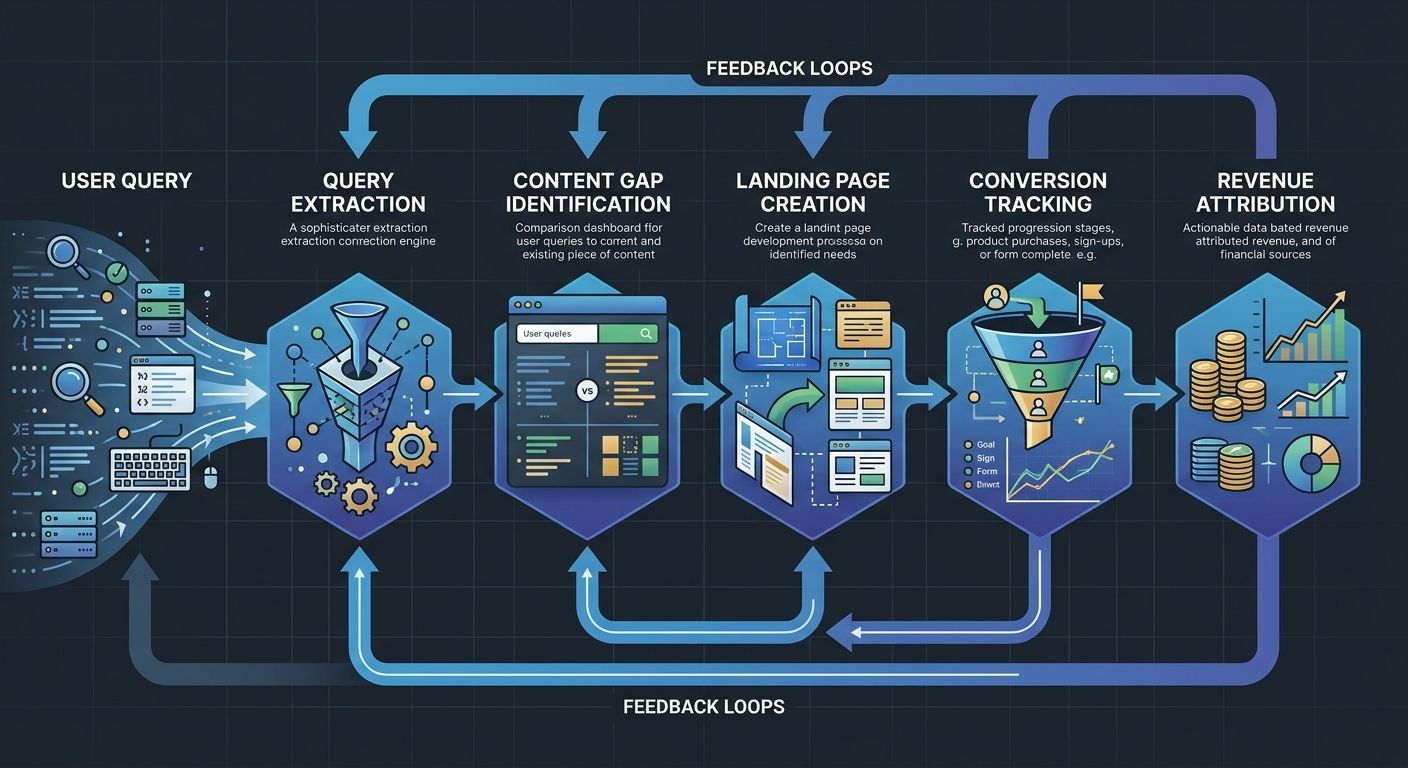
On-site search queries are first-party gold. Visitors are telling you exactly what they want, in their own language, on your own property. As Search Engine Land's first-party data coverage states, "Search has a new responsibility to take its high-intent first-party data and use it across the marketing ecosystem."
Pull your on-site search logs monthly. Cross-reference them against your existing content inventory. The queries with zero matching results are your content gaps, validated by actual user demand rather than keyword tool estimates. One e-commerce client found that 34% of their on-site searches used product attribute combinations (like "waterproof bluetooth under $50") that didn't match any existing category or filter page. Building 12 attribute-combination landing pages drove $89,000 in incremental revenue over the following quarter.
This approach connects directly to the long-tail comparison strategy that captures decision-stage buyers, with a critical difference: you're sourcing the long-tail queries from your own data rather than competitive research tools. The intent signal is stronger because these people already found your site and searched within it.
Report search visibility ROI in the language your CFO already speaks
SEO reports filled with ranking movements, domain authority scores, and impression counts get skimmed and forgotten. The fix is translating every metric into financial language that maps to existing business KPIs. High-performing agencies concentrate on "editorial quality, conversion support, and clear reporting" to demonstrate indispensable value, and the same principle applies to in-house teams presenting to leadership.
The calculation is concrete. If your first-party data shows that organic visitors convert to qualified leads at 3.2% and your average deal size is $28,000 with a 22% close rate, every 1,000 organic sessions represents $197,120 in potential pipeline (1,000 × 0.032 × $28,000 × 0.22). That number makes budget conversations productive. "We need to recover the 340 daily sessions lost after the core update" becomes "we need to recover $67,000 in weekly pipeline value."
This financial framing is where moving beyond keyword rankings becomes practical rather than philosophical. Rankings are an input. Revenue is the output. First-party data connects the two with a verifiable chain.
Audit your analytics stack for first-party data gaps quarterly
Your analytics infrastructure degrades continuously. Tag managers accumulate dead tags. Consent management platforms block tracking events in new jurisdictions. CRM integrations break silently after API updates. A quarterly audit catches these gaps before they corrupt a full quarter of reporting data.
The audit checklist should cover five areas: consent coverage rates across geographies (target above 65% opt-in), tag firing accuracy (compare expected events against actual recorded events using your GA4 debug workflow), CRM data completeness (what percentage of form submissions arrive with full UTM attribution intact), cross-device identification rates, and on-site search logging coverage. Each gap represents revenue data you're losing.
A financial services client discovered during an audit that their consent management update had silently reduced GA4 event tracking to 41% of actual traffic for 6 weeks. They had been making optimization decisions based on less than half their real data. Quarterly audits prevent that kind of invisible erosion from compounding across your entire measurement stack.
Connect your first-party insights to AI search visibility
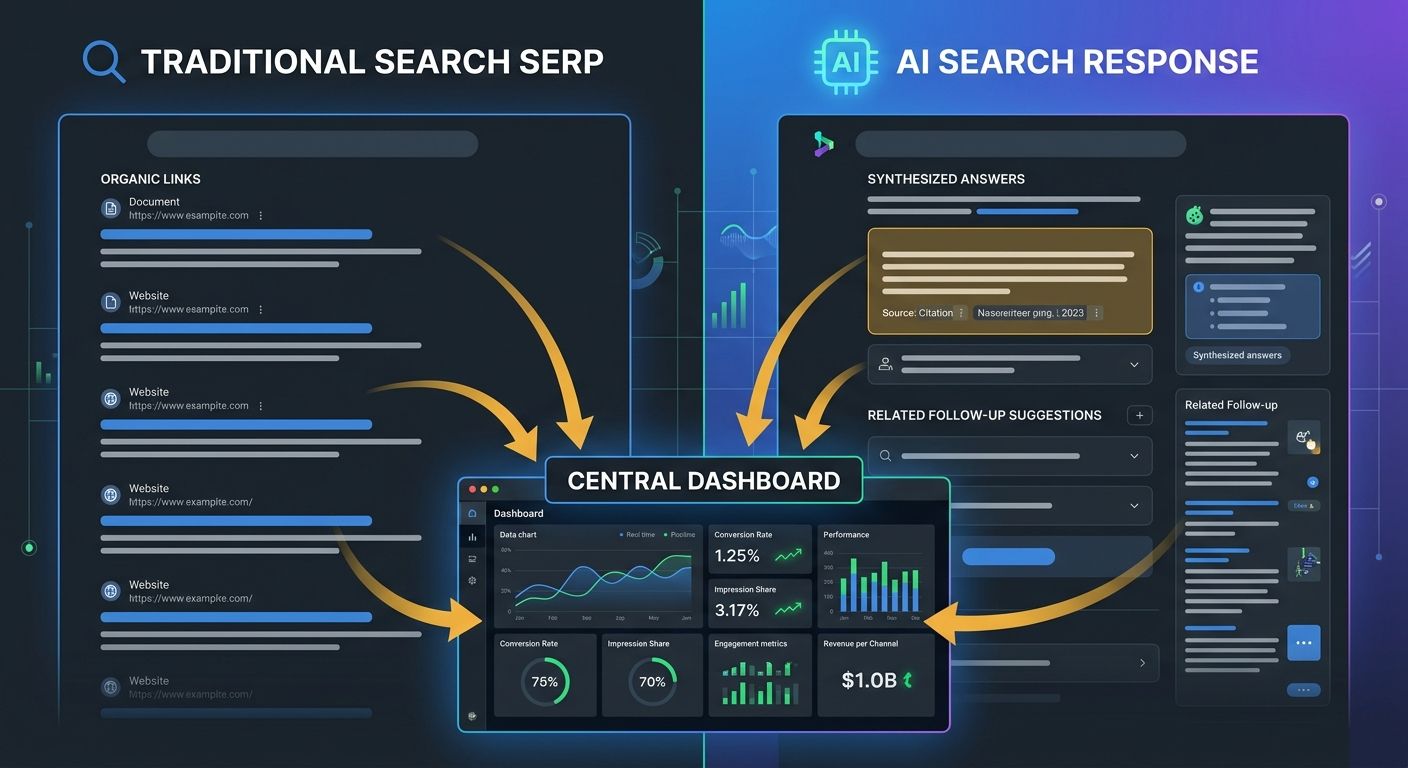
Search Engine Land's first-party data guide documents the link between owned data and organic results: "By linking SEO visibility with CRO results, first-party data turns organic growth into measurable business outcomes." This principle extends to AI search channels. When 76% of brands disappear from ChatGPT and Gemini recommendations, the brands that remain visible produce content grounded in original data and documented expertise.
Your first-party data gives you something AI systems value: unique information that doesn't exist elsewhere on the web. Original research, proprietary benchmarks, customer survey results, and performance data from your own operations all feed the kind of content that AI systems preferentially cite. Companies prioritizing this approach have reported 5x year-over-year increases in traffic and demo requests from LLM-driven queries, according to AI visibility platform data tracked through 2026.
Building a dual-engine visibility strategy that covers both traditional search and AI search requires first-party data as the foundation for both channels. The data tells you what to create. The creation feeds both engines. And the measurement confirms which engine delivered revenue.
When These Rules Break
These rules assume you have enough organic traffic to generate meaningful first-party data. If your site gets fewer than 500 organic sessions per month, you don't have the statistical volume to make first-party conversion mapping reliable. In that scenario, start with competitive keyword research and content volume to build a traffic baseline, then layer in the first-party infrastructure once sessions reach a useful threshold.
The rules also assume your sales cycle is trackable. If you sell consumer products at a $15 average order value through Amazon, your first-party data strategy looks different from a B2B SaaS company with a 90-day sales cycle. The attribution chain is shorter, the conversion events are simpler, and the emphasis shifts toward aggregate behavioral patterns rather than individual lead tracking.
And if your industry faces regulatory constraints on data collection (healthcare, financial services, education), every collection mechanism needs legal review before deployment. The first-party data advantage holds in regulated industries, but the implementation timeline extends by 2 to 4 months and the consent architecture requires specialized configuration. The investment still pays off. It takes longer to build, and the organizations that start the build now will hold the measurement advantage when their competitors are still scrambling to replace third-party signals that no longer exist.
Sarah Chen is a senior SEO strategist and analytics consultant with 10+ years of enterprise experience. She holds Google Analytics IQ and Google Search Console certifications and has rebuilt measurement stacks for clients across SaaS, e-commerce, and financial services.

Sarah Chen
SEO strategist and web analytics expert with over 10 years of experience helping businesses improve their organic search visibility. Sarah covers keyword tracking, site audits, and data-driven growth strategies.
Related Articles

The SEO Benchmarking Cadence Audit: How to Stop Tracking Vanity Metrics and Start Making Data-Driven Ranking Decisions
The benchmarking cadence audit replaces static annual metric reviews with a three-frequency system — weekly pulse checks, monthly trend analysis, quarterly strategic pivots — where each layer filters SEO KPIs through conversion impact.

Local Marketing Analysis Identifies Conversion Gap Costing Service Businesses High-Intent Leads
An analysis published June 12, 2026, by the Rockland County Times identifies a structural blind spot in local marketing programs: businesses optimize for map pack visibility but fail to build conversion systems for the high-intent traffic they generate, according to the publication's examination of
The Search Intent Mismatch Audit: Why Your Content Ranks but Doesn't Convert
Pages that rank on page one but convert below 1% don't have a CRO problem. They have a content classification problem, where the page answers the wrong type of question for the person searching.
Explore more topics