
The SEO Workflow Breakdown: Building a Repeatable System That Scales With Your Team
Switching from ad-hoc SEO execution to a structured workflow system reduced time-to-publish from over two weeks to three to five days per content asset, while cutting brief creation time from two to three hours down to 30 minutes. These gains compound across every piece of content a team produces.

The SEO Workflow Breakdown: Building a Repeatable System That Scales With Your Team
Switching from ad-hoc SEO execution to a structured workflow system reduced time-to-publish from over two weeks to three to five days per content asset, while cutting brief creation time from two to three hours down to 30 minutes. These gains compound across every piece of content a team produces.
Why Ad-Hoc SEO Execution Breaks Past Three People
Every SEO team starts the same way: one or two people handling research, writing, technical audits, and reporting through spreadsheets, Slack threads, and memory. That works until the third person joins. Then assignments get duplicated, briefs contradict each other, and technical fixes sit in development queues for weeks because nobody documented the priority.
According to research from Growth Minded Marketing, one of the biggest blockers for SEO success is a lack of alignment between technical SEO teams and web development teams. Site speed optimizations, crawl error resolution, and schema markup implementation often sit in development queues for weeks or months because teams aren't working from the same roadmap.
This misalignment has a direct cost. When you're publishing 4-8 pieces of content per month with a small team, a 2-3 week review cycle means your Q1 keyword targets don't go live until Q2. Your competitors who operate on 30-day sprint cycles are capturing those rankings while your content waits in approval limbo.
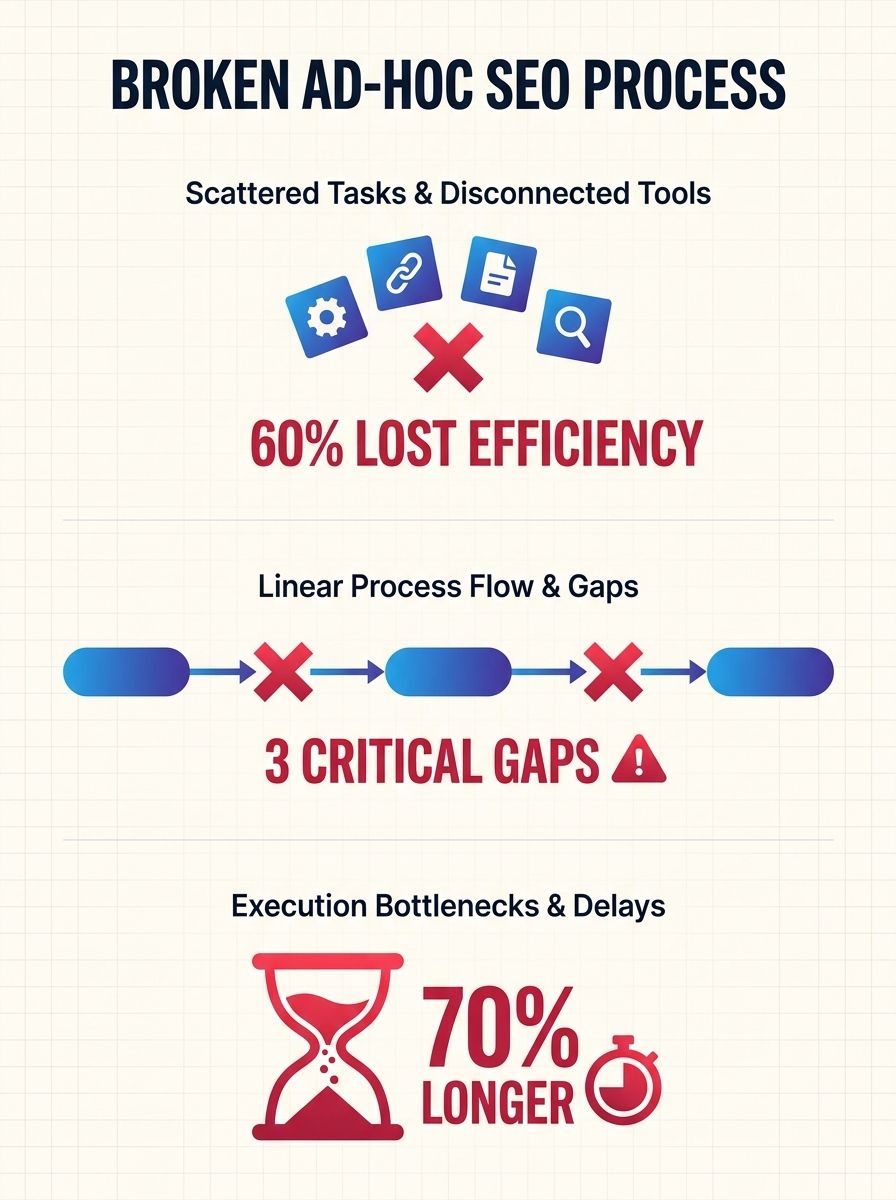
The organizational impact mirrors what happens when teams operate in departmental silos. Work gets done, but it gets done slowly, redundantly, and without the cross-functional awareness that turns individual tasks into compounding results.
The Five-Stage Workflow Architecture
A scalable SEO workflow breaks into five distinct stages, each with defined inputs, outputs, owners, and handoff triggers. I use a framework I call the RBPRD pipeline: Research, Brief, Produce, Review, Distribute. Each stage has a single owner and a concrete deliverable, so there's no ambiguity about when a task moves forward.
Research generates a prioritized keyword list with search intent classifications, competitive gap data, and estimated traffic potential. The output is a ranked opportunities backlog, refreshed on 30-day cycles.
Briefing converts each approved opportunity into a structured content brief. Automated briefing tools pull target keywords, recommended word counts, competing page analysis, and internal linking suggestions into a template. This step alone, when automated, drops from 2-3 hours of manual work to roughly 30 minutes per brief.
Production assigns briefs to writers based on topic expertise and current capacity. AI tools handle research summaries and first-draft scaffolding, while human writers add original insights, expert quotes, and the experience signals that satisfy E-E-A-T requirements.
Review runs content through SEO optimization checks (keyword density, schema readiness, internal link placement) and editorial review in parallel rather than sequentially. Centralized comments and status-based triggers reduce review cycles from 3-5 days to 1-2 days.
Distribution handles publishing, indexing requests, social promotion, and internal link insertion into existing content. Post-publish monitoring tracks ranking movement, click-through rates, and cannibalization flags.
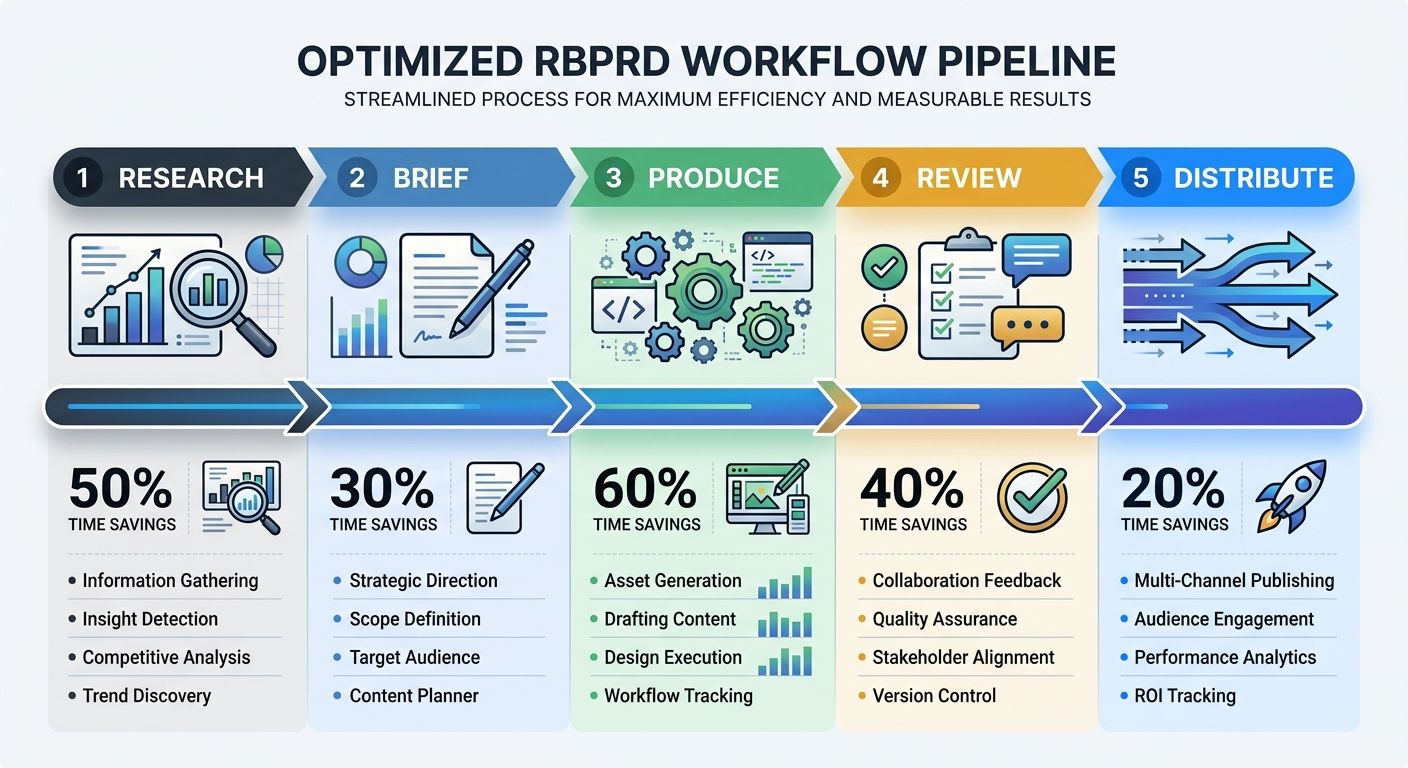
Planable documented this kind of structured approach in their own growth process, scaling organic traffic to 80,000 monthly visits and securing over 1,000 keywords in top-3 rankings by maintaining disciplined stage gates rather than ad-hoc publishing. The organic growth systems that work at scale share this characteristic: they define clear exit criteria for each phase so nothing advances until it's ready.
Automating the Repeatable Parts
SEO workflow automation targets the 60-70% of recurring tasks that don't require strategic judgment. The goal is removing manual data transfer, status updates, and report compilation so your team spends time on the 30-40% that actually moves rankings.
Here's where automation delivers the clearest ROI across the five stages:
Workflow Stage | Manual Task | Automated Alternative | Time Saved Per Asset |
|---|---|---|---|
Research | Keyword gap analysis in spreadsheets | Automated opportunity scoring with intent classification | 1-2 hours |
Briefing | Copy-pasting competitor data into docs | Template-populated briefs triggered by keyword approval | 1.5-2.5 hours |
Production | Writer assignment via email/Slack | Capacity-based routing with expertise matching | 15-30 minutes |
Review | Sequential editorial → SEO → legal passes | Parallel review with status-triggered notifications | 2-3 days |
Distribution | Manual indexing requests and social scheduling | Auto-submit to Google Indexing API + scheduled promotion | 30-45 minutes |
Platforms like monday.com provide the centralized visibility that makes this coordination possible, offering portfolio oversight and multi-view management through timeline, calendar, and Gantt views designed for cross-functional teams coordinating SEO initiatives across departments.
The trap most teams fall into is automating everything at once. Start with briefing automation (highest time savings per asset) and review-stage notifications (longest delay reduction). Add research and distribution automation in the second 90-day cycle after your team has adapted to the new handoff rhythms.
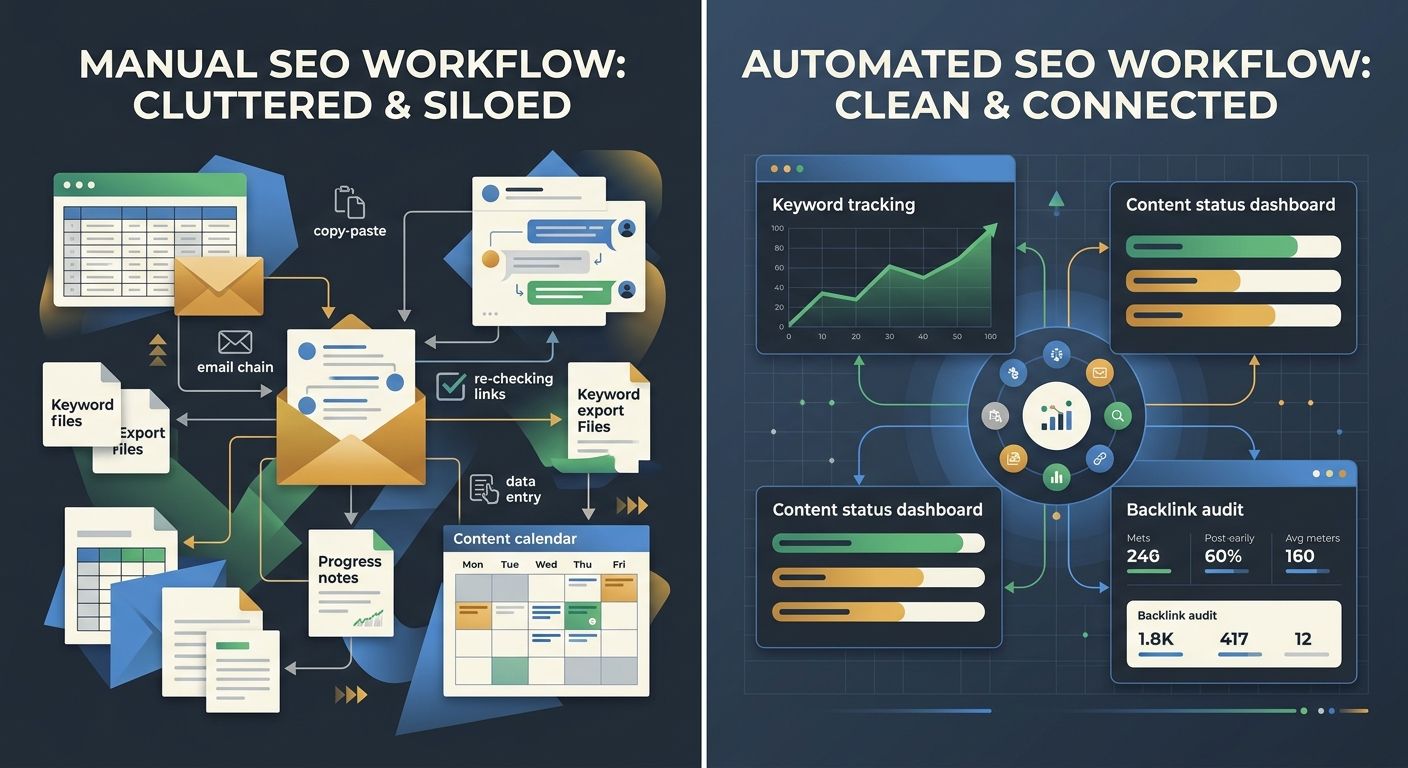
If your content production timeline is already creating bottlenecks, workflow automation addresses the structural cause rather than adding more people to a broken process.
Cross-Team Coordination Through SOPs and Sprint Cycles
Cross-team SEO coordination fails when it relies on meetings alone. Weekly syncs generate awareness but rarely generate accountability. The structural fix is pairing Standard Operating Procedures with 30-90 day sprint cycles that give every team member a defined scope and measurable target.
SOPs are, according to analysis from FatJoe's cross-functional team research, "one of the best ways to integrate new aspects into your workflows." An SOP for content creation outlines the on-page SEO optimization process step by step. An SOP for digital PR details the process of identifying high-authority sites for outreach. Each document removes the question of "how do we do this?" so team discussions focus on "what should we prioritize?"
Enterprise teams that combine structured SOPs with sprint-based execution have reported up to 120% annual traffic growth through these organic growth systems. The key mechanism is that sprints force prioritization. When your team commits to 15 deliverables in a 30-day sprint rather than maintaining an infinite backlog, every piece of content gets the attention it requires to perform.
Dave Ashworth, Technical SEO Consultant, described the reporting side of this coordination when reviewing DashThis: the tool allows teams to "quickly and easily get key multi-channel performance metrics in one easy to digest report." That shared visibility is what keeps developers, writers, and strategists aligned on what's producing results and what's stalling.
For teams dealing with technical SEO debt alongside content production, sprint cycles provide a natural mechanism to allocate capacity across both workstreams without one perpetually starving the other.
Dashboard Tracking That Connects Activity to Outcomes
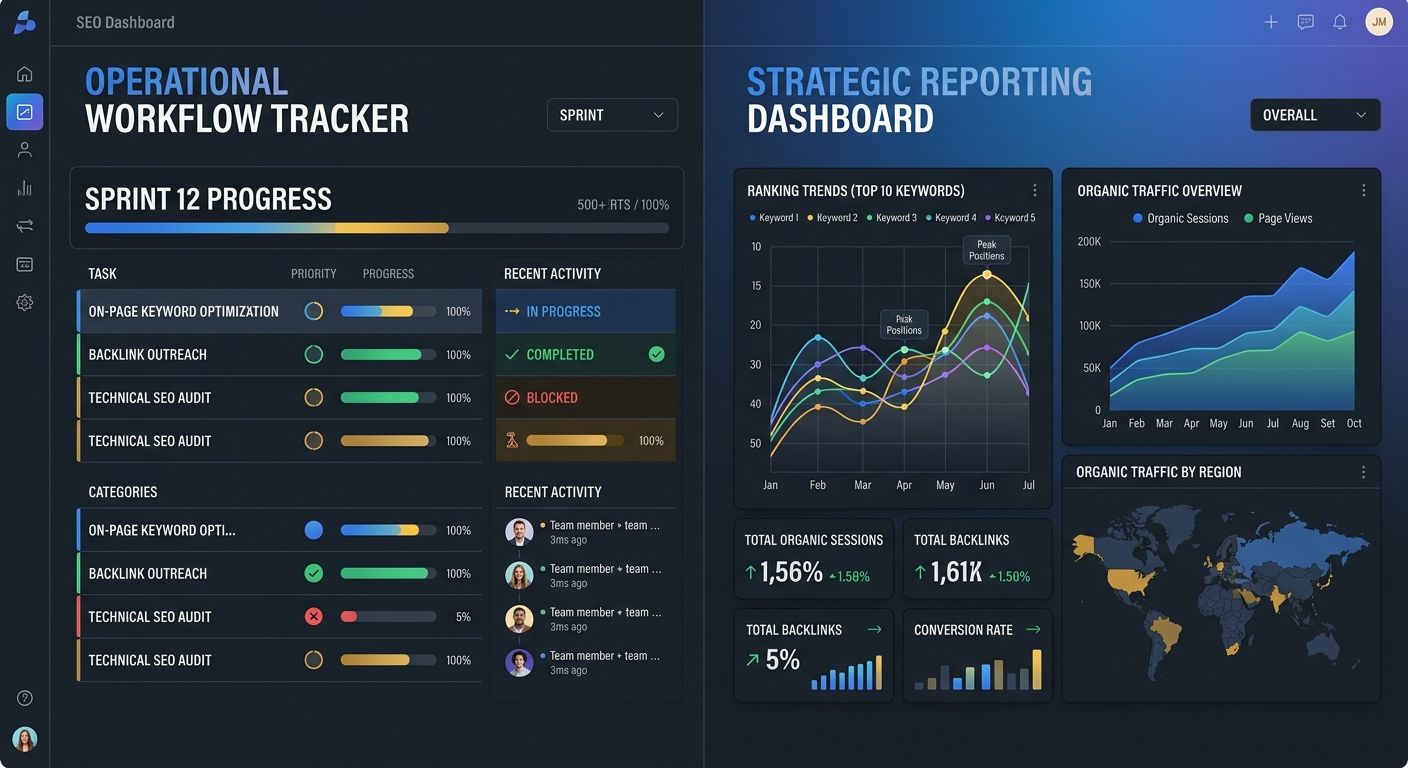
SEO dashboard tracking serves two audiences: the team executing the work and the stakeholders funding it. A single dashboard trying to serve both fails at both jobs. You need an operational layer and a reporting layer.
The operational dashboard tracks workflow velocity: briefs created this sprint, content in review, pieces published, indexing confirmation rates, and days-in-stage averages. This is the daily-use view that tells a team lead whether the system is flowing or stuck. Tools like Octoboard consolidate rank tracking and SEO analytics into automated dashboards that update in real-time, eliminating the 3-4 hours per week many teams spend compiling manual reports.
The reporting dashboard tracks outcomes: organic sessions, keyword ranking distribution, click-through rates by page cluster, and conversion attribution. This is the monthly or quarterly view that connects SEO activity to business results. The strength of templates from platforms like HubSpot and Rows lies in their data visualization capabilities, presenting complex multi-channel data through charts, graphs, and tables that make performance tracking accessible to non-SEO stakeholders.
If your analytics infrastructure has data governance gaps, fix those before building dashboards on top. Automated reports built on unreliable data create false confidence, which is worse than no data at all.
The Open Threads
Several questions remain genuinely unresolved for teams building these systems. AI-assisted content production continues to shift the ratio of human-to-machine effort in the production stage, but E-E-A-T requirements for ranking stability still demand original expertise. Where that boundary settles will reshape how teams staff and structure their workflows over the next 12-18 months.
Attribution also remains messy. Connecting a specific sprint's output to revenue requires multi-touch attribution modeling that most mid-market teams haven't implemented. The workflow system captures activity data cleanly, but the gap between "this content ranks #3" and "this content generated $47,000 in pipeline" still depends on CRM integration maturity that varies widely across organizations.
And the tooling landscape keeps fragmenting. The 2026 evaluation from Sight AI identified that each SEO automation platform addresses specific workflow gaps, meaning teams often run 3-5 tools to cover the full RBPRD pipeline. Consolidation will come, but right now, the integration layer between tools is often the weakest link in an otherwise well-designed workflow. The teams that build with clean handoffs between stages, regardless of which tools occupy each stage, will adapt fastest when the market shifts underneath them.

Alex Chen
Alex Chen is a digital marketing strategist with over 8 years of experience helping enterprise brands and agencies scale their online presence through data-driven campaigns. He has led marketing teams at two successful SaaS startups and specializes in conversion optimization and multi-channel attribution modeling. Alex combines technical expertise with strategic thinking to deliver actionable insights for marketing professionals looking to improve their ROI.
Related Articles

The Content Production Bottleneck: Why Your Publishing Timeline Kills SEO Performance
Inefficient content production workflows reduce marketing team productivity by up to 40%, and 45% of teams report they can't keep pace with their own publishing targets in 2026.

The Organizational SEO Siloing Problem: Why Your Best Technical Work Gets Lost Between Teams
Technical SEO execution fails at the org chart, not at the codebase. Industry analysis shows 67% of organizations cite non-SEO development tasks as the primary barrier to implementing technical SEO changes, a bottleneck costing an estimated $35.9 million in unrealized annual revenue per enterprise.

The SEO Benchmarking Cadence: Why Weekly Tracking, Monthly Reviews, and Quarterly Pivots Beat Static Annual Audits
Google's March 2026 core update reshuffled 79.5% of top-three search positions in under two weeks. Paid search teams scrambled to adjust bids while SEO teams running annual audit cycles had no framework to diagnose what happened, let alone respond.
Explore more topics