
AI-Referred Traffic Converts at 11x the Rate of Traditional Search, Yet Remains Invisible to Most Analytics Platforms
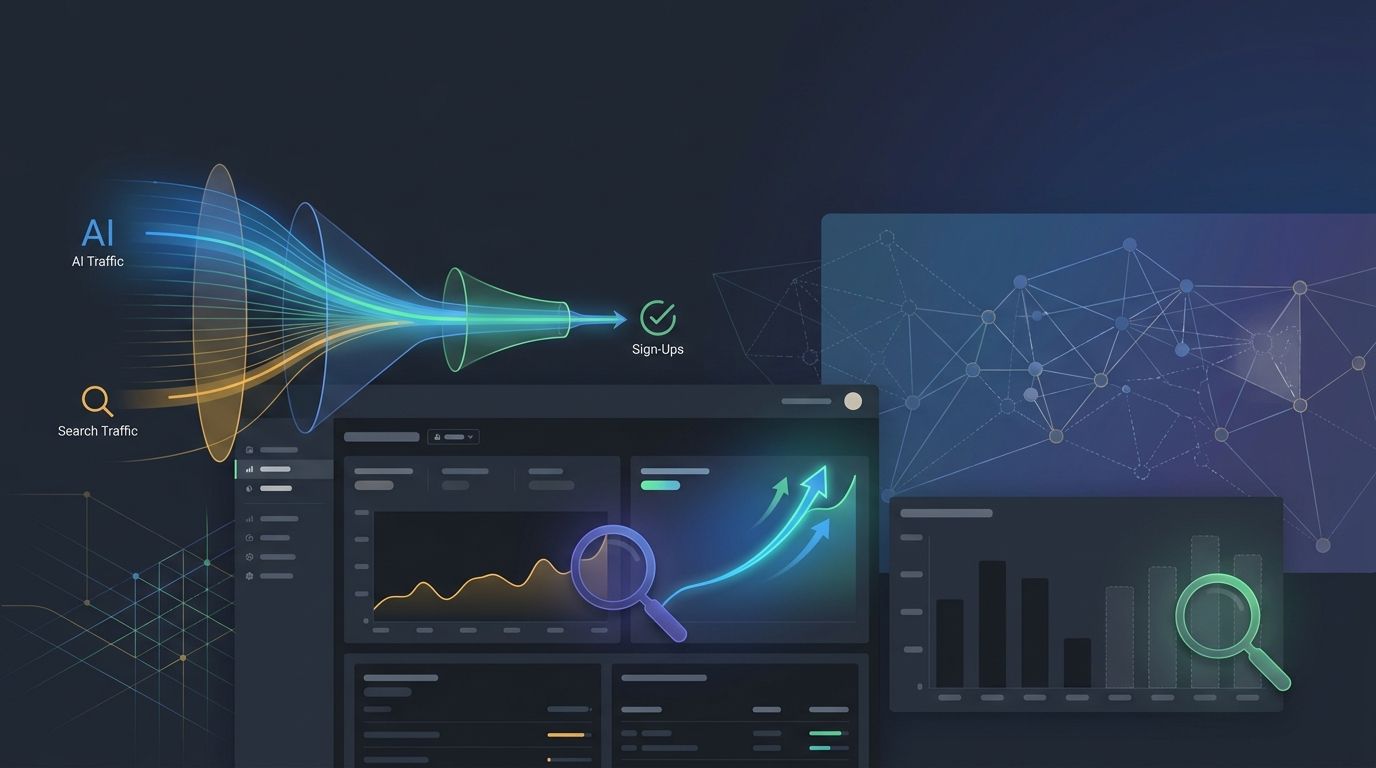
Visitors referred by large language models convert to sign-ups at 1.66%, more than eleven times the 0.15% rate recorded for traditional search traffic, yet most analytics platforms classify this traffic as "direct" or "unknown," according to an analysis published July 13 by Rankability, a St.
AI-Referred Traffic Converts at 11x the Rate of Traditional Search, Yet Remains Invisible to Most Analytics Platforms
Visitors referred by large language models convert to sign-ups at 1.66%, more than eleven times the 0.15% rate recorded for traditional search traffic, yet most analytics platforms classify this traffic as "direct" or "unknown," according to an analysis published July 13 by Rankability, a St. Louis-based SEO and AI visibility software company serving digital agencies. The finding, which draws on Microsoft Clarity's 2025 study of more than 1,200 publisher sites and Adobe Digital Insights' generative AI referral traffic report, reveals a systematic attribution gap that leaves agencies unable to measure performance from their highest-converting acquisition channel.
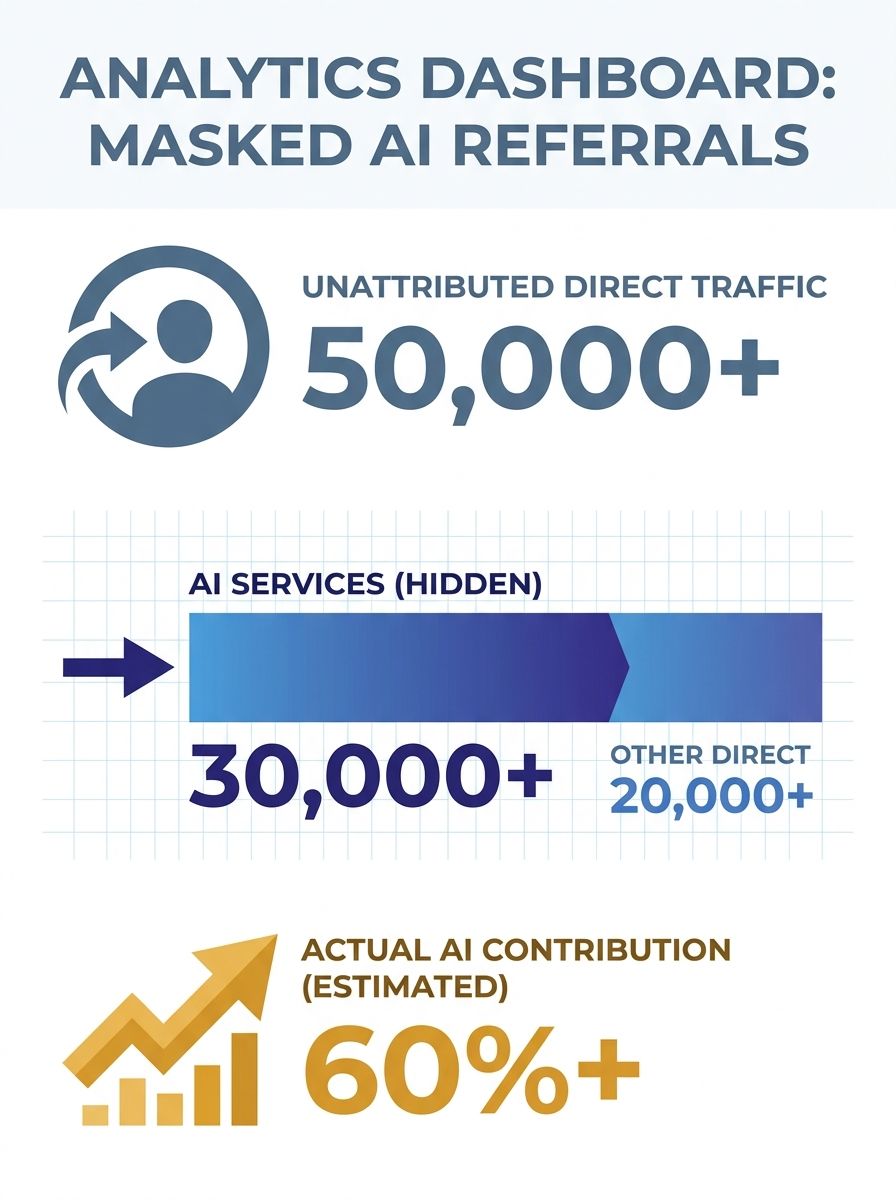
The performance gap carries immediate implications for agencies managing channel investment and content strategy. When a user follows a link surfaced by ChatGPT, Perplexity, or another LLM, the referrer string passed to the destination site is often absent, malformed, or unrecognized by standard analytics platforms, according to Rankability's analysis. Google Analytics and most tag-based tools classify unrecognized referrers as "direct" traffic, placing AI-driven sessions in the same reporting bucket as users who typed a URL directly into the browser. A client's monthly analytics report may show flat or declining organic search performance while a new and higher-converting traffic source accumulates inside the direct channel, undetected.
AI Traffic Outperforms Every Traditional Acquisition Channel
Microsoft Clarity's 2025 analysis of more than 1,200 publisher and news websites found LLM-referred visitors converted to sign-ups at 1.66%, compared with 0.15% from traditional search, 0.13% from direct traffic, and 0.46% from social media. The conversion advantage over search represents an 11x multiplier. Social media traffic converted 72% less effectively than AI referral, while traditional search and direct traffic trailed by 91% and 92% respectively.
The quality signal extends beyond conversion rates. Adobe Digital Insights' 2025 report found that AI-referred visitors spend 41% more time on site and bounce 23% less than non-AI traffic. These engagement signals would visibly move channel performance metrics in standard reporting dashboards if they were being attributed correctly, the Rankability analysis notes.
Volume remains small but is accelerating rapidly. Microsoft Clarity data shows AI-driven platform traffic grew 155.6% over eight months, though AI referrals still represent less than 1% of overall sessions across the publisher set studied. The channel is expanding from a small base, meaning its quality signal is measurable while its volume has not yet attracted the measurement infrastructure that other channels receive by default.
Retail and Publisher Data Point to Cross-Vertical Pattern
Adobe Analytics' 2025 research found traffic to U.S. retail websites from generative AI sources grew 1,200% between July 2024 and February 2025, the steepest acceleration of any acquisition channel Adobe tracked over that seven-month window. Retail conversion rates for AI-referred visitors in that dataset follow the same directional pattern as Microsoft Clarity's publisher findings: higher intent, higher engagement, and stronger downstream action than the site average.
The performance pattern holds across two structurally different site types optimizing for different conversion events, which the Rankability analysis suggests reflects a durable characteristic of the AI-referred visitor rather than a category-specific artifact. The visitor arriving via an LLM recommendation has received a curated response to a specific query before clicking through; the navigational intent is already resolved at the point of referral.
The attribution gap affects decision-making at the point where agencies and clients allocate budget between channels. Decisions about content strategy, channel investment, and resource allocation are being made on data that systematically excludes the channel showing the best return, according to the analysis.
The Measurement Infrastructure Lag
Standard analytics platforms lack the referrer-string taxonomy required to classify AI engine traffic as a distinct channel. Google Analytics, Adobe Analytics, and tag-based alternatives were built to recognize referrers from search engines, social platforms, and advertising networks whose URL structures have been stable for years. LLM platforms use inconsistent or absent referrer strings that fall outside existing classification rules.
The practical consequence for agencies is a widening gap between the traffic they can see and the traffic that drives business outcomes. A client running tests to optimize content for AI visibility has no reliable way to measure whether that optimization work is delivering traffic or conversions unless they implement custom referrer tracking outside their standard analytics stack.
Rankability's analysis draws on two independent datasets covering different verticals and conversion goals—Microsoft Clarity's 1,200+ publisher sites measuring newsletter sign-ups and Adobe's retail dataset measuring purchase intent—both published in 2025. The convergence between the two suggests the performance advantage is tied to user intent characteristics rather than implementation artifacts specific to one site type or measurement method.
The Takeaway
Agencies optimizing content for generative engine visibility face a measurement paradox: the traffic they are working to generate converts at multiples of traditional search, yet their reporting dashboards classify it as unattributed direct traffic. Without custom referrer detection or platform-specific tracking parameters, the channel showing an 11x conversion advantage remains invisible in monthly performance reports, making it impossible to quantify return on optimization work or justify budget shifts toward AI channel investment.
The attribution gap creates a second-order problem for unified SEO strategy between traditional search and AI engines. Agencies can track Google Search Console impressions and clicks with precision, but have no equivalent measurement infrastructure for ChatGPT citations, Perplexity link placements, or other LLM referral events. The performance data exists—Microsoft Clarity and Adobe both captured it at scale—but it requires analytics configurations that most agencies have not yet implemented. Until platforms ship native LLM referrer taxonomies or agencies deploy custom tracking solutions, decisions about where to allocate optimization resources will be made on incomplete channel data, systematically underweighting the acquisition source that delivers the highest-quality visitors.

Sarah Chen
SEO strategist and web analytics expert with over 10 years of experience helping businesses improve their organic search visibility. Sarah covers keyword tracking, site audits, and data-driven growth strategies.
Related Articles

AI Search Tools Supplement Rather Than Replace Google, Similarweb Traffic Data Shows
Ninety-five percent of ChatGPT's 494 million users also actively use Google, according to Similarweb data tracking audience overlap between March and May 2026, showing AI search tools have not replaced traditional search engines but instead added a supplementary layer to existing search behavior, ac
Brands Ranking #1 on Google Missing 62% of AI Overview Citations, Adweek Analysis Shows
Brands holding first-page Google rankings are absent from 62% of citations in AI-generated search answers, according to a July 22 analysis by Adweek examining generative engine optimization adoption patterns, as only 38% of pages cited in Google's AI Overviews come from URLs in the top ten tradition
AI Overviews Now Trigger on 48% of Google Searches, Slashing Organic CTR Up to 61%
AI Overviews now appear on 48 percent of all Google search queries—a 58 percent increase over the past three months—and zero-click searches have climbed to 83 percent on queries that trigger the feature, according to data published by Quasa on May 24. The shift has driven organic click-through rate
Explore more topics