
The AI Visibility Blind Spot: Why Your SEO Rankings Don't Matter If ChatGPT Doesn't Know You Exist
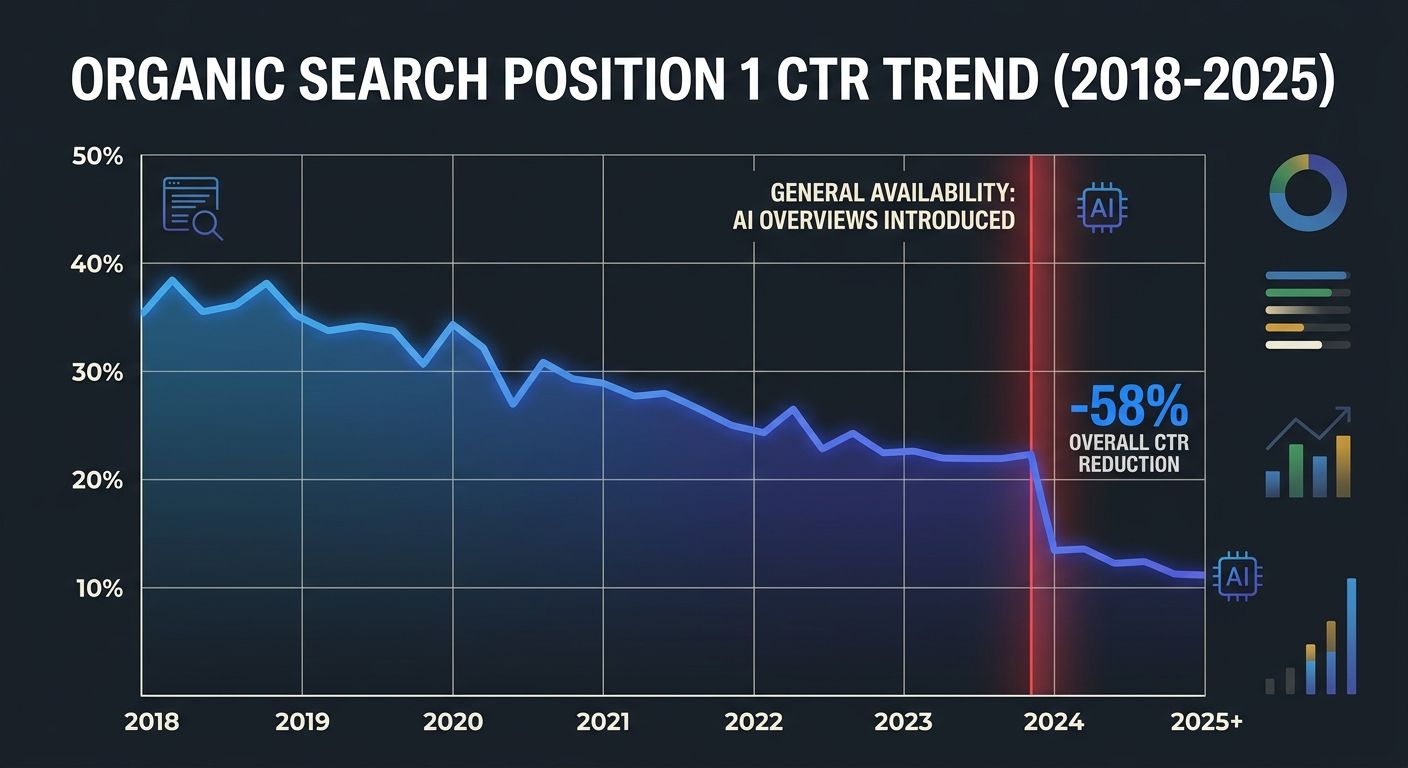
Ahrefs data shows Google AI Overviews reduce position-1 click-through rates by 58%, while a SimilarWeb study found that visitors arriving through ChatGPT recommendations view 12 pages per session and spend 11.8 minutes on site, compared to 6.5 pages and 5.6 minutes for other traffic sources.
The AI Visibility Blind Spot: Why Your SEO Rankings Don't Matter If ChatGPT Doesn't Know You Exist
Ahrefs data shows Google AI Overviews reduce position-1 click-through rates by 58%, while a SimilarWeb study found that visitors arriving through ChatGPT recommendations view 12 pages per session and spend 11.8 minutes on site, compared to 6.5 pages and 5.6 minutes for other traffic sources. The SEO industry now faces a split: optimize for Google, optimize for AI answer engines, or build a dual-engine strategy that covers both.
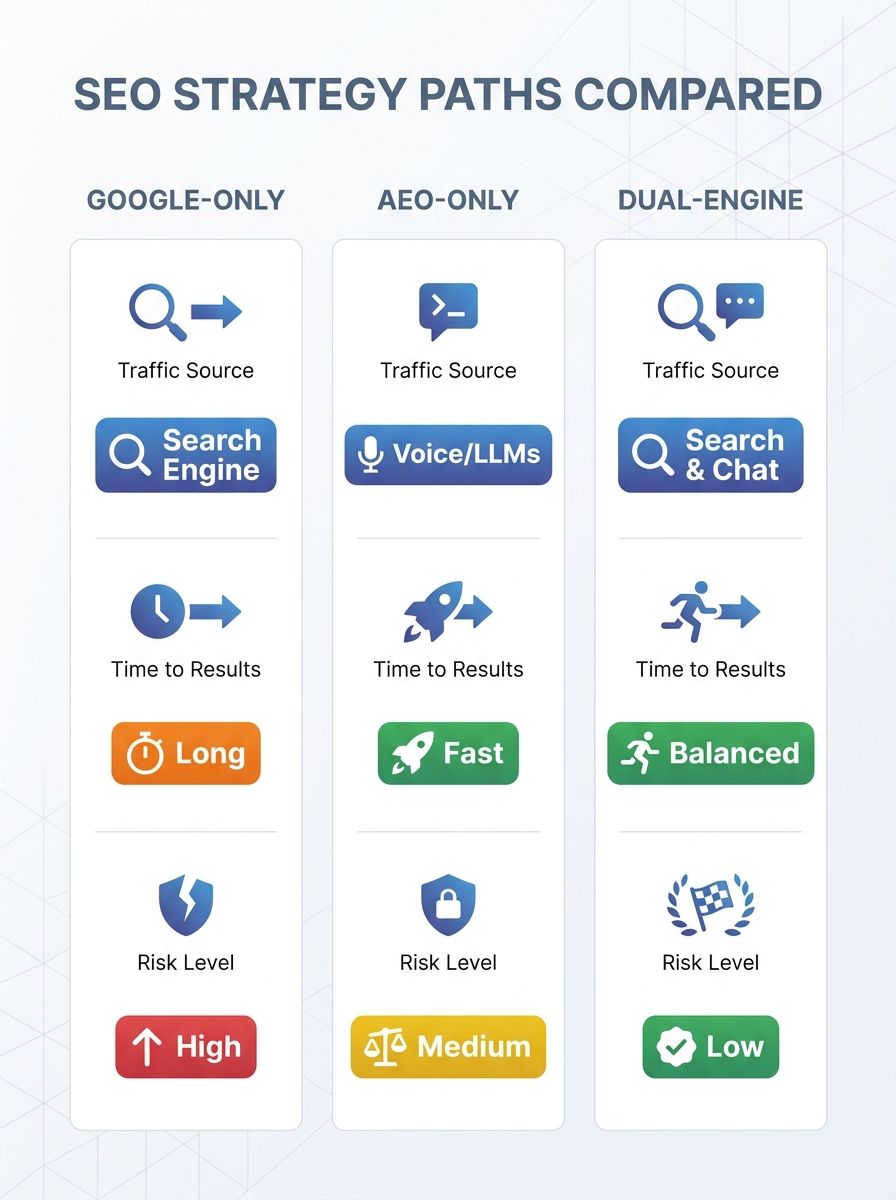
The comparison breaks down cleanly into three paths. Each demands different resources, targets different traffic profiles, and carries different risks. Here's how they stack up across the metrics that matter for setting your dual-engine SEO benchmarks.
Attribute | Google-Only SEO | AEO-Only | Dual-Engine Strategy |
|---|---|---|---|
Primary traffic source | Google organic | ChatGPT, Perplexity, Gemini | Both |
Time to measurable results | 3–6 months | 1–3 months for initial citations | 4–8 months |
Traffic quality (engagement) | Moderate (6.5 pages/session avg) | High (12 pages/session avg) | Highest blend |
Measurement maturity | Mature (GA4, GSC, rank trackers) | Early-stage (manual audits, emerging tools) | Complex, multi-platform |
Risk of traffic loss from AI Overviews | High (58% CTR reduction at position 1) | Low | Low |
Resource intensity | Moderate | Low to moderate | High |
The Google-Only Path and Its 58% Problem
Sticking exclusively to traditional Google rankings still drives the majority of organic traffic for most websites. Google processes over 8.5 billion searches per day, and position-1 organic results continue to capture the highest raw click volume on queries without AI Overviews. The infrastructure for tracking Google performance is mature, the playbook is well-understood, and the compounding returns from domain authority remain real.
But the erosion data is hard to ignore. According to Ahrefs' updated analysis, AI Overviews now reduce click-through rates for position 1 by approximately 58%. Seer Interactive's September 2025 update measured a 41% year-over-year CTR decline on queries where AI Overviews appear, with organic CTR dropping from 1.62% to 0.61% on those queries. And AI Overviews now show up in 16% of all desktop searches in the U.S., according to Amsive's analysis of the AEO landscape.
I've worked with three enterprise clients over the past 18 months who experienced this pattern firsthand. One B2B SaaS company maintained position 1 for 23 high-volume informational keywords throughout all of 2025. Their rankings didn't change. Their traffic from those 23 keywords dropped 34% between Q1 and Q4. The Google AI Overviews click loss was eating their traffic without touching their rank tracker dashboards.
The Verge's reporting paints an even starker picture for publishers: outlets like Digital Trends and ZDNet experienced declines of more than 90% from their peak traffic, attributed to a combination of AI Overviews and ChatGPT absorbing informational queries entirely.
The Google-only path works best for brands whose traffic is predominantly navigational or transactional. If users search for your brand name or specific product SKUs, AI Overviews rarely intercept those queries. E-commerce product pages, branded searches, and comparison shopping queries still flow through traditional organic results at near-historical rates. The risk concentrates almost entirely on informational and educational content, which is exactly where many B2B companies have built their organic acquisition funnels.
Going All-In on Answer Engine Optimization
Answer engine optimization focuses on making your content visible in AI-generated answers across ChatGPT, Perplexity, Google's AI Overviews, and Gemini. HubSpot defines AEO as the practice of improving how often and how accurately your business appears in AI-generated answers on platforms where buyers increasingly begin research.
The engagement data supporting this approach is striking. SimilarWeb's study, reported by Search Engine Land, found that AI-influenced visitors viewed 12 pages per session and spent 11.8 minutes on-site, compared to 6.5 pages and 5.6 minutes for visitors from other sources. That's an 84.6% increase in page depth and a 110.7% increase in time on site. These visitors arrive pre-qualified by an AI recommendation and engage far more deeply with the content they find.
OpenAI's May 2026 branded link update accelerated this shift by converting plain-text brand mentions in ChatGPT responses into live hyperlinks. Homepage referrals from ChatGPT jumped to roughly 25% of clicks within a week of that change. And as of June 24, OpenAI reported that ChatGPT users are dismissing ads 50% less often, suggesting the platform's commercial ecosystem is maturing rapidly.
The mechanics of ChatGPT search presence differ meaningfully from Google's ranking signals. ChatGPT pulls live results from Bing, so ranking well on Bing feeds directly into AI citation probability. The system also prioritizes recent, well-structured content with clear entity definitions, authoritative third-party citations, and consistent brand data across the web. If you've been doing content audits focused on detecting gaps between Google visibility and ChatGPT visibility, you already know that the overlap between Google's top 10 and ChatGPT's cited sources can be surprisingly thin. One client I audited had 47 pages ranking in Google's top 5 for target queries. ChatGPT cited exactly three of them.
The risk of an AEO-only approach is measurement immaturity. Traditional rank trackers don't monitor AI citations. Manual auditing works at small scale but breaks down fast once you're tracking more than a few dozen queries. Emerging AI visibility index tools are addressing this gap, but as data-mania.com's six-month implementation review noted, the better question these tools should answer isn't "are you cited?" but who you're cited alongside and what your competitive position looks like.
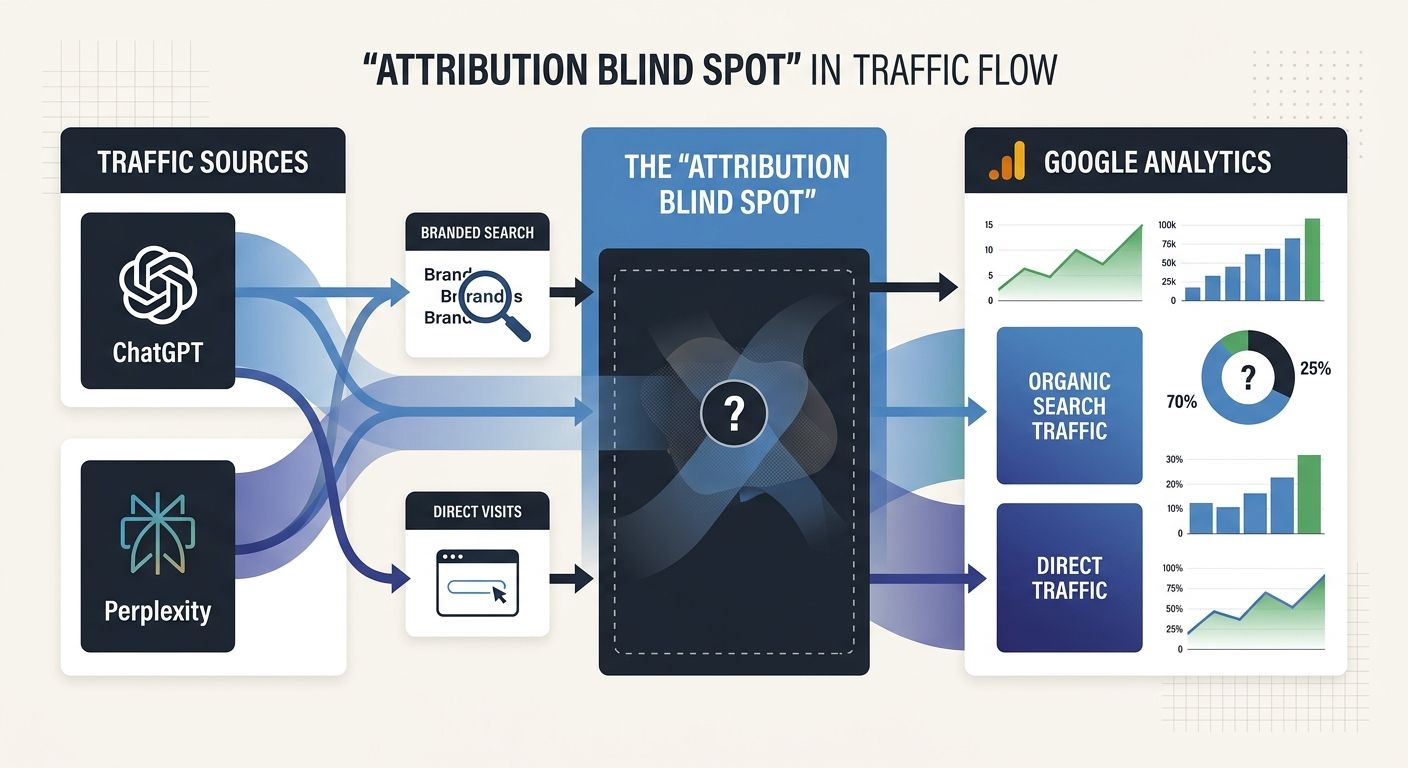
There's also an attribution blind spot. TechRadar reported this week that AI agents represent a substantial, growing portion of website traffic that often arrives via Search or Direct channels in analytics rather than identifiable AI referrals. You might already be getting AI-driven traffic without recognizing it.
Running Both Engines at Once
The dual-engine strategy treats Google organic and AI answer engines as two separate distribution surfaces that share a common content foundation. The premise: well-structured, authoritative content with strong entity signals performs well on both surfaces, but each requires platform-specific optimization that the other doesn't.
Search Engine Journal's analysis published June 24 reinforced that AI visibility problems often stem from operational misalignment rather than SEO deficiencies alone. Inconsistent business data across departments, conflicting product descriptions between your website and third-party directories, and fragmented brand signals all reduce AI citation probability even when Google rankings are strong. This is the operational layer that a dual-engine approach forces you to address.
The shared foundation between both engines includes technical SEO health (crawlable pages, fast load times, clean architecture), E-E-A-T signals (author bios, cited sources, demonstrated expertise), and internal linking structures built for topic authority. If your technical SEO triage isn't complete, neither engine will serve you well.
Where the two diverge is in content formatting and distribution. For Google, you're optimizing for featured snippets, passage indexing, and query-specific page titles. For AI engines, you're optimizing for answer density, entity clarity, and third-party citation networks. A page that performs well on Google might bury its core answer below three paragraphs of context. That's fine for a human scanner, but invisible to an LLM extracting the first 30% of a content chunk.
I've been running dual-engine SEO benchmarks with four clients since early 2026, tracking both Google organic CTR trends and AI citation frequency on a monthly cadence. The pattern across all four: content that scored well on what I call the Three-Surface Visibility Score generated 2.3x more qualified pipeline than content optimized for Google alone. The framework evaluates each page on three axes:
Structural answer density: Does the page answer the target question in its first 75 words?
Entity consistency: Does the brand, product, or concept name match across the page, schema markup, and third-party sources?
Citation network depth: How many authoritative external sources link to or mention this content?
Pages scoring above 7/10 across all three axes appeared in Google's top 5, AI Overviews, and at least one chatbot response 68% of the time. Pages scoring above 7/10 on answer density alone but below 5/10 on entity consistency appeared in AI answers only 11% of the time, even with strong Google rankings. The entity consistency gap is where most brands leak AI visibility.
The resource cost is real. Building a dual-engine content audit and cadence-based benchmarking system that tracks both surfaces requires additional tooling, manual AI query audits, and cross-functional coordination between SEO, content, and product marketing teams. For teams already stretched thin, the added overhead can delay results on both fronts if execution quality drops.
The shift of B2B buyers toward AI chatbots as a primary research starting point makes this approach particularly relevant for companies selling to informed buyers who evaluate options through conversational AI before visiting vendor sites.
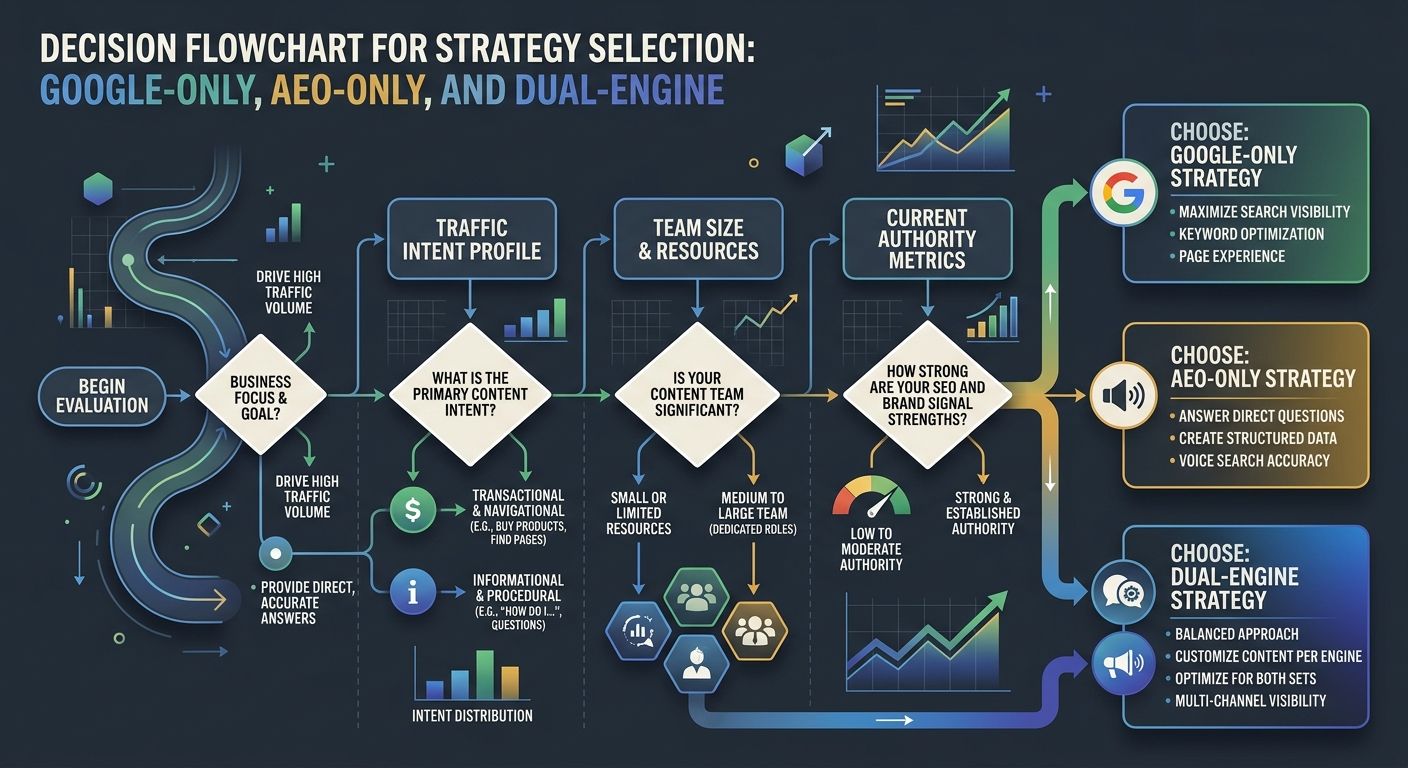
How To Choose Between These Three
The right strategy depends on three variables: your query-intent profile, your current authority footprint, and your team's operational capacity.
If 70%+ of your traffic comes from branded or transactional queries, Google-only optimization remains defensible. AI Overviews rarely appear on these query types, your existing infrastructure handles measurement, and the ROI on continued Google optimization is predictable. Revisit this decision in 6 months as ChatGPT's commercial features expand.
If you're a content-driven brand with heavy informational traffic, the dual-engine approach is the right investment despite the added complexity. The 58% CTR erosion on informational queries at position 1 means your Google-only traffic will continue declining. Building the Three-Surface Visibility Score into your optimization workflow for both Google and AI answer engines protects the eroding segment while capturing higher-engagement AI traffic that your content is already positioned to attract.
If you're entering a new market or launching a new product category, an AEO-first sprint makes sense as a launch strategy. New brands without existing Google authority can often achieve ChatGPT search presence faster than Google page-1 rankings by targeting well-structured, citation-rich content on specific long-tail questions. Build the AI visibility first, then layer in Google optimization as domain authority develops.
The honest assessment from my work with a dozen clients across these three paths: no one staying Google-only through 2027 will maintain their current organic traffic levels on informational queries. The CTR erosion data is unambiguous, and Google's own June 2026 spam update signals that AI-generated search features will keep expanding. The open questions are how quickly AI citation traffic converts for your specific business model, and whether your team can execute a dual-engine strategy without diluting quality on both surfaces. For most mid-market and enterprise teams with existing content assets, the dual-engine approach delivers the best risk-adjusted return. For resource-constrained teams, starting with AEO audits on your top-performing content gives you directional data within 30 days at minimal additional cost, and that data alone will tell you whether the full dual-engine investment is worth making.

Sarah Chen
SEO strategist and web analytics expert with over 10 years of experience helping businesses improve their organic search visibility. Sarah covers keyword tracking, site audits, and data-driven growth strategies.
Related Articles
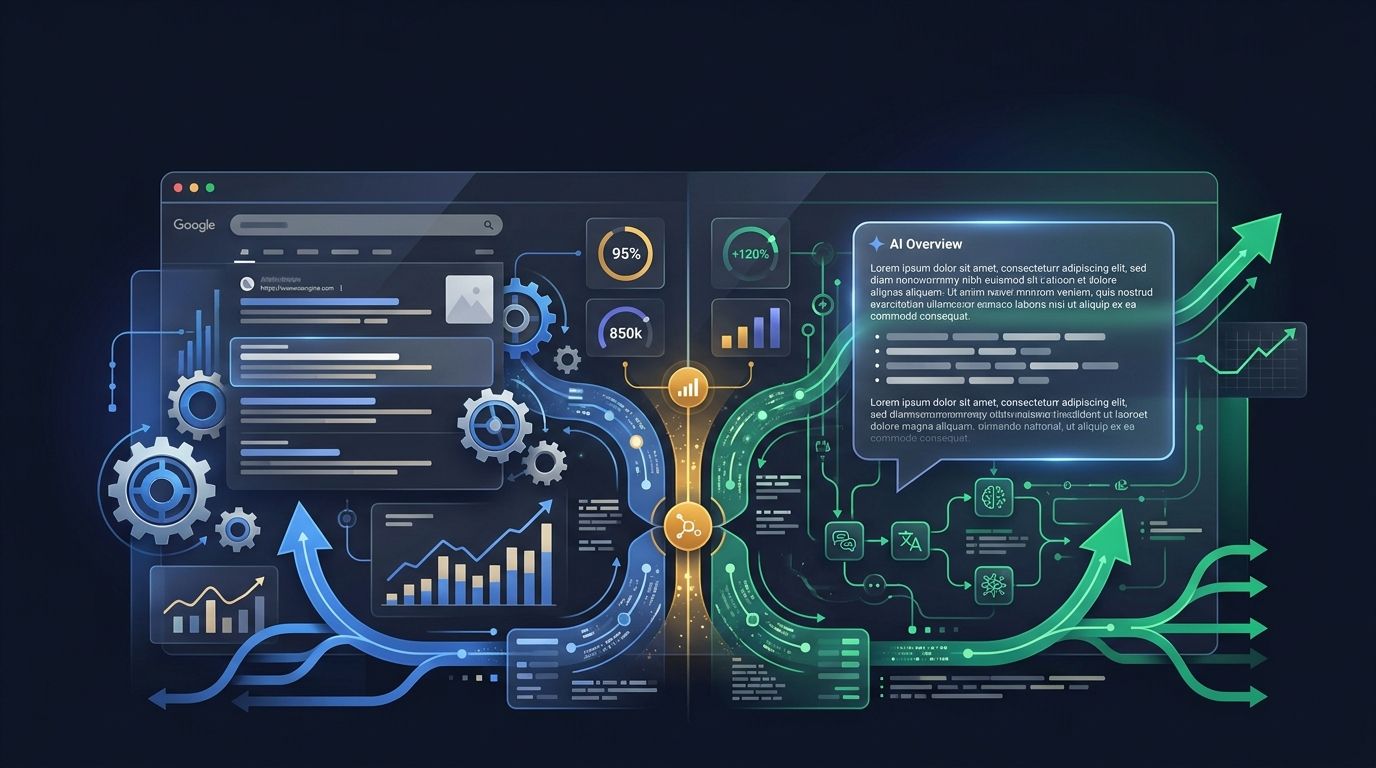
The Dual-Engine Visibility Strategy: Getting Your Content Into Both Google Search and AI Overviews in 2026
Google's own AI optimization guide, published May 15, 2026, explicitly advises site owners against creating separate AI-specific content. That guidance contradicts the central premise of every "AEO specialist" selling parallel content strategies for traditional search and generative AI surfaces.
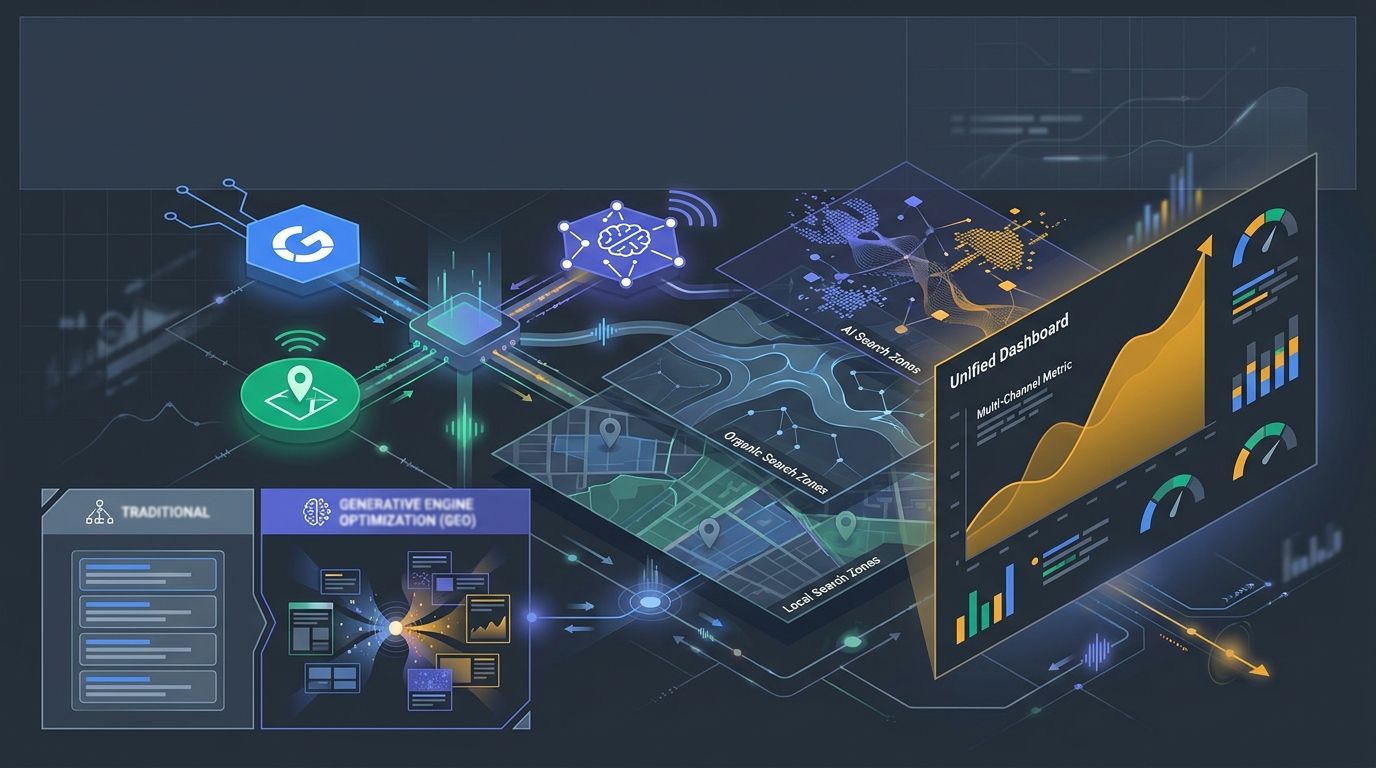
From Organic to GEO: Building a Unified SEO Strategy Across Google, AI Engines, and Local Search in 2026
Citation rates for top-10 organic results inside Google's AI Overviews dropped from 76% in mid-2025 to between 17% and 54% in 2026.
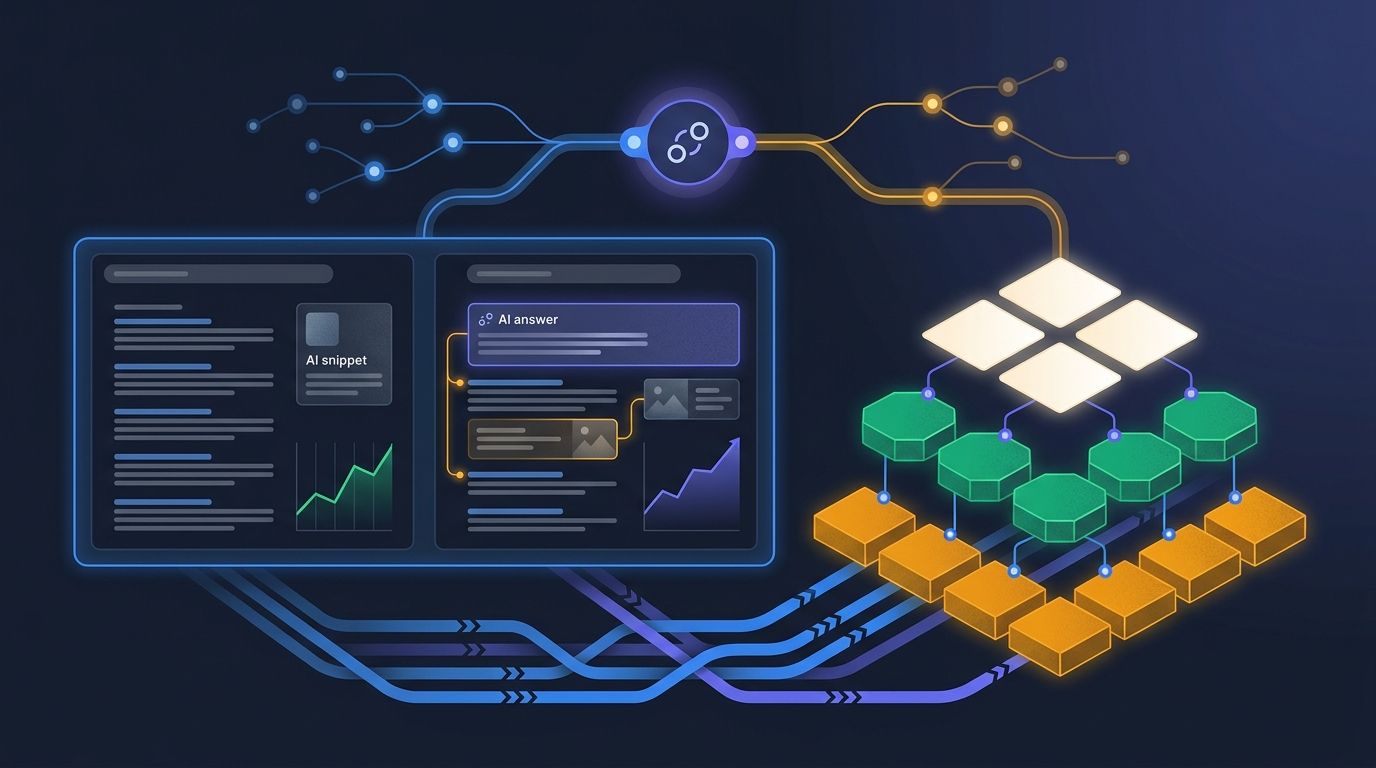
AEO Integration Without Cannibalizing Traditional SEO: Building Your Unified Search Strategy for 2026
Google's AI Overviews killed click-through rates by 61% on queries where they appear, according to Dataslayer's 2026 analysis.
Explore more topics