
The Content Plan Audit: How to Reverse-Engineer Your Strategy from Random Publishing
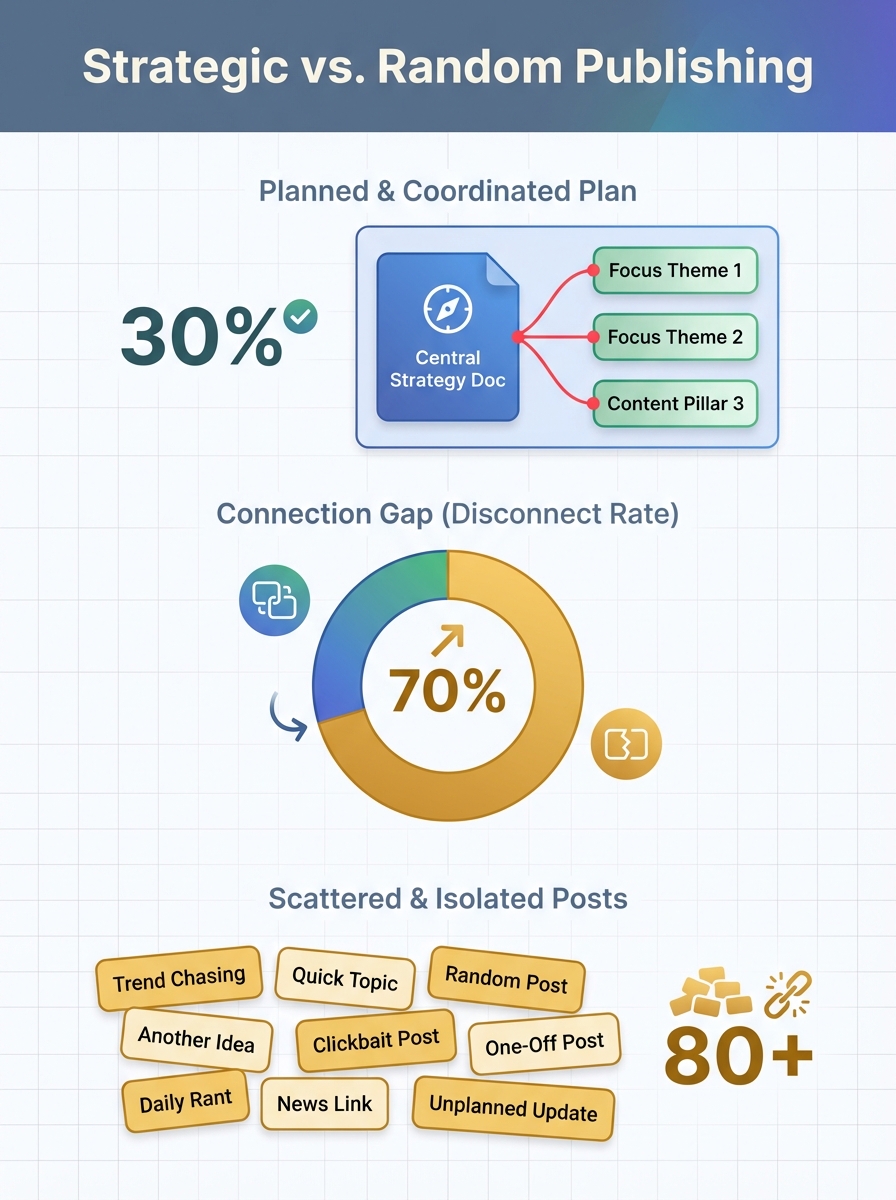
I pulled up a client's blog index and counted 247 published posts. Then I sorted them by business objective. Seventy-one percent mapped to... nothing. No specific goal, no target audience segment, no funnel stage. Just topics someone thought sounded interesting on a Tuesday morning.
The Content Plan Audit: How to Reverse-Engineer Your Strategy from Random Publishing
I pulled up a client's blog index and counted 247 published posts. Then I sorted them by business objective. Seventy-one percent mapped to... nothing. No specific goal, no target audience segment, no funnel stage. Just topics someone thought sounded interesting on a Tuesday morning. The scariest part? This company had a "content strategy." It was a 14-page Google Doc that nobody had opened in eight months.
This is the gap most marketing teams live in. They have a strategy document somewhere. They also have a publishing calendar that drifted away from that document around week three. What they don't have is a system for catching the drift. A content strategy audit is that system, and if you've never done one, you're probably publishing more randomly than you think.
The Comfortable Lie of "We Have a Strategy"
Most teams conflate having a calendar with having a strategy. A content calendar tells you when things publish. A strategy tells you why they exist and who they serve. When I ask teams to explain the strategic purpose of their last ten posts, the answers usually trail off around post four.
The content planning mistakes I see most often aren't dramatic. Nobody decides to abandon their strategy. It erodes. A sales rep requests a blog post about a niche feature. The CEO reads a competitor's article and wants a response piece. Someone on the team has a hot take they're excited about. Each individual decision seems reasonable. Collectively, they produce a blog that reads like a bookstore's bargain bin.
And the real cost isn't just wasted effort. According to Mailchimp's content planning guide, teams with solid analytics can see exactly which topics their audience cares about, helping them prioritize future content and justify resource investments. Without that measurement-driven feedback loop, you're guessing. And guessing compounds.
What a Content Strategy Audit Actually Measures
A content audit isn't just an inventory. An inventory tells you what exists. A content strategy audit evaluates how those pages perform, measuring traffic, SEO metrics, quality, and strategic alignment to determine what actions to take next. The distinction matters because you can have a perfect spreadsheet of every URL on your site and still have zero insight into whether your content is working.
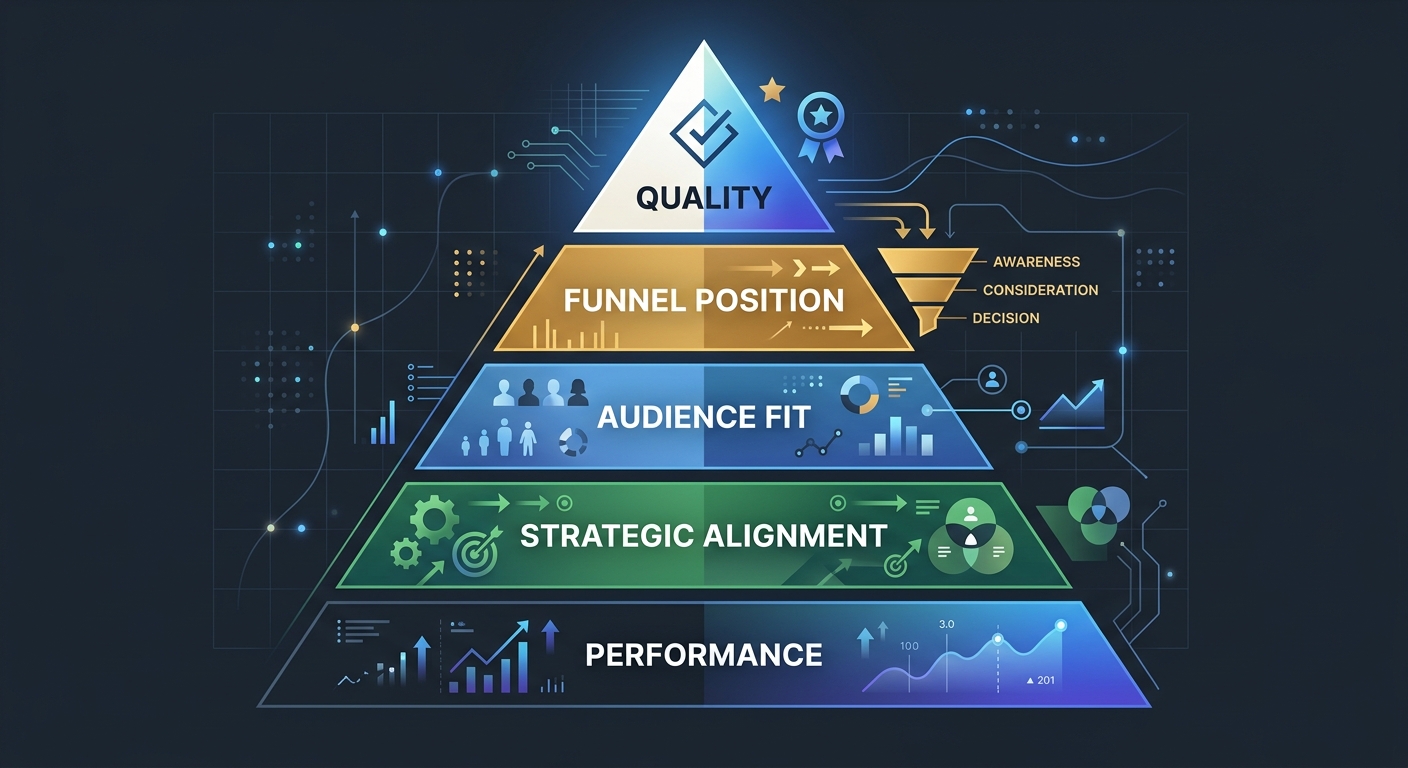
The audit I run for clients measures five dimensions:
Performance — organic traffic, engagement metrics, and conversions
Strategic alignment — does this piece map to a documented business objective?
Audience fit — does the topic address a real need of a defined audience segment?
Funnel position — where does this content sit in the buyer's path?
Quality and freshness — is the information current, well-written, and meeting E-E-A-T standards?
Most teams only measure dimension one. That's like evaluating your diet by counting calories while ignoring whether you're eating any protein. A post can drive traffic and still be strategically useless if it attracts an audience that will never buy from you.
If you're not sure whether your analytics setup is even reporting accurately, fix that first. Bad data makes every audit decision suspect.
The Reverse-Engineering Framework: From Chaos to Clarity
Here's the practical process I use. It works whether you have 50 posts or 5,000.
Step 1: Export Everything
Start with a complete content inventory. Export your XML sitemap or pull every published URL from your CMS. You want the full picture, including forgotten posts from three years ago that still get trickle traffic.
For each URL, pull: page title, publish date, word count, organic sessions (last 90 days), bounce rate, average time on page, and any conversion data you have. If tracking metrics that actually affect your business feels overwhelming, focus on organic sessions and conversions as your two anchor metrics.
Step 2: Define Your Buckets (After the Fact)
This is where reverse-engineering gets interesting. Instead of starting with your strategy doc, start with your actual content. Read through your titles and group them into themes that emerge naturally. You'll typically find 8-15 topic clusters.
Now compare those clusters to your business objectives. You'll almost certainly find:
Clusters that align perfectly with what you sell (good)
Clusters that are adjacent but don't connect to revenue (questionable)
Clusters that have nothing to do with your business (why do these exist?)
That third category is where most of the waste lives. I once found a SaaS company's blog had 30+ posts about general productivity tips. Their product was accounts payable automation. The productivity content drove traffic but zero conversions. Every hour spent on those posts was an hour not spent on content their actual buyers needed.
Step 3: Score and Sort
Use a simple scoring system. The B2B Mix recommends a 1-5 or high/medium/low rating for each dimension to transform subjective quality assessments into comparable data. I use a three-column approach: Performance Score (based on traffic and conversions), Alignment Score (based on strategic fit), and a combined Priority Score.
Every piece of content falls into one of four action buckets:
Keep and promote — high performance, high alignment
Update and optimize — high alignment, underperforming
Consolidate — multiple pieces covering the same topic, cannibalizing each other
Remove or redirect — low performance, low alignment
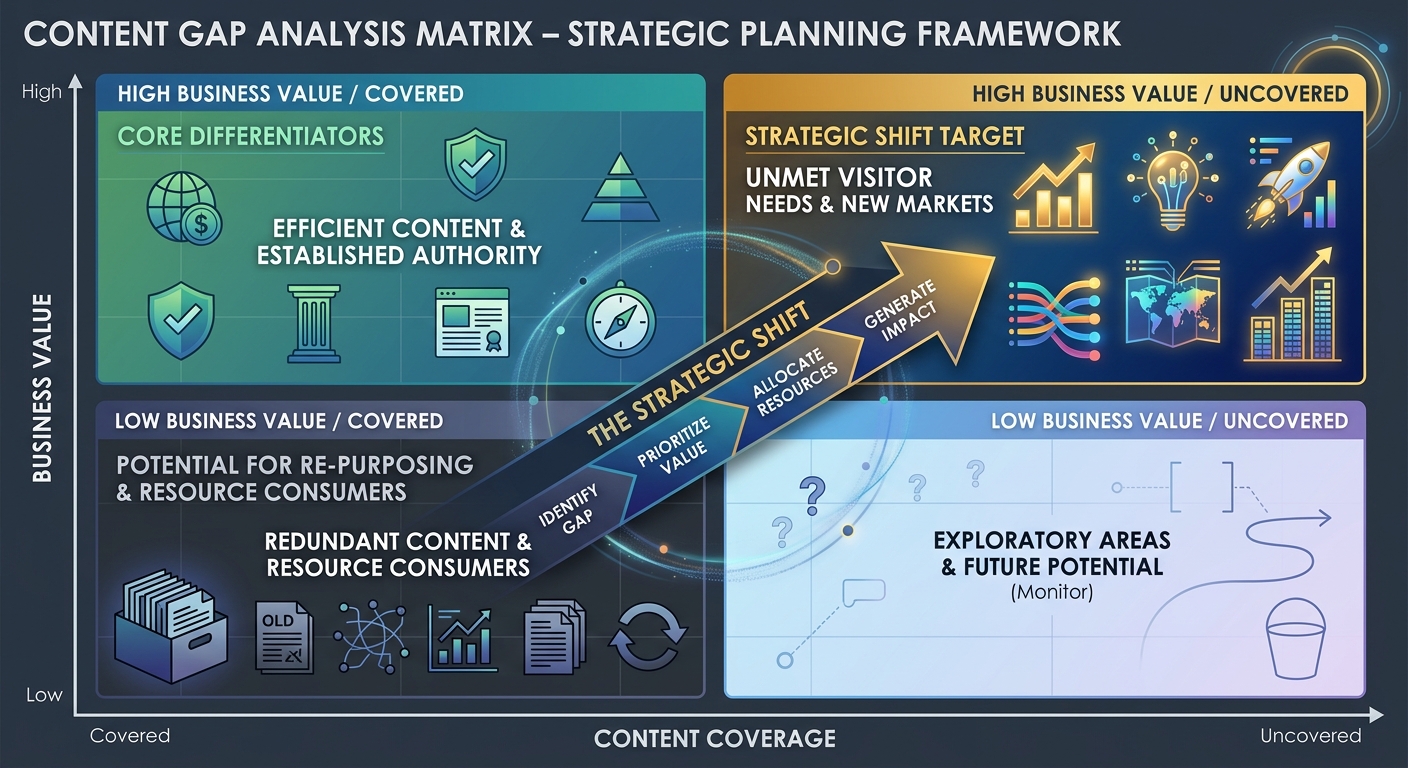
Step 4: Build the Gap Map
Your existing content tells you where you've been. Your content goal mapping exercise tells you where you should go. Compare the topic clusters you found in Step 2 against the actual questions your buyers ask during sales conversations, the problems your product solves, and the keywords your competitors rank for that you don't.
The gaps are your editorial roadmap. And they're almost always more valuable than the content you already have.
This is where building content hubs around pillar topics becomes especially powerful. Instead of publishing disconnected posts, you're constructing interconnected topic clusters that signal depth and authority to both readers and search engines.
The Audience Research Gap Nobody Talks About
Here's an opinion that might sting: most content teams don't actually know their audience. They know their buyer persona doc. That's not the same thing.
Audience research gaps show up in audits as a pattern. You'll see content that's technically about the right topic but written at the wrong level of expertise, or solving the wrong version of the problem. A blog post about "what is SEO" on a site selling enterprise SEO tools is a classic example. The people who need to learn what SEO is are not the people who sign six-figure contracts for SEO software.
I check for audience misalignment by asking three questions about every piece of content:
Who specifically would search for this?
Where are they in their buying process?
After reading this, what would they do next?
If you can't answer all three, the content lacks intent. It might rank. It might get traffic. But it won't move anyone toward a business outcome. As MarTech points out, these mistakes can derail performance before you even begin publishing.
When your audit reveals audience misalignment, the fix usually isn't deleting content. It's rewriting introductions, adjusting technical depth, and adding clear next steps that connect to your funnel. Sometimes it's also an honest conversation about whether you're targeting the right channels entirely.
Building the Content Alignment Framework
Once your audit is complete, you need a system that prevents the drift from happening again. I call this the content alignment framework, and it's embarrassingly simple. Every content brief must answer four questions before production begins:
What business objective does this support? (Pick one. If you can't, don't publish it.)
Which audience segment is this for? (Name the specific person, not "marketers.")
What action should the reader take after consuming this? (Be specific.)
How will we measure success? (Define the metric before publishing, not after.)
This framework sounds basic because it is. The problem was never complexity. The problem was that teams skip the alignment step because they're under pressure to publish. Volume feels productive. Strategy feels slow. But publishing unaligned content is the most expensive kind of slow because you're spending resources to generate noise.
The Audit Cadence That Actually Works
One audit isn't enough. Content drift is continuous, so your correction mechanism needs to be too.
For most teams, I recommend a quarterly mini-audit of your top 50 pages by traffic, combined with a full audit every six months. The quarterly check catches decay early. The full audit recalibrates your strategy against current business priorities. Major events like product launches, rebrands, or algorithm updates should trigger an additional review.
Your content marketing strategy should explicitly include audit dates. Put them on the calendar the same way you schedule publishing. If you only plan creation and never plan evaluation, you're building a library nobody curates.

What Happens After the Audit
The audit produces three deliverables:
An action list for existing content (update, consolidate, or remove)
A gap map showing topics you need to create
An alignment framework that governs future publishing decisions
Prioritize the action list by impact. Update high-alignment underperformers first because they're closest to generating returns. Consolidate overlapping content second because duplicate pages actively hurt your SEO. Remove or redirect irrelevant content third.
For the gap map, don't try to fill every gap at once. Pick the three to five topics with the highest business value and build those out as clusters. If you're repurposing existing content into evergreen formats, you can often fill gaps faster than starting from scratch.
The Takeaway You Can Use Monday Morning
Pull up your last 20 published posts. For each one, write down the business objective it serves and the specific audience segment it targets. If you can do that for all 20 without guessing, your strategy is tighter than 90% of the teams I've worked with. If you find yourself stalling after five or six, you don't have a content problem. You have an alignment problem. And now you have a framework to fix it.

Sarah Chen
SEO strategist and web analytics expert with over 10 years of experience helping businesses improve their organic search visibility. Sarah covers keyword tracking, site audits, and data-driven growth strategies.
Frequently Asked Questions
- What is a content strategy audit and how is it different from a content inventory?
- A content strategy audit evaluates how pages perform by measuring traffic, SEO metrics, quality, and strategic alignment to determine what actions to take next, whereas an inventory simply tells you what content exists. An audit provides insight into whether your content is actually working, not just what you have published.
- How do I know if my content is strategically aligned with my business goals?
- You can evaluate strategic alignment by asking three questions about each piece: Who specifically would search for this? Where are they in their buying process? And after reading this, what would they do next? If you can't answer all three, the content lacks strategic intent and may not move readers toward a business outcome.
- What are the five dimensions of a content strategy audit?
- A comprehensive content audit measures: Performance (organic traffic, engagement, conversions), Strategic alignment (whether pieces map to documented business objectives), Audience fit (whether topics address real needs of defined segments), Funnel position (where content sits in the buyer's journey), and Quality and freshness (whether information is current and meets E-E-A-T standards).
- How should I prioritize content changes after completing an audit?
- Prioritize by impact: first update high-alignment underperforming content, then consolidate overlapping pages that hurt SEO, and finally remove or redirect irrelevant content. For gaps, pick three to five topics with the highest business value and build those out as clusters rather than trying to fill every gap at once.
- What four questions should every content brief answer before publishing?
- Every content brief must answer: What business objective does this support? Which audience segment is this for? What action should the reader take after consuming this? And how will we measure success? If a content idea can't answer all four, it should go into a backlog rather than onto the publishing calendar.
- How often should I conduct a content strategy audit?
- Most teams should conduct a quarterly mini-audit of their top 50 pages by traffic and a full audit every six months. Major events like product launches, rebrands, or algorithm updates should trigger an additional review to prevent content drift.
- What is a content gap map and why is it valuable?
- A gap map identifies topics your audience needs that you haven't covered yet by comparing your existing content clusters against questions buyers ask, problems your product solves, and keywords competitors rank for that you don't. Gap maps are often more valuable than auditing existing content because they reveal your editorial roadmap.
Explore more topics