
B2B Software Buyers Shift from Google to AI Chatbots as Primary Research Starting Point, G2 Data Shows
More than half of B2B software buyers now begin their research using AI chatbots rather than Google, according to data released June 26 by G2. The company's 2026 AI Search Insight Report found that 51% of buyers start with AI tools, up from 36% seven months earlier, marking a fundamental shift in ho
B2B Software Buyers Shift from Google to AI Chatbots as Primary Research Starting Point, G2 Data Shows
More than half of B2B software buyers now begin their research using AI chatbots rather than Google, according to data released June 26 by G2. The company's 2026 AI Search Insight Report found that 51% of buyers start with AI tools, up from 36% seven months earlier, marking a fundamental shift in how enterprise software purchasing decisions begin, according to G2.
The shift carries immediate consequences for vendor visibility. G2's report found that 69% of B2B software buyers ended up choosing a different vendor than they originally expected, while 33% purchased from a brand they had never heard of before an AI chatbot recommended it. The shortlist is forming before traditional marketing touchpoints, websites, sales outreach, paid search ads, enter the decision process.
Review Citations Drive AI Visibility More Than Paid Ads
AI chatbots rely on third-party citations rather than advertising spend to determine which software products to recommend, the G2 data shows. When buyers ask tools like ChatGPT or Perplexity for software recommendations, 45% cite review platform references as the most confidence-inspiring signal in an AI-generated answer, according to the report.
Review platforms ranked as the second-most influential source shaping buyer shortlists overall, behind only the AI chatbots themselves. G2 captured 22.4% of all software-related citations across ChatGPT, Perplexity, and Google AI Mode, based on an independent analysis of 30,000 AI citations conducted by Kevin Indig, growth advisor at G2.
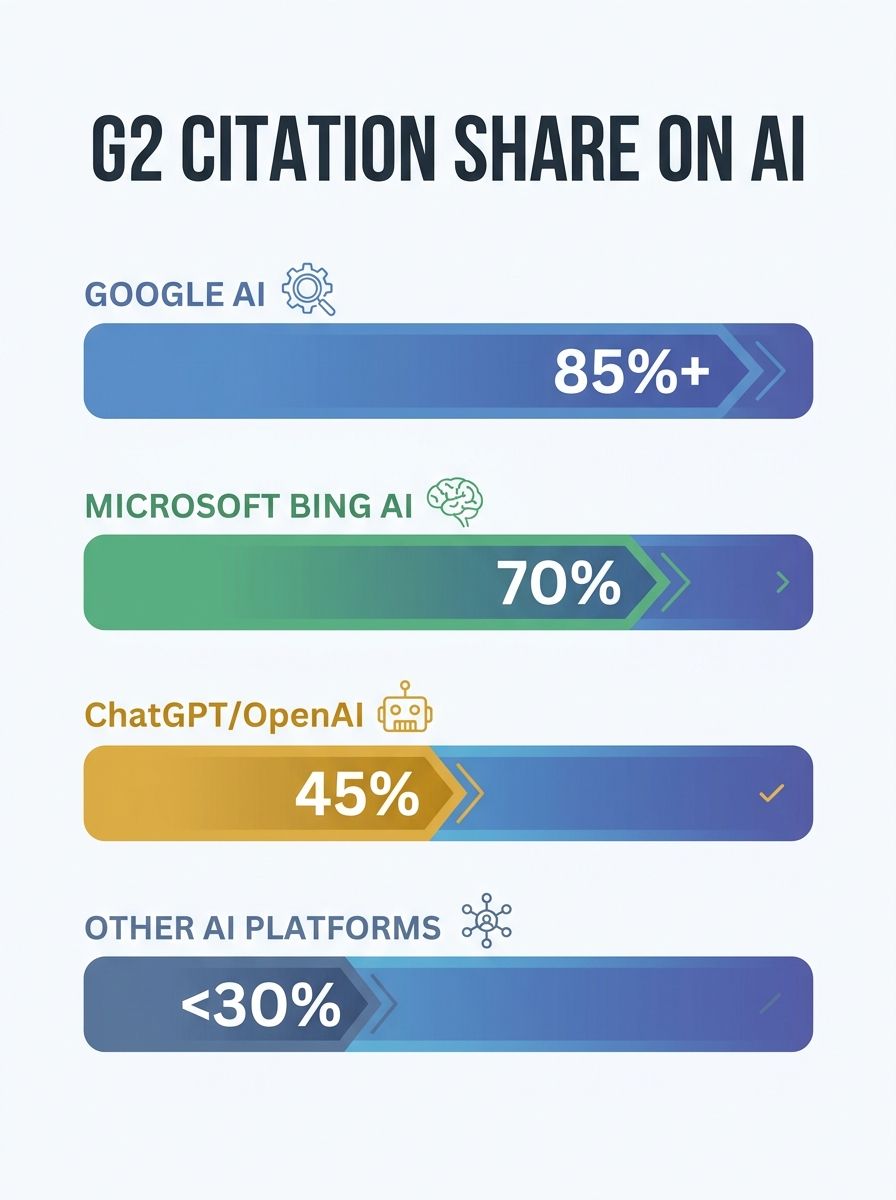
The platform receives an average of 1.53 million daily AI citations across software category searches, a nearly threefold increase in mention volume since March 2026, according to G2 internal data tracked via its Profound monitoring tool across 1,668 software categories.
Google AI Mode Leads Citation Volume, ChatGPT Ranks Fourth
Google AI Mode generates the highest volume of G2 citations for software searches, followed by Perplexity and Gemini, with ChatGPT ranking fourth among major AI platforms analyzed between March and June 2026, G2's internal tracking data shows. The distribution challenges assumptions that ChatGPT dominates AI-driven software discovery.
Buyer behavior inside these tools differs from traditional search patterns. The report found that 33% of buyers open AI sessions with category comparison queries such as "best CRM for enterprise" or "top marketing automation tools," while 31% start with competitor-based prompts that already name specific vendors. Eight in 10 buyers said AI accelerated their purchasing decision timeline.
The citation data reveals a pattern: AI platforms preferentially cite sources with verified peer signals rather than promotional content. Brands appearing in AI-generated recommendations typically maintain deep review foundations in their categories, built incrementally through customer feedback rather than advertising investment.
Category Analysis Shows Review Volume Correlates with AI Visibility
G2 analyzed three software categories, Answer Engine Optimization, SEO Tools, and Marketing, comparing review counts, star ratings, and AI visibility scores. The analysis found that products with higher review volume and maintained ratings above 4.0 stars received proportionally more citations in AI-generated responses to buyer queries.
The data suggests that optimizing for AI answer engines requires a fundamentally different strategy than traditional search engine optimization. While Google search rewarded keyword optimization and link-building, AI chatbots weight third-party validation signals more heavily than on-site content.
This shift impacts how marketing teams should allocate resources. The traditional funnel, where buyers discover brands through paid search, visit websites, then request demos, is compressing. AI tools are performing discovery, research, and preliminary vendor evaluation in a single interaction, often before a buyer visits any vendor website.
The 64% of buyers who encountered errors in AI-generated recommendations relied on review platforms as a verification layer, the report found. When AI chatbots provided incorrect information or outdated data, buyers cross-referenced recommendations against review sites to validate accuracy before proceeding with vendor conversations.
Context and Outlook
The data confirms what many digital marketers suspected but few had quantified: the buyer journey no longer reliably begins with a Google search. For marketing teams, this creates two immediate challenges. First, traditional paid search and SEO strategies may no longer capture buyers at the discovery stage. Second, brands without established review foundations face systematic exclusion from AI-generated shortlists regardless of budget.
The shift places pressure on content strategies built for traditional search. The answer engine content audit framework identifies a recurring pattern where content ranks well in Google but receives zero citations in ChatGPT or Perplexity. That gap appears to widen for brands with thin peer review profiles, suggesting that citation-worthy authority now requires verified third-party signals beyond owned content.
G2's data suggests the acceleration will continue. Citation volume has tripled in three months; the percentage of buyers starting with AI chatbots jumped 15 percentage points in seven months. Marketing leaders treating AI search as an experimental channel may find their competitors building citation foundations that become increasingly difficult to overcome as review volume compounds over time. The brands visible in AI search today are the ones that invested in review acquisition when traditional Google search still dominated, a lag effect that creates winner-take-most dynamics as buyers shift platforms.

Alex Chen
Alex Chen is a digital marketing strategist with over 8 years of experience helping enterprise brands and agencies scale their online presence through data-driven campaigns. He has led marketing teams at two successful SaaS startups and specializes in conversion optimization and multi-channel attribution modeling. Alex combines technical expertise with strategic thinking to deliver actionable insights for marketing professionals looking to improve their ROI.
Related Articles

AI Search Tools Supplement Rather Than Replace Google, Similarweb Traffic Data Shows
Ninety-five percent of ChatGPT's 494 million users also actively use Google, according to Similarweb data tracking audience overlap between March and May 2026, showing AI search tools have not replaced traditional search engines but instead added a supplementary layer to existing search behavior, ac
Self-Promotional Listicles Feed Competitor Recommendations in Google AI Overviews, June 2026 Research Shows
Self-promotional comparison pages that rank brands in a category are now feeding competitor recommendations inside Google's AI Overviews, according to research published in June 2026 by Lily Ray analyzing 100 B2B software queries across three months. Cited brands lose the recommendation 69% of the t

Brands Ranking #1 on Google Appear in Only 31% of AI Search Responses, NP Digital Study Finds
Brands holding the top position in Google search results appear in AI-powered search responses just 31% of the time, according to a March 2026 experiment conducted by digital marketing agency NP Digital that tested 500 commercial keywords across five industries against 4,308 long-tail AI prompts. Th
Explore more topics