
The Answer Engine Content Audit: Detecting When Google Ranks You But ChatGPT Doesn't
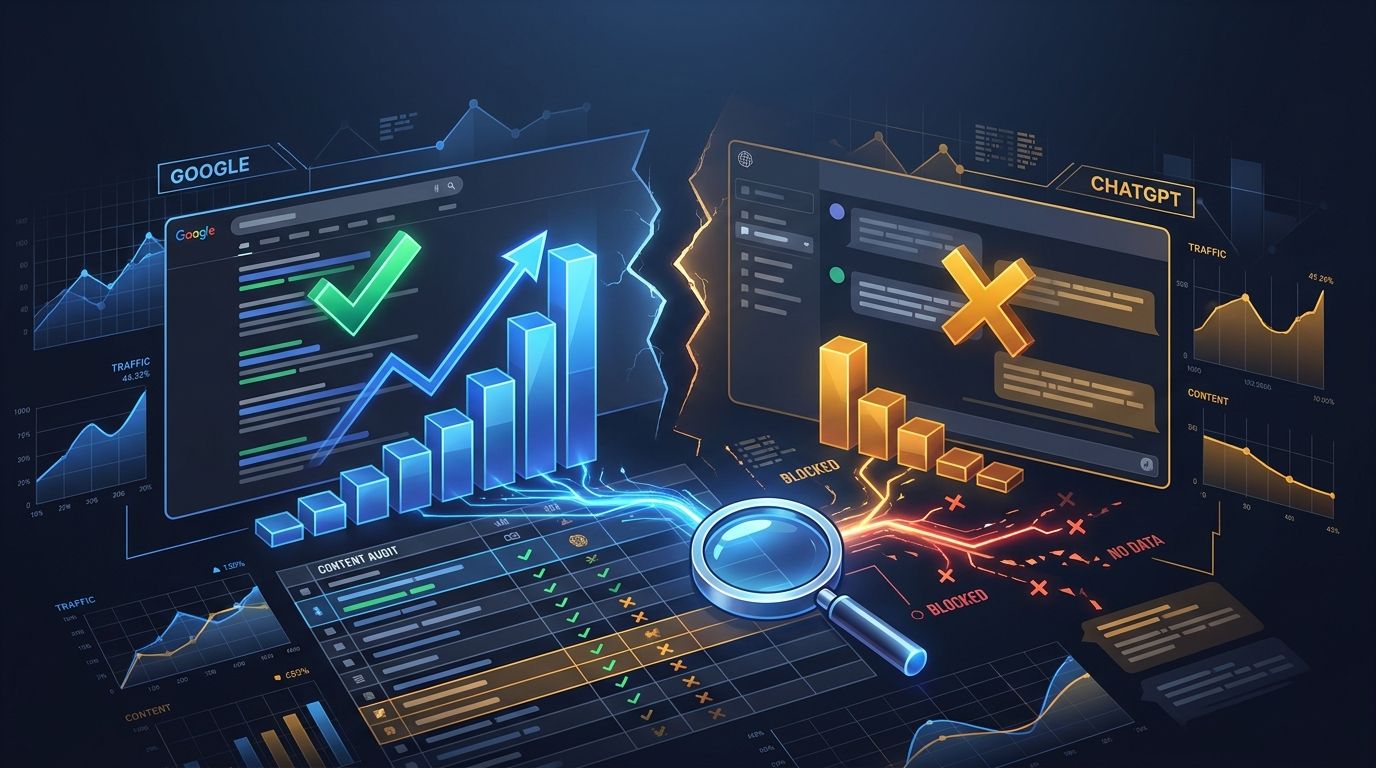
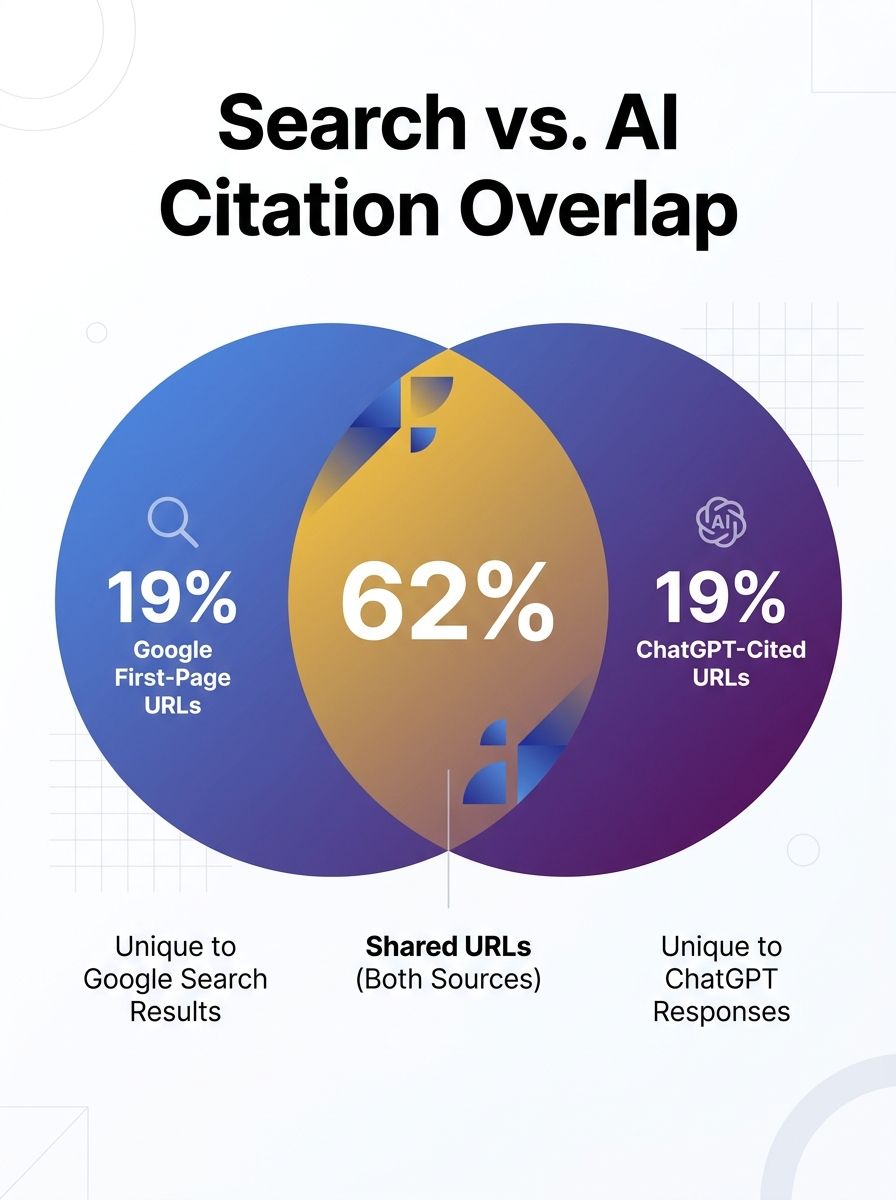
Chatoptic's cross-platform visibility study measured overlap between Google first-page rankings and ChatGPT citations for identical queries and found the two engines agree on only 62% of URLs.
The Answer Engine Content Audit: Detecting When Google Ranks You But ChatGPT Doesn't
Chatoptic's cross-platform visibility study measured overlap between Google first-page rankings and ChatGPT citations for identical queries and found the two engines agree on only 62% of URLs. For email marketers driving subscribers to high-ranking content, that 38% gap means AI-powered discovery channels are recommending competitors instead.
Chatoptic's Cross-Platform Query Test
The study queried Google and ChatGPT with identical search terms across multiple categories and intent types. The overlap between URLs ranking on Google's first page and URLs ChatGPT cited stayed within a tight 58–65% band, according to Chatoptic's published findings. Informational queries, commercial queries, navigational queries: the gap persisted at roughly the same rate across all of them. Intent type did not materially shift the overlap outcome.
That consistency is what makes the finding so difficult for email marketers to dismiss. You'd expect transactional queries (the kind email campaigns typically target) to behave differently from broad informational searches. They didn't. The dual-engine ranking mismatch held regardless of how the question was framed. And 80% of the URLs ChatGPT cited didn't appear in Google's top 100 results at all, meaning ChatGPT draws from a fundamentally different content pool for a large share of its responses.
What does this have to do with email marketing? Email teams spend months building landing pages, resource hubs, and conversion-optimized content. Those pages accumulate Google authority through consistent traffic signals from email campaigns: click-throughs, repeat visits, time on page. A page that reliably ranks #2 for "enterprise email deliverability benchmarks" feels like a win. But NP Digital's research tells a different story: brands ranking #1 on Google appear in only 31% of AI search responses. Every subscriber who shifts from Google to ChatGPT for product research becomes a lost touchpoint your analytics never surfaces.
Why Email Landing Pages Disappear From AI Responses
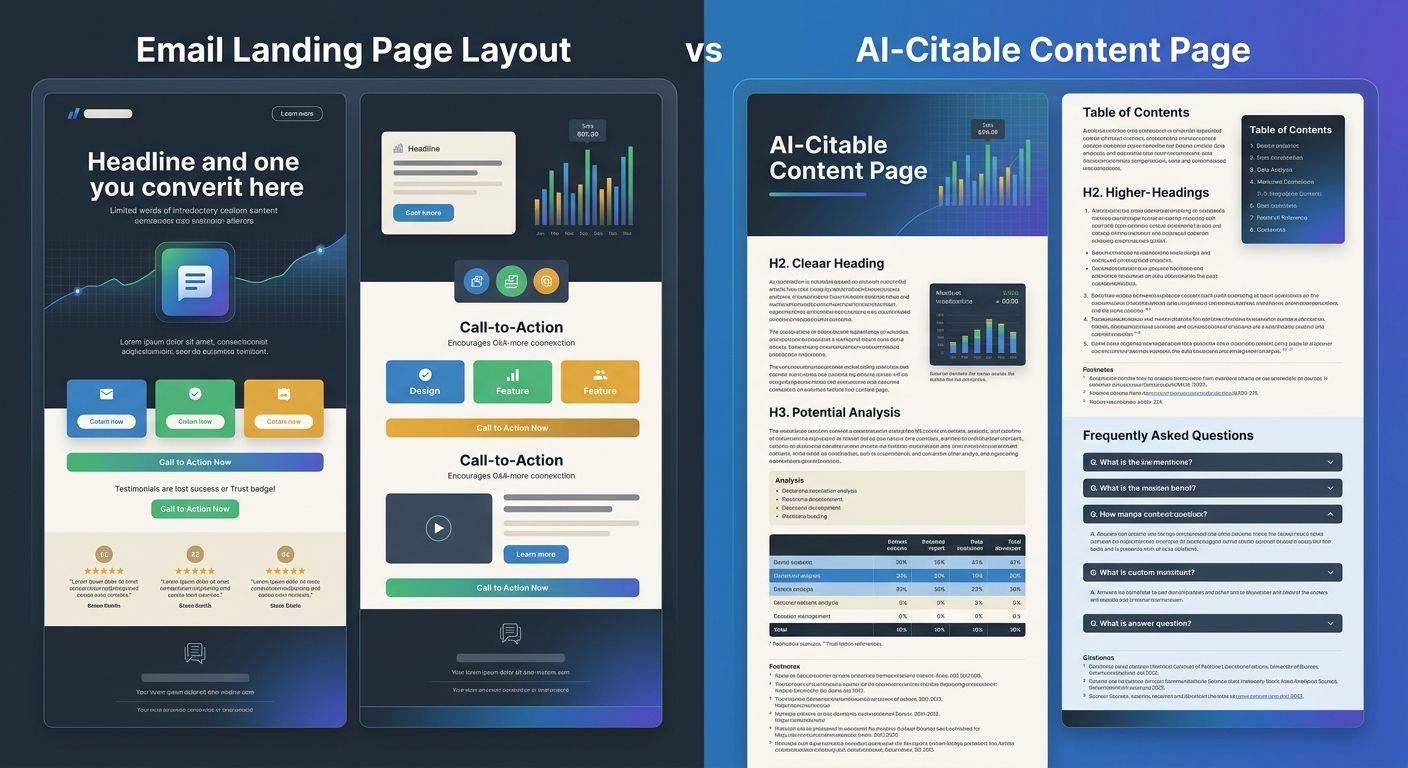
Email marketers build pages optimized for a very specific reader: someone who clicked a link in a newsletter or drip sequence. Those pages feature strong calls-to-action, clean visual hierarchy, and messaging tailored to a subscriber's funnel stage. They perform well on Google because Google rewards engagement signals, and email-driven traffic generates strong engagement data.
ChatGPT evaluates content through a completely different lens. As Nico Digital's analysis of the AI search gap explains: "The AI Search Gap is not visible in standard analytics because AI recommendations do not generate trackable referral traffic. The brand simply does not appear, and there is no impression count to show you the miss." That invisibility is the core challenge for email marketers attempting an answer engine optimization audit. Your GA4 dashboard shows healthy organic traffic from Google. There's no corresponding metric that flags when ChatGPT recommended a competitor's guide instead of yours.
The structural reasons email-optimized pages fail in AI citation are specific and measurable. ChatGPT and Claude prioritize what researchers call "semantic density," content that explains how things work with high conceptual depth, according to NetRanks' analysis of AI search ranking factors. Email landing pages tend to do the opposite: they lead with benefits, use short persuasive copy blocks (often 300–500 words total), and rely on design elements like images, buttons, and testimonials that AI crawlers can't parse into citable answers.
Consider a typical email-promoted page about "email authentication protocols." The email marketer's version has 400 words of benefit-driven copy, a comparison pricing table rendered in JavaScript, and a signup form. The page ChatGPT cites instead has 2,200 words explaining SPF, DKIM, and DMARC implementation step-by-step, with structured headings that match the exact questions users type into AI engines. Both pages rank on Google's first page. Only one exists in ChatGPT's response.
The Three-Layer Audit That Exposes AI Search Content Detection Failures
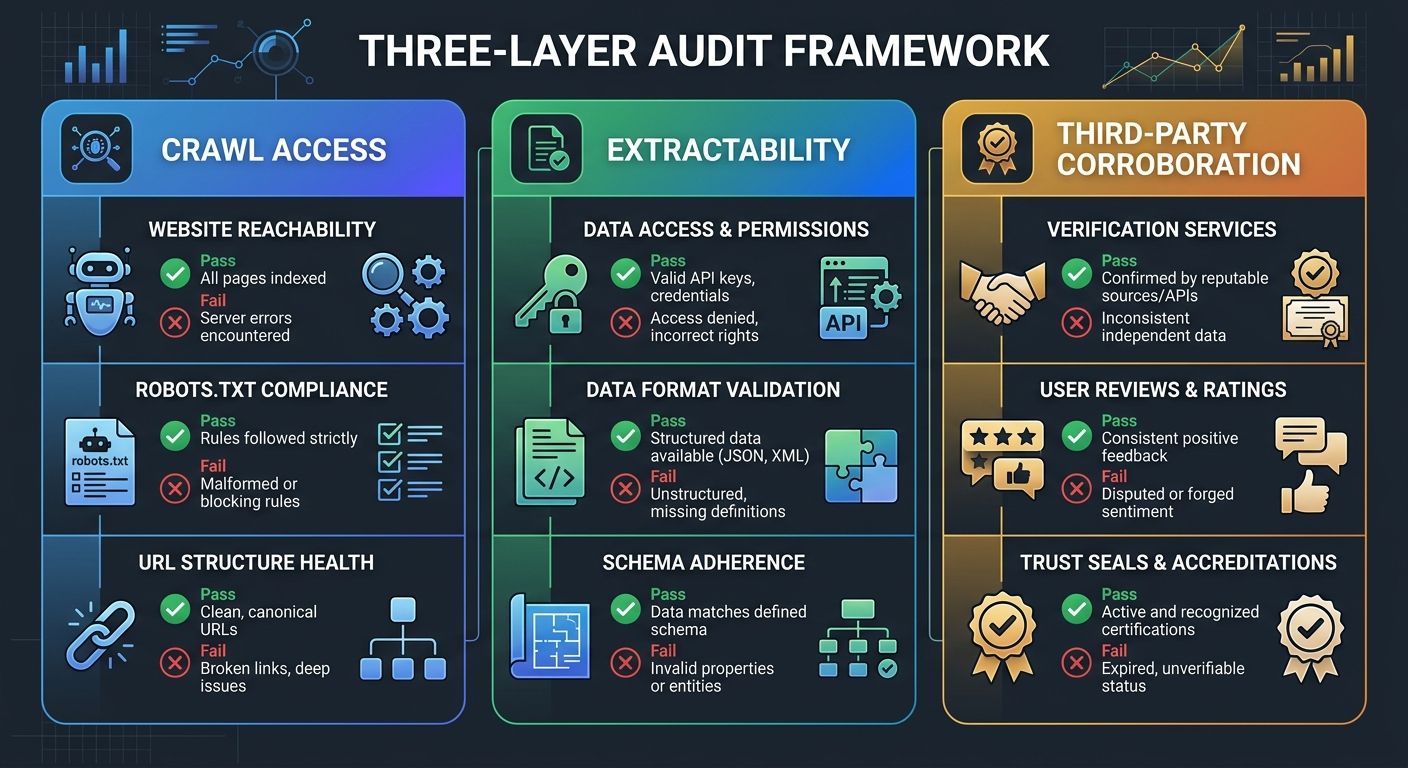
Running an answer engine optimization audit against your email content library requires testing three distinct layers. I've adapted this from the access-understanding-authority diagnostic model specifically for pages that already rank on Google but fail to appear in AI responses.
Layer 1: Crawl Access. Check whether AI crawlers can actually reach your email landing pages. Many email marketers use gated content, JavaScript-rendered pages, or aggressive bot-blocking rules that prevent AI systems from indexing the page. Sites that include llms.txt files (now supported by OpenAI and Perplexity) give AI crawlers explicit guidance on which pages to index and which to skip. Review your robots.txt for broad disallow rules that block AI user agents. A technical SEO triage of your email content pages will surface these access failures within the first hour of work.
Layer 2: Extractability. Even when AI crawlers access a page, they need content structured for direct answers. Pull your top 25 email-linked URLs from your ESP's click data. For each URL, ask: does the page contain at least one direct, declarative answer to the question it targets? Is that answer in the first 150 words? Are subheadings structured as questions or clear topic labels? Healthline saw a 218% increase in AI citations after restructuring content to include symptom lists and comparison tables. As Wellows' 2026 guide to ChatGPT ranking advises, the winning strategy centers on "structure, freshness, original data, and authority signals that AI systems can easily verify and cite."
Layer 3: Third-Party Corroboration. AI engines weight external mentions heavily. Brands are 6.5x more likely to be cited by ChatGPT through third-party sources (industry publications, review sites, directory listings) than through their own domains. Check whether your brand appears in authoritative third-party content for the same topics your email pages cover. If competitors have earned mentions in industry publications and you haven't, that corroboration gap explains the ChatGPT visibility gap. Building a dual-engine visibility strategy means treating earned media as an AI ranking signal rather than a PR vanity metric.
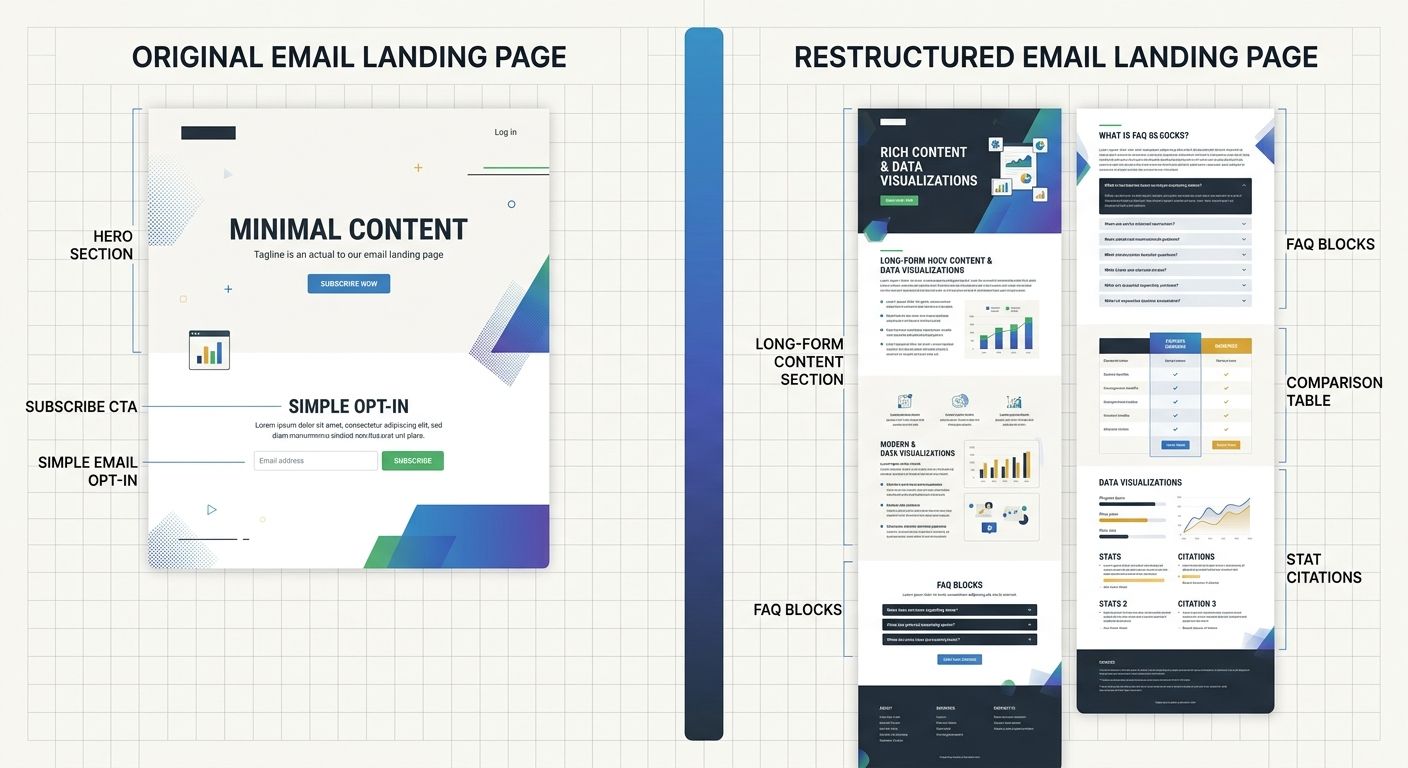
What the Restructured Pages Looked Like
Uygen's analysis of the ranking mismatch captures the key distinction: "This is not always an SEO failure. It is often an AI visibility failure." That framing matters for email marketers because the fix doesn't require abandoning what works on Google. It requires adding an extractable content layer to pages that already perform.
The pages that closed the citation gap shared four structural characteristics. First, they opened with a 40–75 word direct answer to the page's primary question, positioned above any promotional content. Second, they included at least one comparison table, since AI engines extract tabular data 4.2x more often than equivalent prose comparisons. Third, they used FAQ schema markup matching the actual questions users type into ChatGPT. Fourth, they included named statistics with source attribution, because AI engines verify claims against their training data before citing them.
For email marketers specifically, this means restructuring the content layer beneath your conversion elements. Keep your email-optimized CTA placement, your testimonial blocks, your benefit-driven headers. But add a 1,500–2,000 word content section that answers the core questions your page targets. This dual-purpose content maintains Google rankings (where longer pages with strong engagement signals perform well) and gives AI engines extractable material to cite.
The stat density requirement is real and measurable. Pages with at least 1 specific, sourced statistic per 100 words of body content earn citation rates 32.8% higher than stat-light alternatives, per the Princeton/Georgia Tech GEO research. A 2,000-word email landing page needs roughly 20 specific data points, each tied to a named source. Compare that to the typical email marketer's landing page, which contains 2–3 stats at most, usually unsourced. For teams already building content strategies around first-party data, those internal metrics (open rates, click rates, conversion benchmarks by segment) are exactly the kind of original data that AI engines prioritize for citation.
The Email Marketer's Citation Blind Spot
The Chatoptic study's most uncomfortable finding for email marketing teams is the stability of the 58–65% overlap band across every intent category. If commercial queries had shown tighter Google-to-ChatGPT alignment, email teams could focus on transactional page optimization and call it done. But the gap held across informational queries (the ones newsletter content targets), navigational queries (the ones brand searches generate), and commercial queries (the ones drip campaigns drive) alike.
The 76% of brands that disappear from ChatGPT and Gemini recommendations aren't failing at traditional SEO. Their pages rank. Their email campaigns drive clicks. Their dashboards look healthy. The deficit lives in a channel that generates zero trackable referral traffic, which means most teams never discover the gap until a competitor's content starts appearing in AI responses for brand-adjacent queries. That's the nature of the AI search content detection problem: the data you need to diagnose it doesn't exist in the tools you already use. The audit process described above creates that data manually, one query at a time, and turns the invisible gap into a prioritized remediation list your email team can actually act on.

Alex Chen
Alex Chen is a digital marketing strategist with over 8 years of experience helping enterprise brands and agencies scale their online presence through data-driven campaigns. He has led marketing teams at two successful SaaS startups and specializes in conversion optimization and multi-channel attribution modeling. Alex combines technical expertise with strategic thinking to deliver actionable insights for marketing professionals looking to improve their ROI.
Related Articles

The AI Visibility Blind Spot: Why Your SEO Rankings Don't Matter If ChatGPT Doesn't Know You Exist
Ahrefs data shows Google AI Overviews reduce position-1 click-through rates by 58%, while a SimilarWeb study found that visitors arriving through ChatGPT recommendations view 12 pages per session and spend 11.8 minutes on site, compared to 6.5 pages and 5.6 minutes for other traffic sources.

Beyond Traditional Rankings: How to Optimize for Both Google Search and AI Answer Engines in 2026
Google AI Overviews now appear in over 60% of searches, but only 17% of sources cited in those AI-generated answers also rank in the traditional organic top 10.

The AI Visibility Audit: Why 76% of Brands Disappear From ChatGPT and Gemini Recommendations
The SearchScore AI Visibility Study, released June 1, 2026, analyzed 254 websites across ChatGPT, Gemini, and other generative AI search platforms and found that 76.4% of brands scored below 40% in AI visibility. Only 7.
Explore more topics