
Beyond Traditional Rankings: How to Optimize for Both Google Search and AI Answer Engines in 2026
Google AI Overviews now appear in over 60% of searches, but only 17% of sources cited in those AI-generated answers also rank in the traditional organic top 10.
Beyond Traditional Rankings: How to Optimize for Both Google Search and AI Answer Engines in 2026
Google AI Overviews now appear in over 60% of searches, but only 17% of sources cited in those AI-generated answers also rank in the traditional organic top 10. A hybrid SEO and AEO approach that optimizes content for both crawl-based indexing and AI extraction is the baseline requirement for dual search engine ranking in 2026.
That 17% overlap figure carries an uncomfortable implication. The pages Google's crawler rewards and the pages AI systems choose to cite are, overwhelmingly, different pages. When the Google March 2026 core update shifted 79.5% of top-three search results according to SE Ranking analysis, single-channel visibility became visibly fragile. But the deeper revelation came from teams that ran parallel audits afterward: checking their Google rankings alongside their citation rates in ChatGPT, Perplexity, and AI Overviews. One B2B SaaS company I worked with ran exactly this kind of audit. The findings reshaped how they think about every page they publish.
79.5% of Top-Three Results Shifted Overnight
The March 2026 core update was the most disruptive ranking shuffle in three years. SE Ranking's dataset documented that nearly four out of five top-three positions changed hands. For the B2B SaaS site in question, the damage looked manageable at first: they lost 11 of their 47 top-three keyword positions, but their overall organic traffic dropped only 14%. A painful month, but recoverable through standard technical SEO triage.
The real problem surfaced when we expanded the audit scope. I asked a question that most SEO teams still aren't trained to ask: where does this site appear when users pose the same queries to ChatGPT, Perplexity, or Google's AI Overviews?
The answer was stark. Out of 312 queries where the site held page-one Google rankings, it was cited in AI-generated responses for only 23 of them. That's a 7.4% citation rate. The site had spent four years building traditional search authority, earning a domain rating of 71, and accumulating backlinks from 1,400+ referring domains. The AI systems largely ignored all of it.
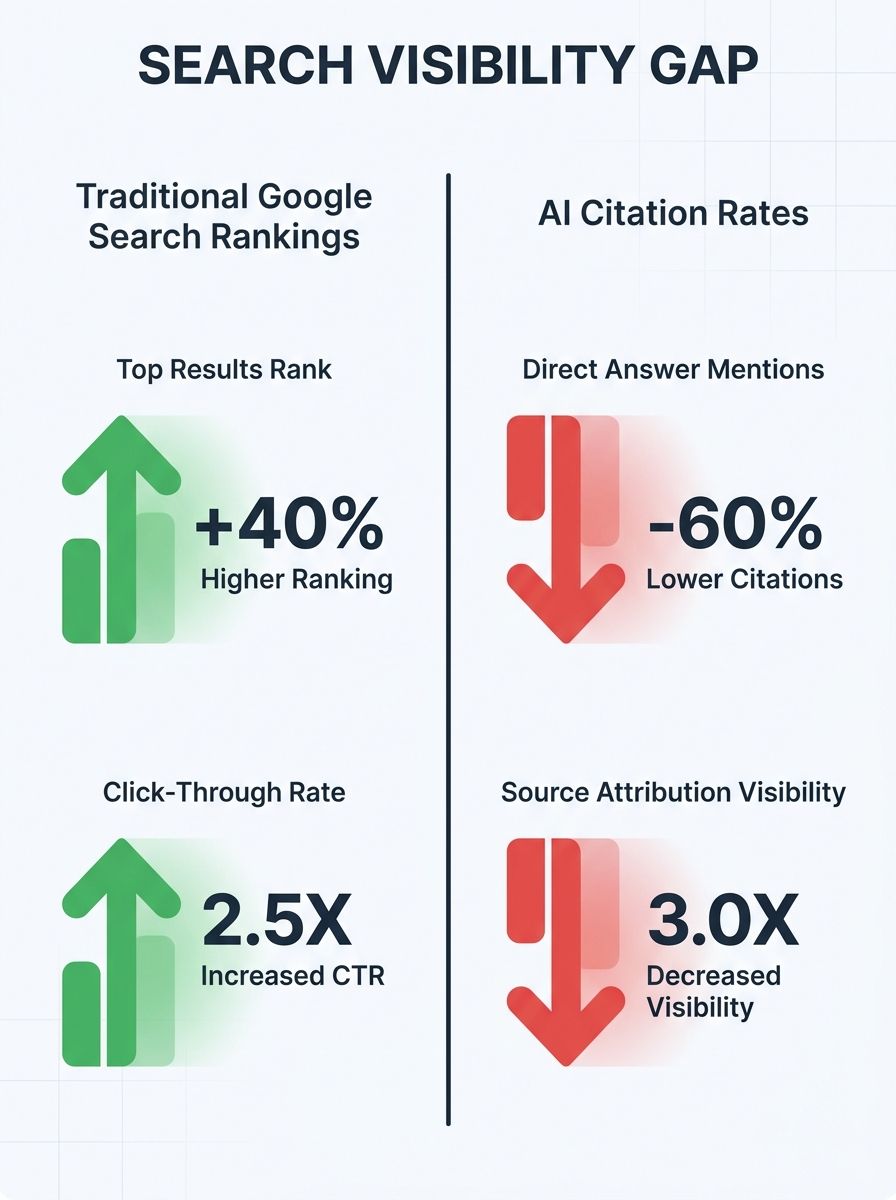
Two Visibility Reports, Two Different Realities
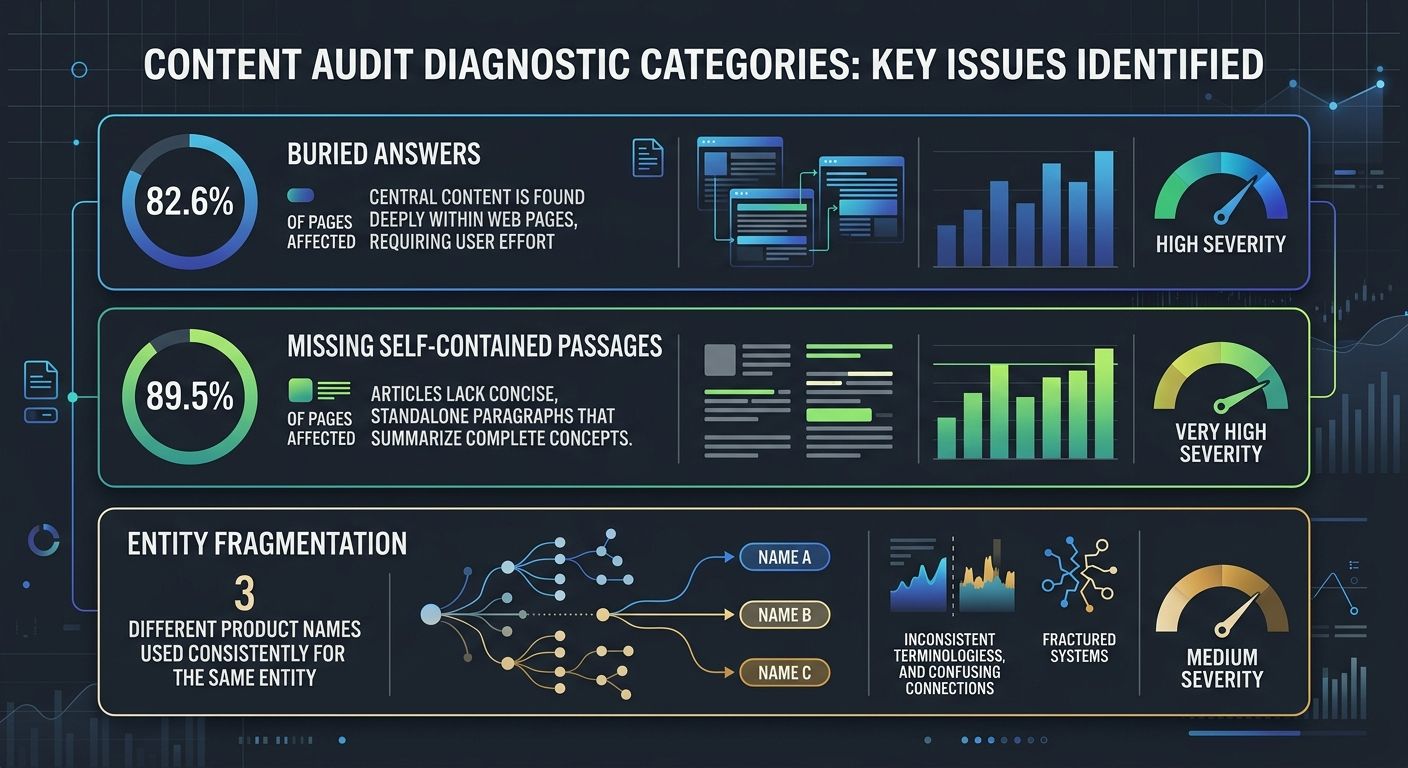
Why was a well-ranking site invisible to answer engines? The audit examined content structure, entity consistency, and passage extractability across 86 of the site's highest-traffic pages. Three patterns emerged.
Pattern one: buried answers. 71 of the 86 pages (82.6%) placed their core answer below the 300-word mark. Traditional SEO training teaches you to build context before delivering the conclusion. AI systems work differently. As Evergreen Media's ChatGPT optimization research documents, compact, citable content drives AI mentions. Clear answers, proprietary data, and strong readability increase the likelihood of citation. The site's pages were well-written, but they read like essays that saved the thesis for paragraph six.
Pattern two: no self-contained passages. ALM Corp's 2026 AEO playbook notes that a single AI-generated response can combine information from multiple pages, compare options, and summarize tradeoffs. For a page to be included in that synthesis, it needs passages that stand alone. The audit found that only 9 of 86 pages contained a self-contained answer block in the 134–167 word range that research identifies as the optimal extraction length. The remaining 77 pages wove their insights across multiple sections in ways that required human reading comprehension to extract meaning.
Pattern three: entity fragmentation. The site referred to its primary product by three different names across different pages. It described its target audience with inconsistent terminology. Entity consistency is one of the six strategic areas HubSpot identifies in answer engine optimization 2026 trends, and this site's entity graph was fractured enough that AI systems couldn't confidently attribute expertise.
The Structural Gap Between Ranked and Cited
The diagnosis pointed to something I've seen repeatedly across enterprise sites built during the 2018–2023 SEO era. These sites were optimized for a world where the goal was getting a user to click through to the page. Every piece of content strategy focused on earning the click: compelling title tags, rich snippets, strategic keyword placement in H1s and meta descriptions. The content itself was structured to retain the visitor once they arrived, with long-form narratives, internal link networks, and conversion funnels embedded throughout.
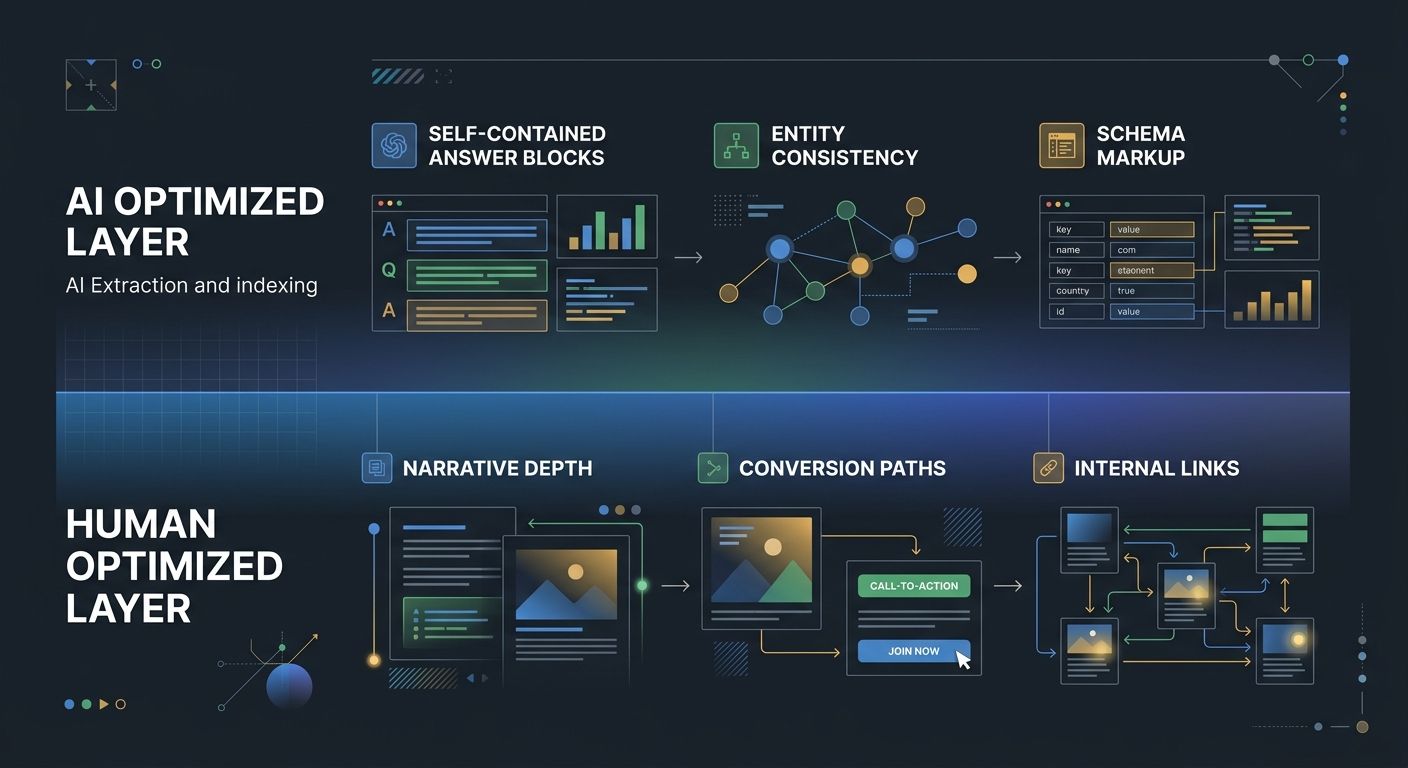
Answer engine optimization requires a fundamentally different content architecture. The page still needs to rank in traditional search, but it also needs to be extractable by AI systems that will never send a click. As the ALM Corp strategy guide puts it: "A page built only for SEO may rank but fail to be cited because the answer is buried. A page built only for AEO may be easy to summarize but too thin to build authority, earn links, or convert."
The Princeton/Georgia Tech GEO paper, which has been validated through 2026 testing, measured exactly how much specific content modifications boost LLM citation rates. Adding direct quotations from named experts delivered a 42.6% increase in citation probability. Adding specific statistics with sources produced a 32.8% lift. Citing sources explicitly yielded a 27.7% improvement. These aren't abstract principles. They're measured effects with documented magnitudes.
This is why I push teams to think about ChatGPT content optimization as an architectural decision, not a content polish. You can't sprinkle AI-friendliness onto an existing page with a few FAQ additions. The page's fundamental information architecture needs to serve two audiences simultaneously.
Rebuilding for Extractability
The rebuild followed a specific sequence across those 86 pages. I'm documenting it because the order matters as much as the individual changes, and teams that sequence this incorrectly often see their traditional rankings dip without gaining AI citations.
Phase one: answer-first restructuring. Every page got a direct-answer paragraph within the first 150 words. This paragraph needed to resolve the primary query without requiring any surrounding context. The team rewrote 86 introductions in 11 working days. Pages that had previously optimized for featured snippets using 2019-era formatting were the hardest to rework because their answer blocks were shaped for Google's old extraction patterns.
Phase two: passage isolation. Each major section received its own self-contained answer block of 134–167 words. These blocks could be lifted verbatim by an AI system and still make sense to a reader encountering them without context. The team identified this as the most time-consuming step: it required rethinking how each section's argument flowed, ensuring the opening sentences of every section worked independently.
Phase three: entity normalization. The product name was standardized to one term across all 86 pages. Audience descriptors were consolidated. The site's About page, author bios, and schema markup were aligned so that every entity reference pointed to the same knowledge graph node. Schema markup alone has been shown to boost citation likelihood by up to 300%, and the site had been running outdated Organization schema that omitted key properties.
Phase four: stat and source density. Following the GEO paper's findings, the team added at least one named statistic with a source citation per 100 words of body content, and one attributed expert quote per 600 words. They pulled from industry reports, customer data (with permission), and published benchmarks. This created the factual density that AI systems prioritize when selecting sources for answer generation.
Tools like SE Ranking's AI Results Tracker and Peec.ai allowed the team to monitor their brand's appearance across AI Overviews and generative AI outputs in near real-time, giving them feedback loops that traditional rank tracking alone couldn't provide.
AI Referral Traffic That Converted Differently
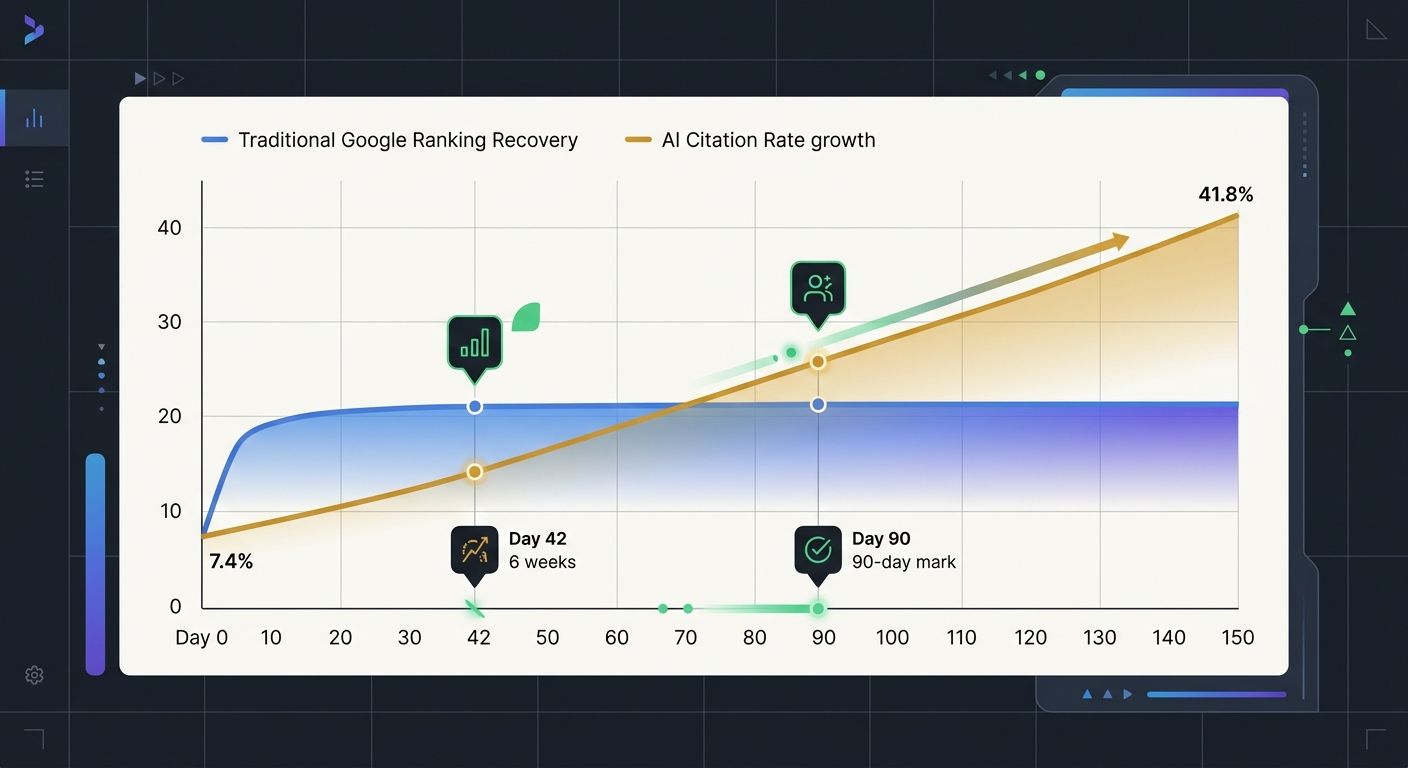
The results arrived in two waves. Traditional Google rankings stabilized within six weeks, with the site recovering 9 of its 11 lost top-three positions. The answer-first restructuring didn't hurt crawl-based rankings because the pages retained their depth, internal linking, and topical authority below the extraction layer.
The AI citation numbers moved more slowly. After 90 days, the site's citation rate across tracked queries rose from 7.4% to 34.2%. After 150 days, it reached 41.8%. The improvement wasn't linear; it arrived in clusters as different AI systems updated their source indices.
But the behavioral data told the most interesting story. AI-referred visitors showed a 23% lower bounce rate and browsed 12% more pages per session compared to traditional organic traffic. Pages cited by AI systems gained 35% more organic clicks and 91% more paid clicks than non-cited competitors occupying similar ranking positions. The AI citation functioned as a credibility signal that amplified performance across other channels.
The site's content team now runs a dual scoring system for every new page before publication. Each draft is evaluated against traditional SEO criteria (keyword targeting, internal link placement, technical architecture alignment) and against AI extractability criteria (answer-first structure, passage isolation, entity consistency, stat density). Pages that score below threshold on either dimension go back for revision.
This dual-engine approach reflects where search stands today. SEO builds visibility in traditional results. Answer engine optimization positions content as the source AI systems cite. And as the SEO benchmarking cadence framework suggests, the metrics you track need to capture both dimensions on separate but coordinated schedules. Ranking well in Google is no longer sufficient on its own. Content needs to be structured and authoritative enough to be referenced by AI systems that synthesize answers from across the web.
The site in this case study didn't abandon anything that made it successful in traditional search. It added a structural layer on top that made the same content legible to a second audience of AI systems reading for extraction rather than engagement. That architectural addition, executed in the right sequence, turned 86 pages from invisible to citable without sacrificing the organic traffic they'd spent years building.
Sarah Chen
SEO strategist and web analytics expert with over 10 years of experience helping businesses improve their organic search visibility. Sarah covers keyword tracking, site audits, and data-driven growth strategies.
Related Articles
From Organic to GEO: Building a Unified SEO Strategy Across Google, AI Engines, and Local Search in 2026
Citation rates for top-10 organic results inside Google's AI Overviews dropped from 76% in mid-2025 to between 17% and 54% in 2026.
AEO Integration Without Cannibalizing Traditional SEO: Building Your Unified Search Strategy for 2026
Google's AI Overviews killed click-through rates by 61% on queries where they appear, according to Dataslayer's 2026 analysis.
The AI Visibility Blind Spot: Why Your SEO Rankings Don't Matter If ChatGPT Doesn't Know You Exist
Ahrefs data shows Google AI Overviews reduce position-1 click-through rates by 58%, while a SimilarWeb study found that visitors arriving through ChatGPT recommendations view 12 pages per session and spend 11.8 minutes on site, compared to 6.5 pages and 5.6 minutes for other traffic sources.
Explore more topics