
Google March 2026 Core Update Shifted 79.5% of Top-Three Search Results, SE Ranking Data Shows
Nearly four in five URLs ranking in Google's top-three positions changed during the March 2026 Core Update, according to volatility data published by SE Ranking on June 7, 2026. The 79.5% shift rate marks the highest positional volatility Google has produced in years, exceeding the 66.8% movement re

Google March 2026 Core Update Shifted 79.5% of Top-Three Search Results, SE Ranking Data Shows
Nearly four in five URLs ranking in Google's top-three positions changed during the March 2026 Core Update, according to volatility data published by SE Ranking on June 7, 2026. The 79.5% shift rate marks the highest positional volatility Google has produced in years, exceeding the 66.8% movement recorded during December 2025's update by 12.7 percentage points.
The March update launched March 27, 2026, two days after Google completed a spam update in under 20 hours—the fastest spam enforcement action in the company's dashboard history, according to the report. Google described the March update as designed to "better surface relevant, satisfying content," but SEO specialists reported stronger enforcement of information-gain signals across affected sites.
Consecutive Updates Compress Recovery Windows
The May 2026 Core Update began rolling out May 21, just 43 days after the March update finished. Analysts cited in the report predict a June 2026 update may launch before May's two-week rollout period completes, compressing the window site operators typically use to assess impact and adjust strategies.
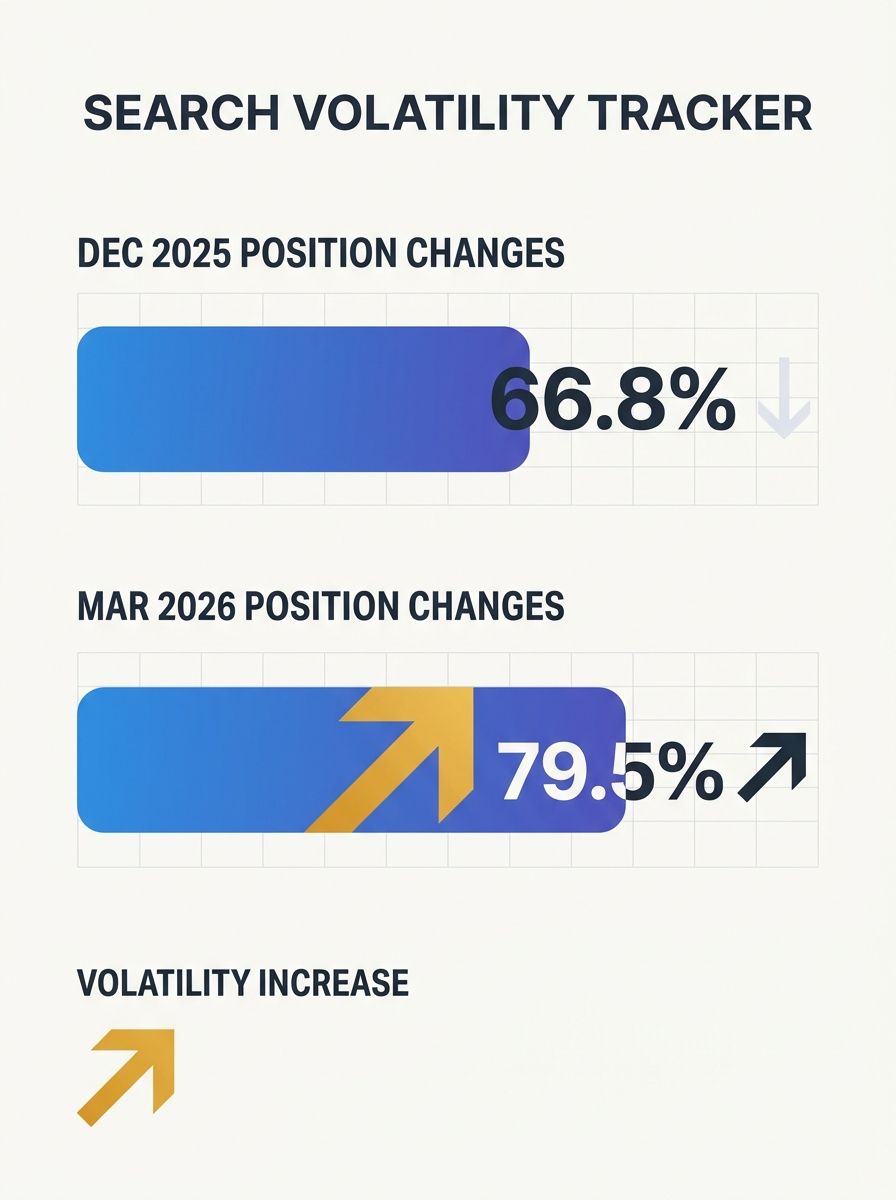
SE Ranking's dataset shows 90.7% of URLs in top-ten positions shifted during March 2026, compared to 83.1% during December 2025—a 7.6 percentage point increase. The report notes approximately 25% of pages ranking in the top ten dropped completely out of the top 100, compared to roughly 18% during previous updates.
Scaled Content and Thin Informational Articles Hit Hardest
Sites producing thin informational articles without original insight, AI-generated content without human review, and scaled operations publishing similar articles targeting keyword variations saw the steepest declines, the analysis found. Affiliate review sites lacking genuine product testing and anonymous content without clear authorship signals also appeared disproportionately affected.
Content rewarded during the March update included pages where Google could confidently identify the author, verify relevant expertise, and detect original research or fresh perspectives, according to patterns observed across tracking tools. The report notes that EEAT signals now apply across all content types, not solely health, finance, and legal topics as in previous iterations.
The February 2026 Discover Core Update preceded March's broader action, targeting personalized content surfaces. Google positioned the March spam update—which ran March 24-25—as cleanup ahead of core quality re-evaluation, the report states.
Speed of Spam Enforcement Signals AI-Powered Quality Systems
Completing a major spam update in under 20 hours represents a significant operational shift. Previous spam updates required days to roll out; the March action's speed indicates machine-scale automation now powers Google's content quality evaluation systems, the report suggests. Manual review at that velocity is not feasible.
Sites maintaining rankings or gaining visibility after March combined verified author expertise, GEO-ready structure, and content demonstrating genuine depth, according to post-update analysis cited in the data. The report advises waiting until rollout completion before implementing changes, noting that premature optimization often targets signals that haven't fully stabilized. Understanding how site architecture affects crawl budget becomes critical when algorithmic volatility increases indexing pressure.
Marketing Implications
SEO teams operating under publish-more-optimize-for-keywords models face mounting pressure to pivot toward expertise-led content strategies. The 79.5% top-three shift rate creates both risk and opportunity: sites relying on volume without depth will continue losing ground, while those investing in verified authorship and original research gain differentiation as Google's quality filters tighten.
The compressed update cadence—March to May in 43 days, with June potentially arriving before May completes—eliminates the traditional three-to-four-month assessment window. Marketing departments must build continuous monitoring into workflows rather than treating updates as discrete events. Implement real-time rank tracking, maintain baseline traffic segments by content type, and pre-assign recovery protocols before volatility hits.
Content strategists should audit existing inventory for information-gain deficits: articles lacking named data sources, original statistics, or clear expertise signals are now high-risk assets. The shift from keyword optimization to knowledge demonstration is no longer gradual—it's enforced at machine scale, under 20 hours for spam and two weeks for broader quality recalibration.

Sarah Chen
SEO strategist and web analytics expert with over 10 years of experience helping businesses improve their organic search visibility. Sarah covers keyword tracking, site audits, and data-driven growth strategies.
Related Articles

Google's August 2026 Algorithm Update Triggers Ranking Volatility Across 45% of Tracked Websites
Google's August 2026 algorithm update triggered ranking volatility across 45% of tracked websites beginning August 8, 2026, according to SEO Vendor's analysis published the same day, with sites demonstrating weak originality and thin evidence reporting steeper traffic declines than pages offering cl

Google Rolls Out June 2026 Spam Update Targeting Low-Quality Content and Manipulative SEO Tactics
Google launched its June 2026 Spam Update on June 24, 2026, deploying automated systems designed to reduce search rankings for websites that violate the company's spam policies, according to Advait Technology Labs. The global update affects all languages and regions and is expected to take several d

Google Assigns Two-Week Rollout to September 2026 Spam Update, Adds Image Search Filter to Search Console
Google began rolling out its September 2026 spam update on September 24 with a two-week completion window, the longest rollout timeframe the company has assigned to any spam update this year, according to Search Engine Journal. The update applies globally across all languages.
Explore more topics