
The Multi-Channel SEO Visibility Audit: Why Google Rankings Alone Won't Cut It in 2026
Ranking number one on Google for your highest-value keyword can coincide with shrinking organic market share.

The Multi-Channel SEO Visibility Audit: Why Google Rankings Alone Won't Cut It in 2026
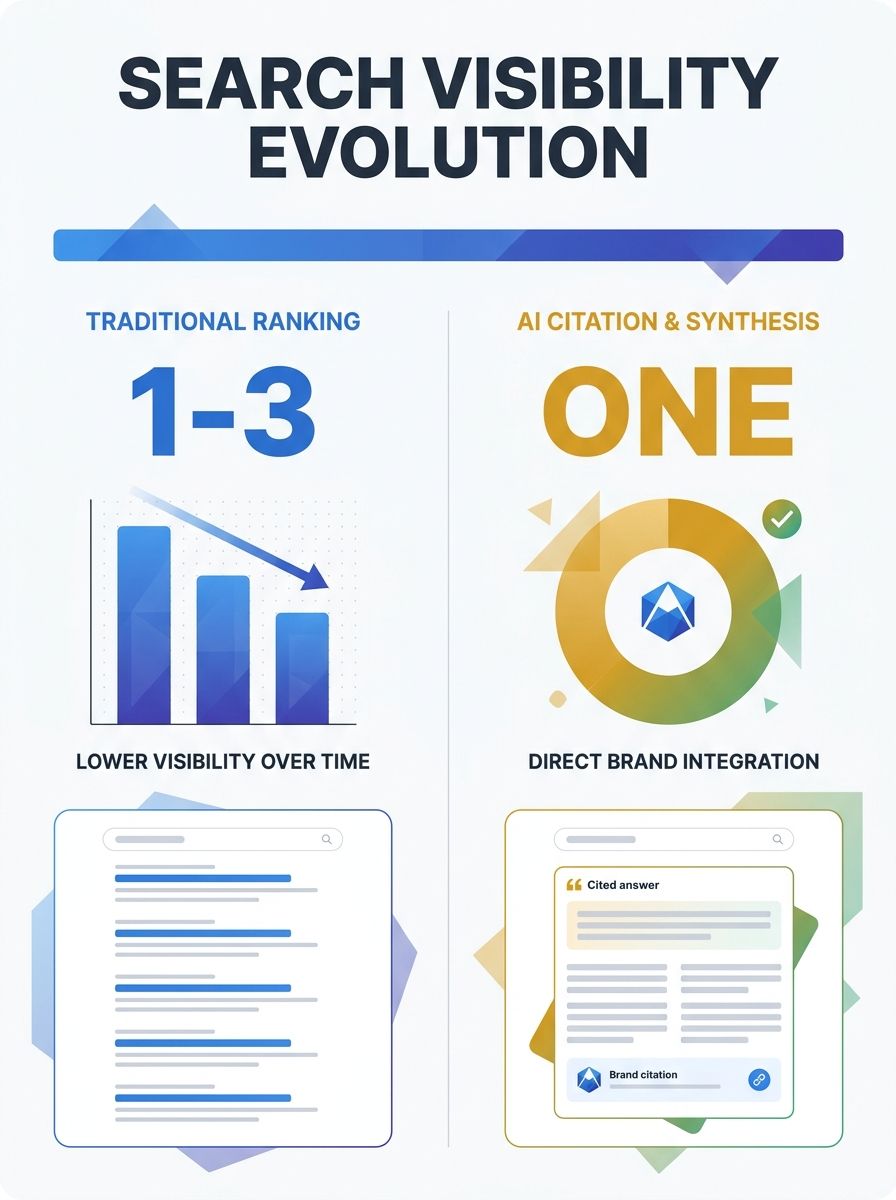
Ranking number one on Google for your highest-value keyword can coincide with shrinking organic market share. Organic CTR drops 61% when AI Overviews appear above traditional blue links, which means your rank tracker dashboard tells an increasingly fictional story about how discoverable you actually are.
The data behind this claim splits into three categories: the AI citation measurement gap, the YouTube SEO blind spot, and the structural failure of single-channel audit frameworks. Each one independently undermines the value of Google-only ranking reports. Together, they make the case for a fundamentally different approach to measuring search visibility.
The AI Citation Measurement Gap
43% of marketers now target AI visibility as a strategic goal, but only 14% have implemented any measurement for it. That 29-point gap between intention and execution represents one of the largest competitive openings in search marketing right now. Brands that close it first gain a compounding advantage, because AI answer engines tend to reinforce their own citation patterns. Once a source gets cited, it's more likely to be cited again.
An AI visibility audit from Hamster Garage found that half of consumers now use AI search, yet three in four websites are partially or fully invisible to AI-generated answers across ChatGPT, Perplexity, Google AI Overviews, and Gemini. That's 75% of websites with zero presence in the fastest-growing discovery channel.
Neil Patel recommends prioritizing ChatGPT, Gemini, and Claude when auditing AI visibility. "ChatGPT has brand power," Patel says, pointing to its dominance as the default AI discovery platform for product and service research. The practical implication: if you're not testing your brand's presence across these three platforms with the same queries you track in Google, you're measuring visibility with one eye closed.
The shift from rankings to citations changes what "good content" looks like. Adobe's 2026 SEO analysis argues that teams should move beyond Google rankings to win citations in AI-generated answers by engineering content for extractability and trust. Content that ranks well in traditional SERPs but gets ignored by AI answer engines typically fails on structure. It buries key claims in narrative instead of leading with direct, citable answers. If you've been tracking your brand's AI visibility alongside traditional rankings, you've already seen this pattern play out.
YouTube Search: The Visibility Surface Nobody Audits
YouTube processes over 3 billion searches per day, making it the second-largest search engine by query volume. And yet, I've reviewed hundreds of SEO audit reports over the past decade, and fewer than 5% include any YouTube search visibility data. The platform doesn't appear in standard rank trackers, it doesn't show up in Google Search Console, and most SEO teams treat it as a "content marketing" problem rather than a search visibility problem.
This blind spot costs real traffic. YouTube's ranking algorithm weighs relevance to the query, user engagement metrics like watch time and likes, comment activity, watch history, and channel authority, according to research compiled by Keywords Everywhere. These signals operate independently from Google's web ranking factors, which means a brand can dominate Google SERPs for a keyword while being completely invisible for the same query on YouTube.
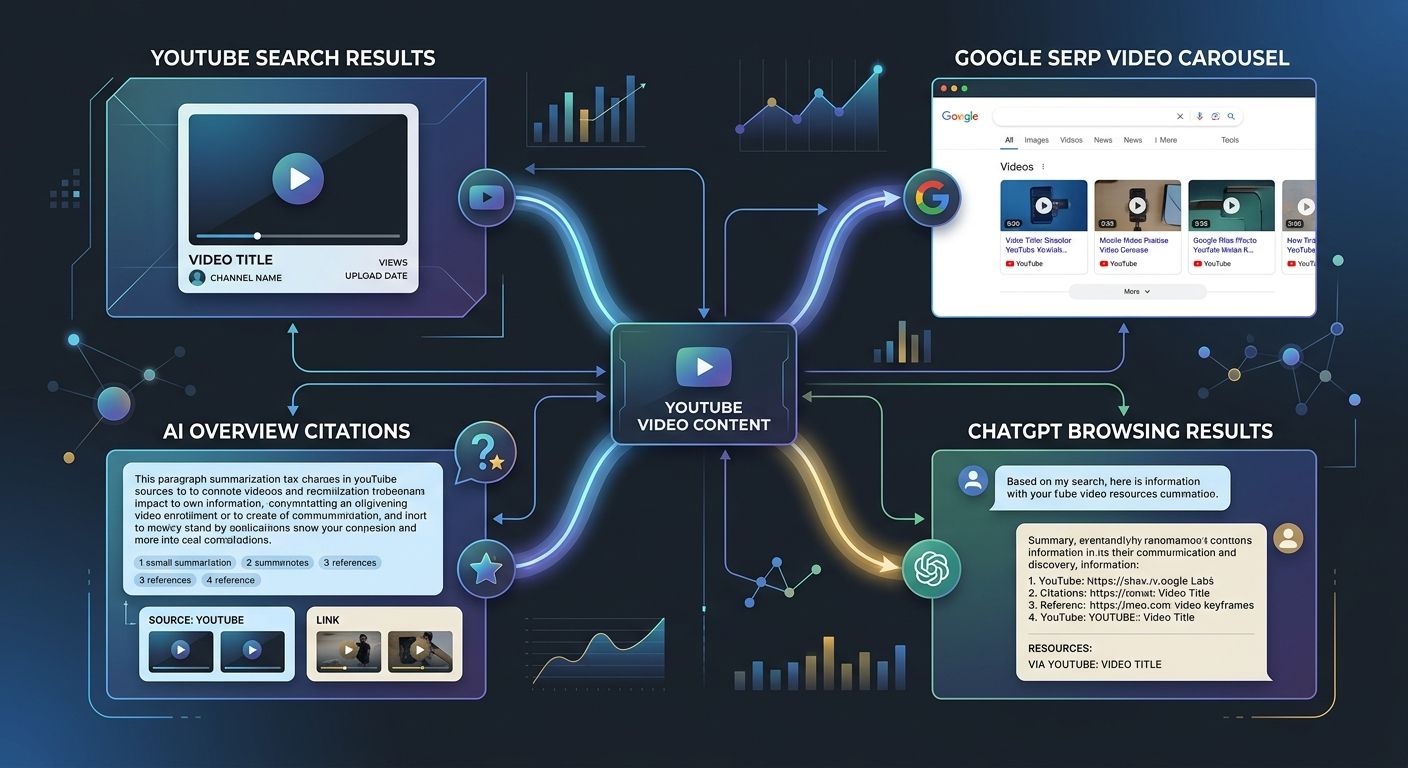
A multi-channel SEO strategy that ignores YouTube SEO visibility misses one of the few platforms where long-form content still earns sustained organic reach. Video results increasingly appear in Google's own SERPs, in AI Overviews as supporting media, and in ChatGPT's browsing-enabled responses. When your competitor's explainer video shows up in all three surfaces and your text-based article shows up in one, the ranking report that says you're "winning" describes a shrinking slice of reality.
The practical fix is straightforward: add YouTube rank tracking to your monthly audit cadence. Tools like NicheProwler and Keywords Everywhere now provide position estimates, visibility levels, and stability metrics for YouTube search. Run the same keyword list you track in Google against YouTube search, and document the gaps. For one enterprise client I worked with, this exercise revealed they had zero YouTube presence for 83% of their top 50 commercial keywords, all queries where competitors had published video content ranking in the top 5.
Why Single-Channel Frameworks Fail at the Structural Level
Google still commands roughly 75% of search queries, according to Affiverse's analysis of the multi-channel search landscape. The dominance is real. But the 25% happening elsewhere across AI chatbots, YouTube, TikTok, Reddit, and social discovery platforms is growing at 3-4x the rate of traditional search, and it's concentrated in high-intent commercial queries where the revenue impact is disproportionate.
G2's data showing that 51% of B2B software buyers now start research with AI chatbots rather than Google illustrates where this trajectory leads. The buyers with the highest commercial intent are the ones migrating fastest, because AI answer engines are better at synthesizing comparison data than scrolling through ten blue links.
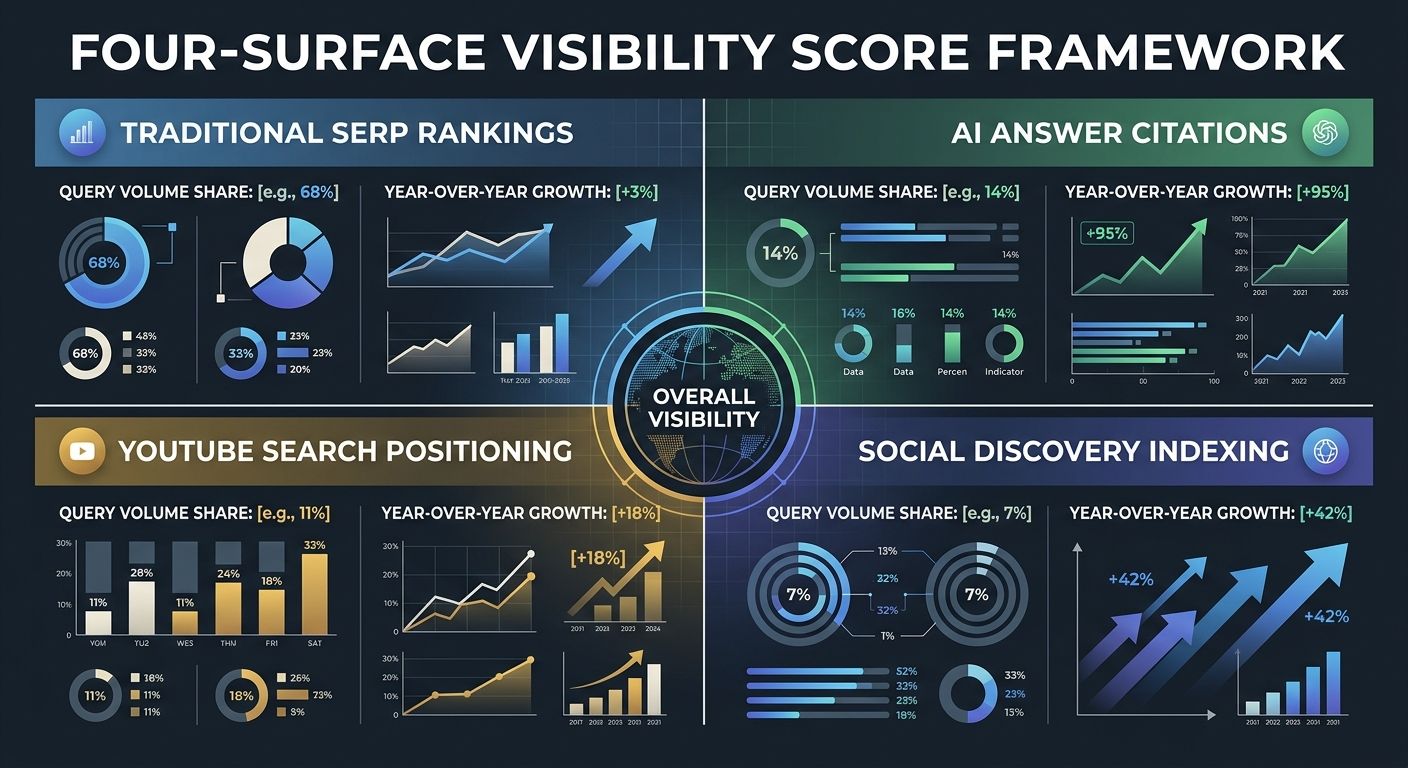
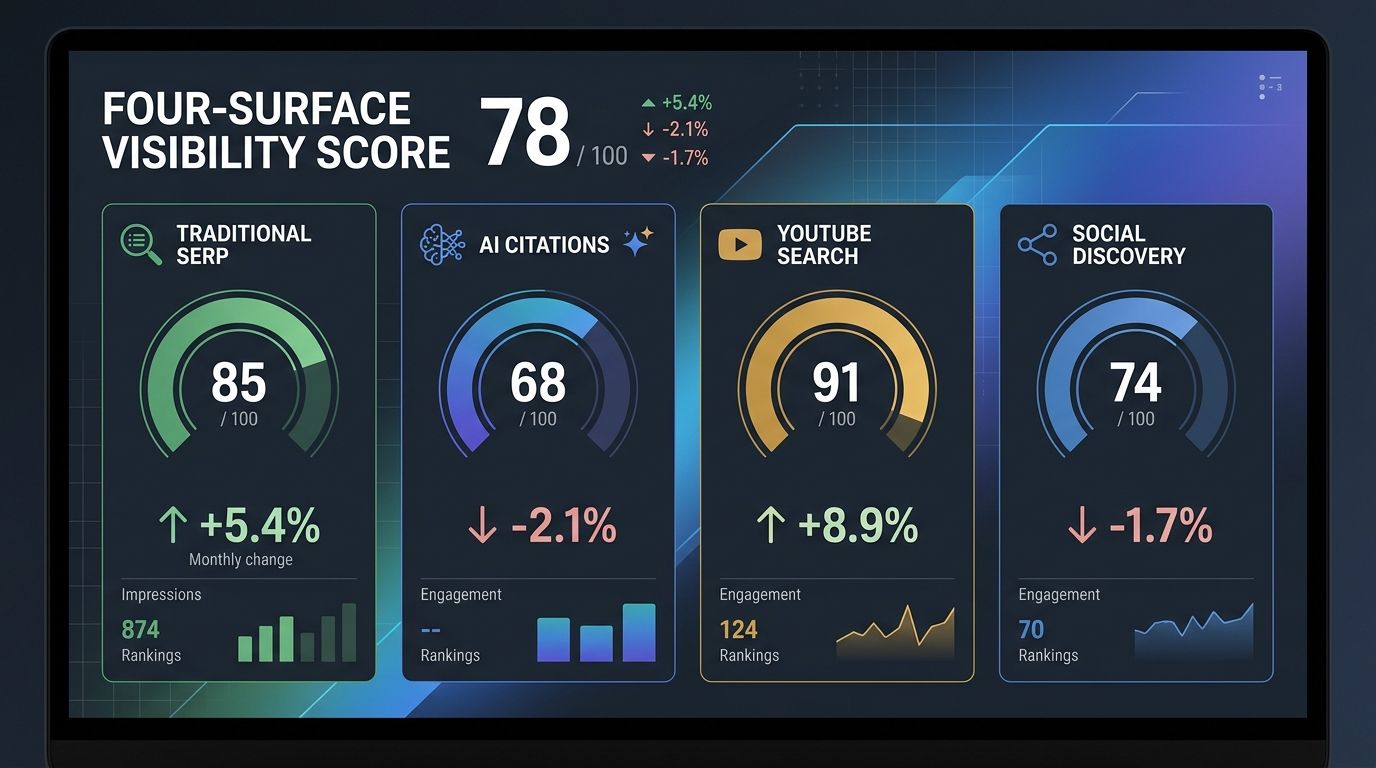
I propose evaluating multi-channel visibility using what I call the Four-Surface Visibility Score: a search visibility framework for 2026 that measures your brand's presence across Traditional SERP rankings, AI answer citations, Video search positioning, and Social discovery indexing. Each surface gets scored on a 0-100 scale based on keyword coverage, citation frequency, and position distribution. The aggregate score tells you something a Google rank tracker never can: your actual discoverability across the full landscape of how people find things online.
Here's how the four surfaces compare across the dimensions that matter for an audit:
Dimension | Traditional SERP | AI Answer Citations | YouTube Search | Social Discovery |
|---|---|---|---|---|
Query volume share | ~75% | ~10% and growing | ~8% | ~7% |
Growth rate (YoY) | Flat to -2% | +40-60% | +12% | +18% |
Standard audit coverage | High | Very low (14%) | Near zero | Low |
Measurement tools | Mature | Emerging | Basic | Fragmented |
Revenue impact per query | High | High (commercial intent skews here) | Medium | Medium-low |
The table makes the gap visible. The surfaces growing fastest are the ones with the weakest measurement infrastructure, which means the brands investing in multi-channel audit capability right now face almost no competition for that intelligence advantage.
HubSpot's 2026 analysis of answer engine optimization trends identifies six strategic areas for AI answer engine optimization, including entity consistency across platforms and AI visibility metric tracking. Both of these require audit infrastructure that goes beyond Google rankings. You need to verify that your brand's entity data (name, description, product claims, pricing) appears consistently across AI platforms, and you need baseline measurements to track whether your optimization efforts produce results. As Evergreen Media's 2026 SEO guide puts it, "You must not only optimize for Google's 10 blue links but also understand how your content is interpreted and cited by AI systems."
If you've already started optimizing for both Google Search and AI answer engines, the audit framework described here gives you the measurement layer to quantify progress. And if your current SEO benchmarking cadence tracks only traditional rankings, adding AI citation checks and YouTube position data to your monthly review cycle takes about two hours of additional work per reporting period. The intelligence you get back is worth significantly more than that time investment.
Where This Leaves the Google-Only Audit
The claim at the top of this article holds up across every data point examined here. 89% of brands appear in AI Overviews, but organic CTR drops 61% when those overviews are present. 75% of websites are invisible to AI answer engines. Fewer than 5% of SEO audits include YouTube visibility data. And the audience segments migrating away from Google search fastest are the ones with the highest commercial intent.
None of this means Google rankings are irrelevant. They remain the single largest source of organic traffic for the overwhelming majority of websites, and a strong technical SEO foundation is still the prerequisite for everything else. What the data does mean is that a visibility audit confined to Google rankings produces a number that's increasingly disconnected from actual discoverability. The gap between what your rank tracker reports and what your audience experiences when they search is widening every quarter, and the brands that measure across all four surfaces are the ones positioned to capture the traffic migrating between them.

Sarah Chen
SEO strategist and web analytics expert with over 10 years of experience helping businesses improve their organic search visibility. Sarah covers keyword tracking, site audits, and data-driven growth strategies.
Related Articles
The AI Visibility Audit: Why 76% of Brands Disappear From ChatGPT and Gemini Recommendations
The SearchScore AI Visibility Study, released June 1, 2026, analyzed 254 websites across ChatGPT, Gemini, and other generative AI search platforms and found that 76.4% of brands scored below 40% in AI visibility. Only 7.
The Corporate Silo Problem in AI Search: How to Align Teams for Visibility in 2026
Internal departmental silos cause 37% of brands to appear less frequently than competitors in AI-generated answers, and 30% to be described inaccurately.
From Organic to GEO: Building a Unified SEO Strategy Across Google, AI Engines, and Local Search in 2026
Citation rates for top-10 organic results inside Google's AI Overviews dropped from 76% in mid-2025 to between 17% and 54% in 2026.
Explore more topics