
MarTech Publishes Four-Part Diagnostic Framework Separating Traffic Decline Root Causes
MarTech published a four-part diagnostic framework on July 20 that separates organic traffic decline into distinct root causes requiring different remediation strategies, according to content strategist Ashish Jacob's analysis, adding zero-click SERP features as a fourth category alongside the tradi
MarTech Publishes Four-Part Diagnostic Framework Separating Traffic Decline Root Causes
MarTech published a four-part diagnostic framework on July 20 that separates organic traffic decline into distinct root causes requiring different remediation strategies, according to content strategist Ashish Jacob's analysis, adding zero-click SERP features as a fourth category alongside the traditional three-factor model SEO practitioners have used for years.
The framework addresses a widespread diagnostic gap: teams reflexively update content when traffic drops without identifying whether the page lost rankings, lost clicks to AI Overviews, no longer matches searcher intent, or targets a shrinking query volume. Each scenario requires a different fix, Jacob wrote, yet most organizations apply the same refresh-and-republish workflow regardless of root cause.
The analysis arrived as AI-generated search summaries reshaped click distribution patterns. Fewer than one in three Google searches now send a click to the open web in 2026, according to the framework, with roughly 68 percent of searches ending without a click—up from approximately 60 percent two years earlier. On queries where an AI Overview appears, the top organic result loses around 58 percent of its clicks, Jacob reported.
Four Traffic Decline Patterns Replace Three-Factor Model
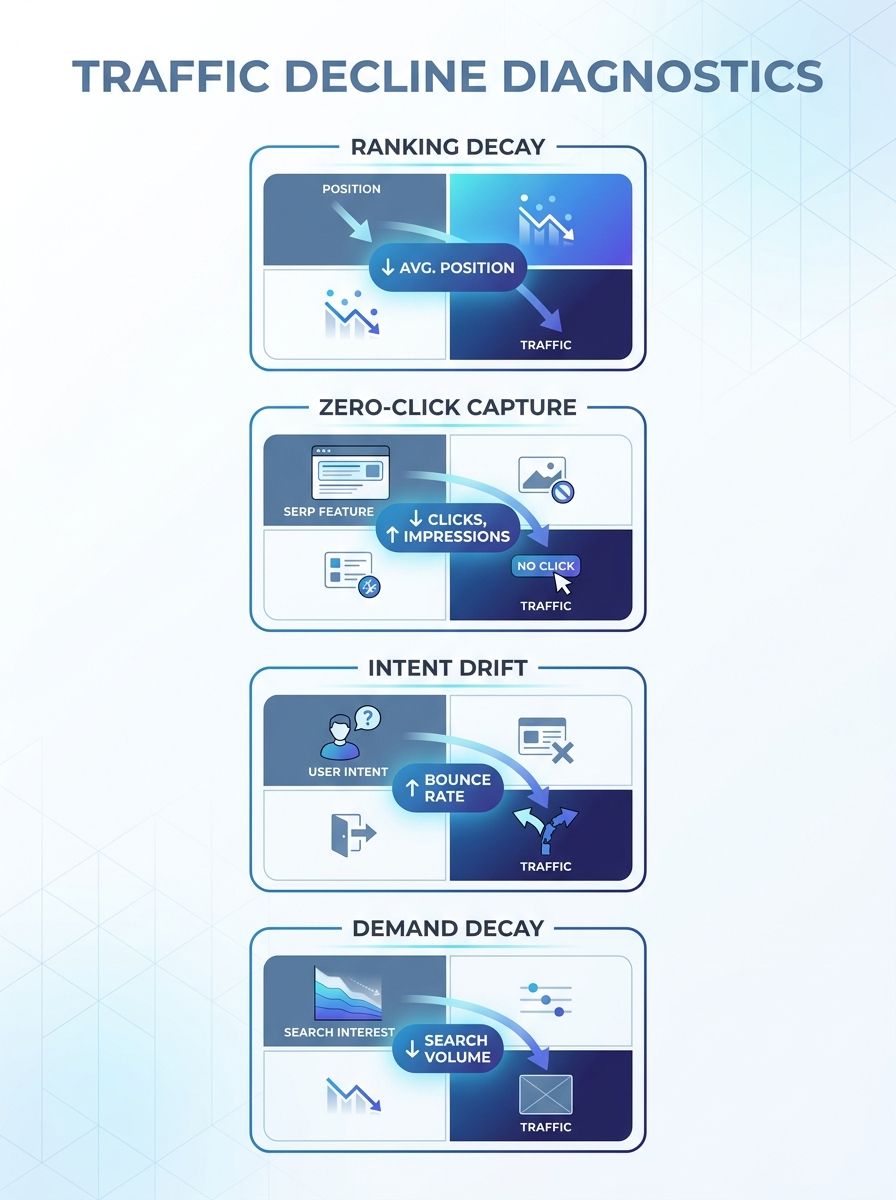
The traditional content decay model attributed traffic loss to three causes: competitor displacement, intent shift, or declining demand. The MarTech framework adds zero-click capture as a fourth pattern, each leaving distinct signals in Search Console data.
Ranking decay shows clicks down, impressions down, and average position worsening—the signature of competitor displacement, stale content, lost backlinks, or keyword cannibalization between a site's own pages. This remains the only scenario where routine content refreshing reliably restores traffic, according to the framework.
Zero-click capture presents clicks down while impressions hold flat or increase and position remains stable or improves. "You're still ranking, often higher than before, and still losing clicks," Jacob wrote. The pattern indicates AI Overviews, featured snippets, or other SERP features answering queries directly on results pages. Content updates fail to recover clicks because the page never lost rankings—it lost the click to an answer box.
Intent drift displays clicks down and position roughly holding, but the SERP composition changed. Google reinterpreted the query and now surfaces different content formats—video, comparison tables, product pages—that the declining page no longer matches. The framework flags this as requiring manual SERP review because metrics alone miss the format mismatch.
Demand decay—"the imposter," per the framework—shows clicks down, impressions down, but position held or improved. The page retained or gained ranking strength while the topic attracted fewer searches. "This is the one that fools teams into refreshing a page that was never coming back," Jacob wrote.
Diagnostic Protocol Uses Existing Search Console Data
The framework instructs practitioners to compare three Search Console metrics across a trailing period: total clicks, total impressions, and average position. The metric combination identifies which of the four patterns applies.
Teams checking only clicks miss the distinction between lost rankings and lost click-through from stable or improved rankings. Impressions data separates shrinking demand from zero-click capture, while position trends separate ranking losses from intent mismatches, according to the diagnostic protocol.
The analysis emphasized that AI Overviews appear disproportionately on informational queries—the query type most blog content targets—making zero-click capture the fastest-growing decay type for content marketing teams. The framework noted that refreshing content to combat zero-click losses wastes resources because the ranking never declined.
Reading Between the Lines
The framework's timing reflects an industrywide reckoning: traditional ranking-focused SEO models no longer explain traffic behavior when most searches never leave Google's results page. By isolating zero-click capture as a distinct pattern, the diagnostic separates problems teams can solve through better content from problems requiring structural changes to SERP feature optimization or query targeting strategy shifts.
The four-part structure also exposes how much diagnostic guesswork currently drives content operations. Without explicit rules for interpreting metric combinations, teams default to refresh workflows that treat symptoms rather than causes. Jacob's framework offers a repeatable triage protocol using data already available in Search Console, lowering the skill barrier for accurate root-cause identification.
The framework stops short of prescribing remediation tactics for each decay type, focusing instead on correct diagnosis. That leaves implementation questions—how to optimize for answer boxes, how to pivot content formats when intent drifts, when to retire demand-decayed pages—as follow-on challenges. The diagnostic itself, however, closes the gap between "traffic dropped" and "here's what broke," which most content teams currently cross through educated guessing.

Alex Chen
Alex Chen is a digital marketing strategist with over 8 years of experience helping enterprise brands and agencies scale their online presence through data-driven campaigns. He has led marketing teams at two successful SaaS startups and specializes in conversion optimization and multi-channel attribution modeling. Alex combines technical expertise with strategic thinking to deliver actionable insights for marketing professionals looking to improve their ROI.
Related Articles
Content Frameworks Built for 2019 Featured Snippets Now Reduce AI Overview Click-Through
Content frameworks optimized for featured-snippet extraction in 2019 now undermine click-through from AI Overviews appearing in 2.5 billion users' search results, according to a June 20 analysis published on Search Engine Journal examining how "answer the query in 40 words at the top" strategies lea

The SEO Mistake Triage System: Diagnosing Root Causes Instead of Treating Symptoms
Automated SEO audit tools flag hundreds of issues per crawl but assign equal visual severity to missing alt text and accidental noindex tags on revenue pages.

Marketing Teams Report Organic Traffic as Primary KPI Despite 48% AI Overview Coverage and 68% Zero-Click Search Rate
Marketing teams continue to structure quarterly search performance reports around organic traffic and click-through metrics even as Google's AI Overviews now generate answers for 48 percent of all queries without requiring users to click any result, according to June 2026 research published by Spark
Explore more topics