
OpenAI's Ad Network and the New Search Landscape: What Your SEO Budget Should Do Right Now
---
OpenAI's Ad Network and the New Search Landscape: What Your SEO Budget Should Do Right Now
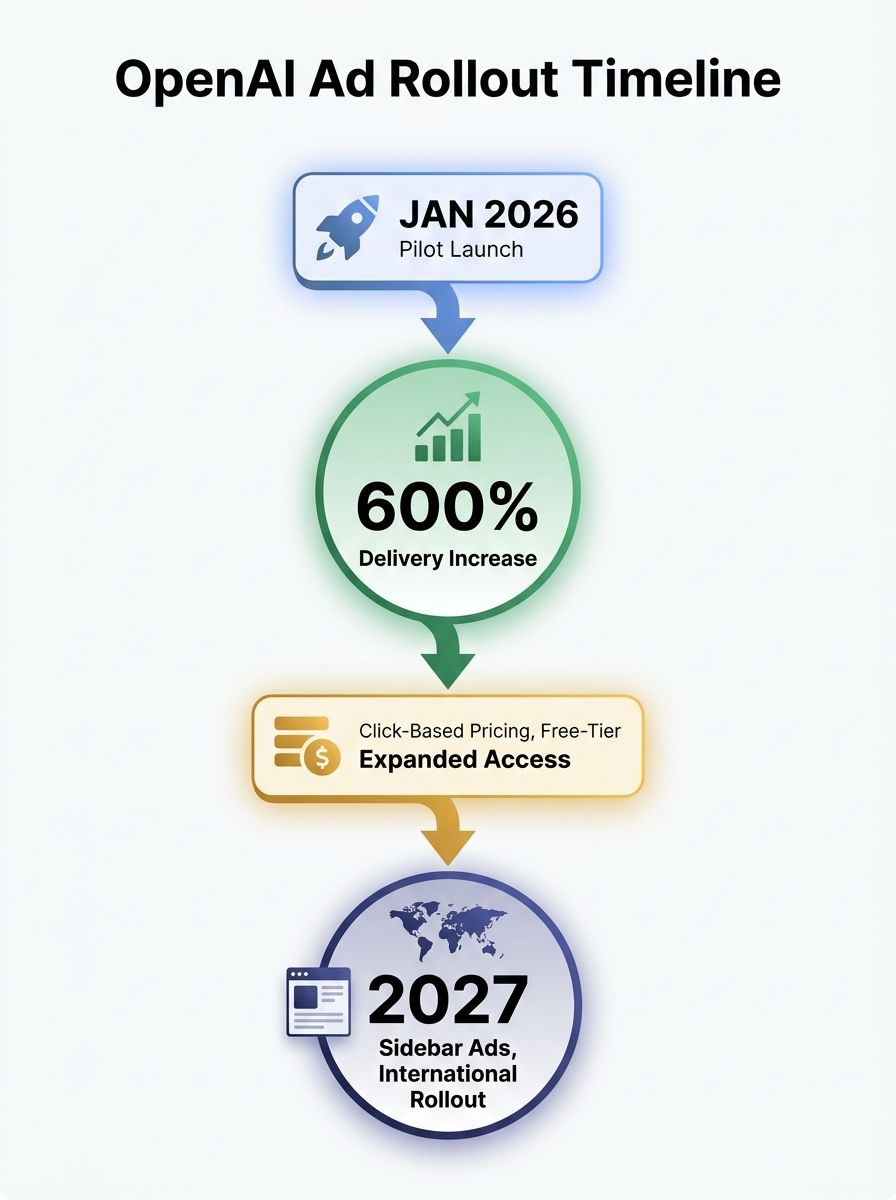
A 600% increase in ad delivery over three weeks. That's the number that caught my eye when CNBC reported on ChatGPT's ad pilot expansion in March. By mid-March, roughly 5% of ChatGPT mobile users were seeing sponsored results, up from just 1% at the start of the month. And this week, OpenAI is reportedly shifting toward click-based pricing for some ChatGPT ads, moving from pure impression models to something that looks a lot more like the performance marketing infrastructure we've built careers on.
I've spent the past two weeks talking to clients about what this means for their budgets. Most are confused. Some are panicking. A few are already moving money. Here's what I'm telling all of them.
What's Actually Happening With OpenAI's Ad Platform Right Now
OpenAI's advertising rollout has been cautious and deliberate. The company officially stated that ChatGPT responses should be "driven by what's objectively useful, never by advertising," and that user data won't be sold to advertisers. That's a meaningful distinction from how Google has operated.
But the commercial machinery is spinning up fast. Here's what's confirmed as of this week:
The minimum spending threshold for pilot advertisers dropped to $50,000, down from the initial $200,000–$250,000 range
The ads manager platform is being updated daily with A/B testing infrastructure and feature flags
Bulk upload support and improved onboarding screens were added for new advertisers
OpenAI hired Shivakumar Venkataraman, a former Google search ad executive, signaling serious intent around ad-tech infrastructure
Sponsored content appears in a dedicated section beneath AI-generated responses, clearly labeled
The timeline for expanded rollout looks aggressive. Q2-Q3 brings expanded ads to ChatGPT Search for free-tier users in English-speaking markets. Q4 introduces sidebar sponsored content and affiliate commission features. Full international expansion is slated for 2027.
And there are restrictions worth knowing about. Advertisers can't show ads related to dating, health, financial services, or politics. Users under 18 won't see ads at all. Conversations touching sensitive topics remain ad-free. These guardrails shape which industries can participate early and which need to wait.
The Slow Rollout Is the Strategy
Some agency insiders are frustrated. According to reporting from CNBC, pilot budgets were locked in for the quarter and couldn't be deployed elsewhere, even as volume remained limited. Advertisers also aren't getting the depth of insights they expected.
But I think the slow rollout is the right call. OpenAI is protecting the one thing that makes ChatGPT valuable as an ad platform: user trust. If early ads feel intrusive or degrade answer quality, the whole model collapses. Google learned this lesson over 20 years. OpenAI is trying to learn it in months.
Meanwhile, competitors are making their positions clear. Anthropic ran Super Bowl ads positioning Claude as explicitly ad-free. Perplexity tested ads and then pulled back. The AI search landscape is fragmenting into ad-supported and ad-free camps, and that fragmentation is exactly why your search budget reallocation strategy matters more than it did in Q3 2025.
Why Your Current Budget Split Is Probably Wrong
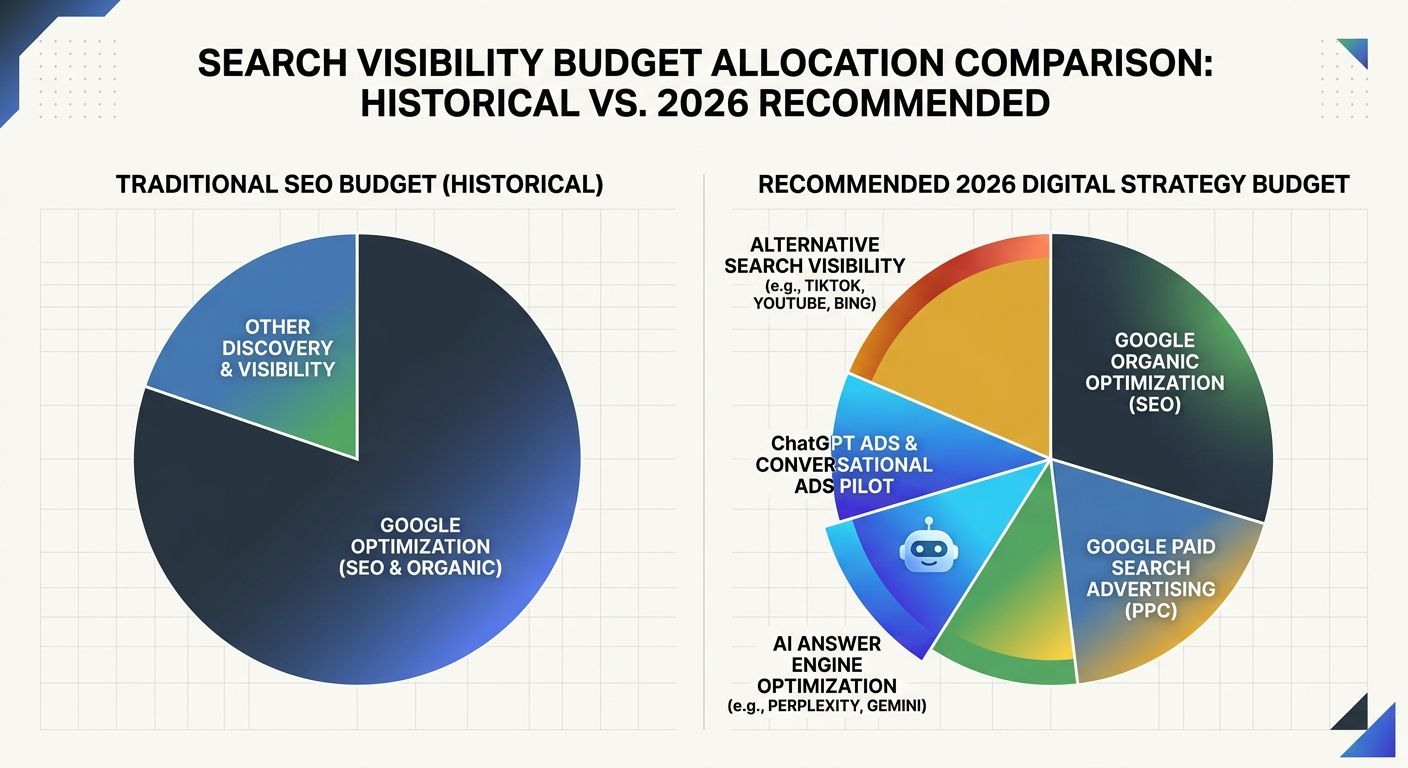
Here's the pattern I keep seeing in client audgets: 70-85% of search spend allocated to Google (both organic SEO and paid), 10-15% to social, and whatever's left scattered across "other." That allocation made sense when Google owned 90%+ of search. It doesn't hold up when users are getting answers from ChatGPT, Perplexity, Claude, Copilot, and a growing list of alternative search engines including DuckDuckGo and Brave.
I worked with an e-commerce client earlier this year who was tracking referral traffic from AI answer engines for the first time. They discovered 11% of their product research traffic was coming from ChatGPT and Perplexity combined. Their SEO budget? Zero dollars allocated to AI answer engines SEO. Zero toward structured data optimization for conversational AI. Zero toward the content formats that actually get cited in AI responses.
That disconnect is happening everywhere. And it's about to get more expensive to fix, because once OpenAI's advertising platform matures and click-based pricing rolls out broadly, early movers will have months of performance data and optimization insights that latecomers won't.
The Budget Framework I'm Recommending to Clients
I'm not going to give you a single budget split because your numbers depend on your industry, audience, and current performance data. But I will give you the framework I'm using.
Step 1: Measure Your Current AI Search Exposure
Before you move a dollar, you need to understand where your brand currently appears in AI-generated answers. If you're not already tracking visibility across ChatGPT, Perplexity, and Copilot, start there. Traditional SEO metrics don't tell the whole story in a zero-click world, as HubSpot's AEO research points out: AEO success must be measured through visibility, influence, and revenue impact, not just rankings and clicks.
Tools matter here. If you're still relying on manual tracking, you're going to struggle with this level of complexity. The right SEO planning and audit system becomes essential when you're monitoring performance across five or six search surfaces simultaneously.
Step 2: Carve Out an AI Search Budget Line
I'm recommending clients allocate 10-15% of their total search budget specifically toward alternative search visibility. This isn't net-new spending for most. It's a reallocation from underperforming Google campaigns or from content production that isn't generating results.
That 10-15% covers three things:
Answer engine optimization work (structured data, schema specificity, semantic HTML, content formatting for AI crawlers)
AI search ads 2026 pilot spending, starting with OpenAI's platform if you're in an eligible category
Monitoring and measurement tools that track citations and visibility in AI-generated responses
Step 3: Fix Your Technical Foundation Before Chasing AI Ads
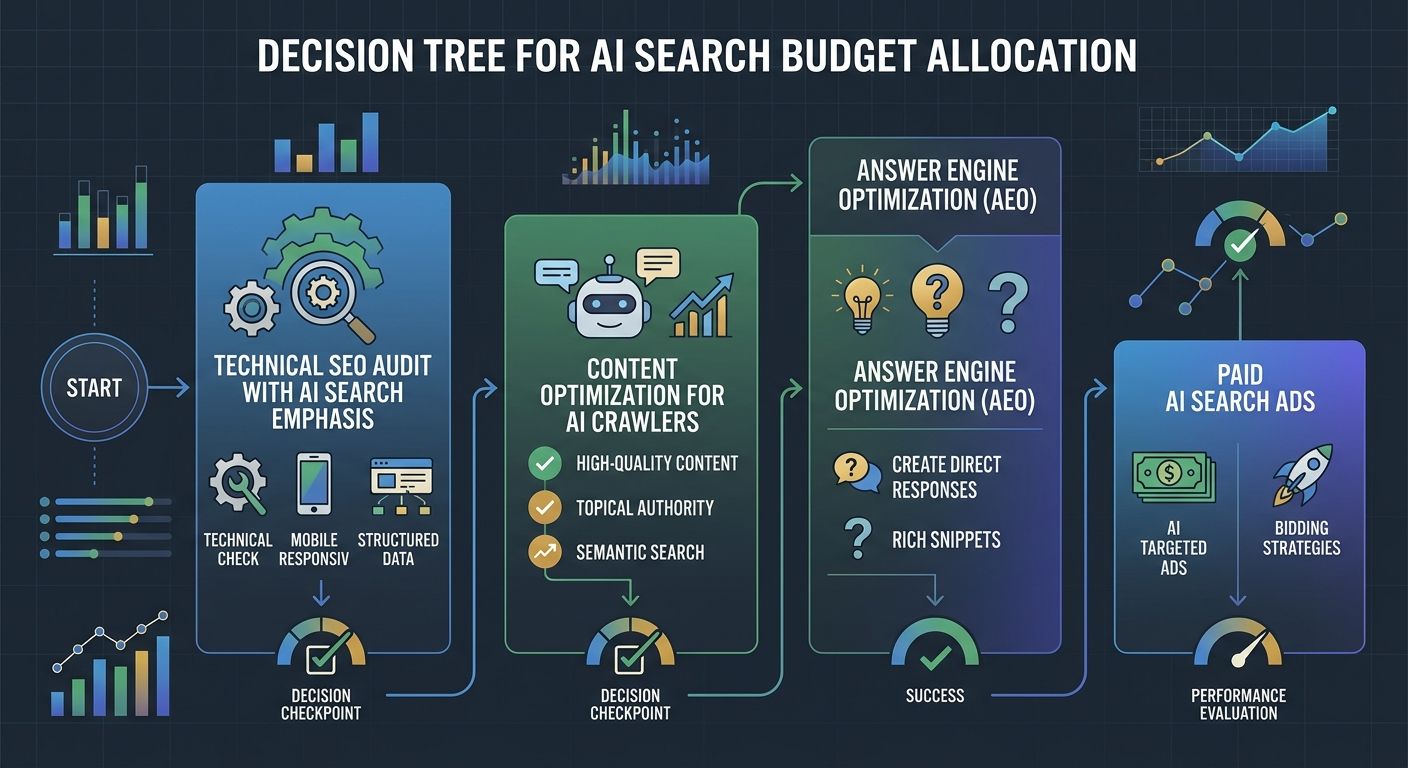
This is where I see teams making mistakes. They want to throw money at the OpenAI advertising platform before their content is even structured to appear in organic AI results. That's backwards.
The technical work comes first. Specific schema markup (not generic "thing" types), proper header hierarchy, FAQ structures, product feeds, and fast page loads. If your technical SEO is passing audits but rankings are still dropping, you likely have structural issues that will hurt your AI visibility too.
Content format diversity also matters. Non-AI-created videos, especially on YouTube, TikTok, and Reels, achieve visibility that text content alone can't reach. AI summary engines increasingly pull from multimedia sources.
Step 4: Build for Zero-Click Visibility
A significant percentage of AI search interactions never result in a click to your site. The user gets their answer and moves on. That doesn't mean the interaction was worthless. It means you need to measure and optimize differently.
Brand mentions in AI responses, citation frequency, and the accuracy of information attributed to your brand all matter. This connects directly to the principles I've written about around winning traffic in zero-click environments. The strategies translate directly to AI answer engines.
Gartner's prediction that brands' PR and earned media budgets will double by 2027 makes sense in this context. Visibility in AI-generated answers depends heavily on brand authority and third-party mentions. Your SEO team and your PR team need to be coordinating far more tightly than they probably are right now.
Step 5: Test Paid AI Search Early, But With Clear Guardrails
If your category allows it (remember, no dating, health, financial services, or politics ads on ChatGPT for now), I'd recommend allocating $50,000-$75,000 for a Q2-Q3 pilot. That's the new minimum threshold, and it gives you enough data to evaluate the channel before the holiday rush.
Set clear success metrics before you start. CPM-based pricing is current, but click-based pricing is coming. Build your measurement framework to handle both models so you can adapt quickly. Make sure your analytics data actually reflects reality before you start attributing conversions to a new channel.
How OpenAI's Ad Model Reshapes Your Quarterly Planning
The emergence of the OpenAI advertising platform isn't just another ad channel to manage. It represents a structural shift in how people find information and make purchasing decisions. AI answer engines are eating into traditional search traffic, and the introduction of paid placement within those engines creates both a threat and an opportunity.
Here's what I'd do this week:
Audit your AI search visibility. Run your top 20 commercial keywords through ChatGPT, Perplexity, and Copilot. Document where your brand appears and where competitors show up instead.
Review your schema markup. Generic types won't cut it. Switch to specific types like "product," "FAQ," "HowTo," and "LocalBusiness." This is as much about AI answer engine visibility as it is about Google.
Talk to your CFO about budget reallocation. The conversation isn't "we need more money." It's "we need to move 10-15% of existing search spend toward channels that are growing while traditional search flattens." If you need help structuring that conversation, understanding the organic vs. paid decision framework can provide the right vocabulary.
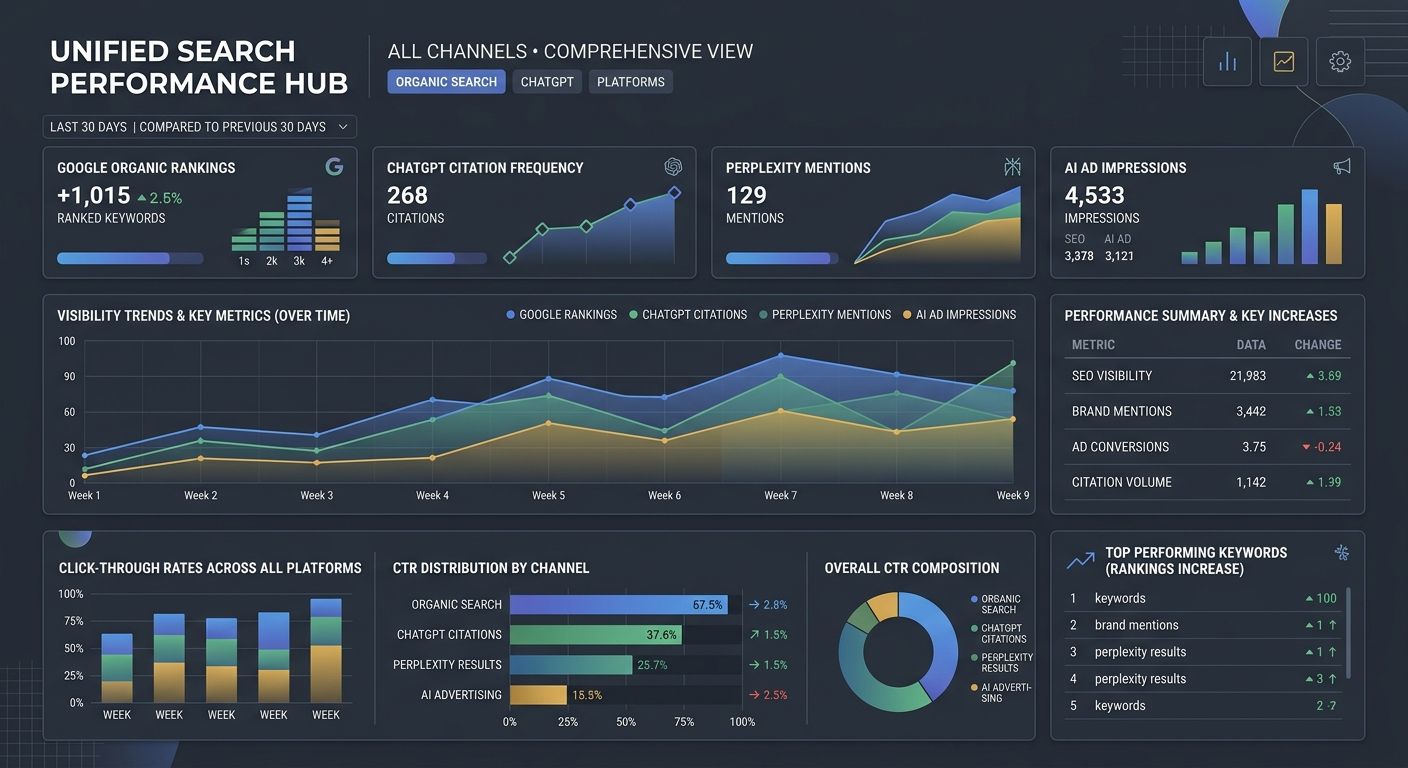
Build a cross-channel measurement dashboard. You need to track traditional rankings, AI citations, and (soon) AI ad performance in one view. Separate dashboards for separate channels will make it impossible to make good reallocation decisions.
The budget conversation will only get more urgent. Truist analysts are calling 2026 an "inflection year" for LLM-powered advertising, projecting that AI search ads could become a core pillar alongside traditional search, social, and retail media. Whether or not that timeline holds, the directional shift is clear.
Your SEO budget for 2026 should reflect the search landscape of 2026, not the one you built your strategy around two years ago. Start measuring, start reallocating, and get your technical foundation in shape before the ad inventory opens up to everyone. The teams that move now will have a meaningful data advantage by Q4. The rest will be playing catch-up.
Sarah Chen
SEO strategist and web analytics expert with over 10 years of experience helping businesses improve their organic search visibility. Sarah covers keyword tracking, site audits, and data-driven growth strategies.
Explore more topics