
Meta's Ad Revenue Surge and the Death of Organic Search: How to Rebuild Your 2026 Marketing Mix
Emarketer projects Meta will generate $243.46 billion in global ad revenue this year, officially dethroning Google as the world's largest ad platform for the first time in digital advertising history. Google's projected $239.54 billion suddenly looks like second place.
Meta's Ad Revenue Surge and the Death of Organic Search: How to Rebuild Your 2026 Marketing Mix
Emarketer projects Meta will generate $243.46 billion in global ad revenue this year, officially dethroning Google as the world's largest ad platform for the first time in digital advertising history. Google's projected $239.54 billion suddenly looks like second place. If you're a marketer who's been running the same channel mix for the past three years, this is the week you need to stop and recalibrate.
I've been tracking Meta advertising dominance in 2026 closely, and the writing was on the wall since Q3 2025 when Meta posted $51.2 billion in quarterly revenue, a 26% year-over-year jump fueled almost entirely by AI-powered ad optimization. But the speed at which this shift has materialized caught even me off guard. The question isn't whether Meta has won the ad revenue crown. It's what this means for your marketing budget, your organic strategy, and where you should be placing your bets right now.
The Numbers Behind Meta's Surge
Let me break down why this matters beyond the headline.
Meta is forecast to grow 24.1% year over year, while Google's growth sits at 11.9%, a rate that's been flat for two years. This isn't a temporary spike. The gap is widening because Meta's growth engine is firing on multiple cylinders simultaneously.
Three factors are driving this:
Advantage+ automated campaigns have seen massive advertiser adoption, with early adopters reporting conversion rate improvements up to 30% thanks to machine learning that predicts user behavior and auto-generates creatives
New ad surfaces across WhatsApp Status and Threads are opening inventory that didn't exist 12 months ago
AI creative tools, including Meta's Emu model, now generate dynamic ad creatives in seconds, cutting production costs by roughly 40%
The story here isn't just about Meta getting bigger. It's about the platform becoming measurably better at turning ad spend into revenue for advertisers. When I ran test campaigns through Advantage+ shopping in Q1, my team saw ROAS improvements of 35% compared to manually optimized campaigns from the same period. That kind of performance gap is why budgets are flowing in Meta's direction.
Why Organic Search ROI Is Eroding Faster Than Traffic Numbers Suggest
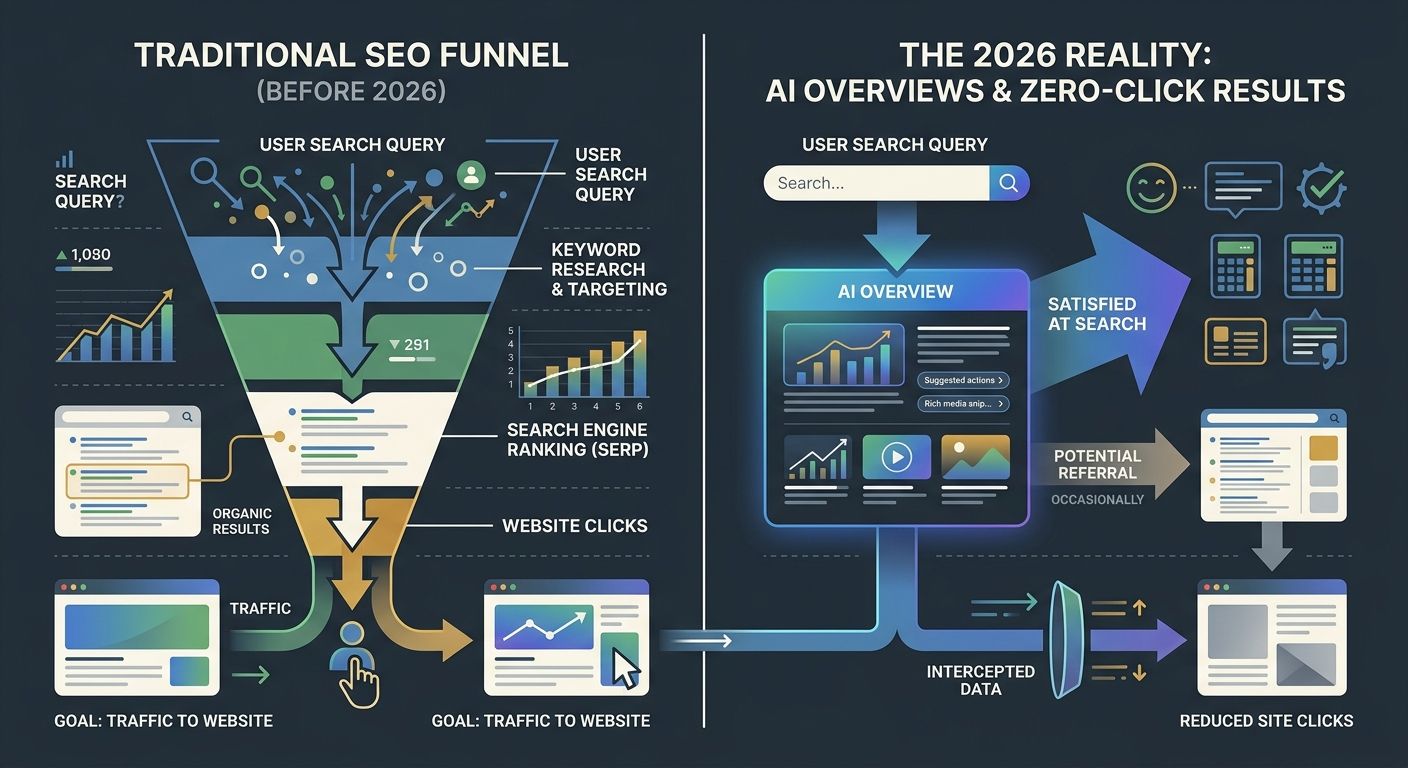
Here's where I need to push back on some of the doom-and-gloom narratives. Organic search traffic is down 2.5% year over year according to a large-scale Similarweb analysis of over 40,000 sites. That's real, but it's nowhere near the 25% to 60% drops that get thrown around at marketing conferences.
The actual problem is more nuanced. Traffic might be holding relatively steady, but the value of that traffic is eroding fast. Here's the data point that keeps me up at night: 60% of Google searches now end without any click to a website, up from 58% in 2024. And for queries where AI Overviews appear, the damage is far worse. One documented case showed impressions climbing 27.56% while clicks simultaneously dropped 36.18% and CTR collapsed from 5.98% to 3.35%.
Read that again. Rankings improved. Impressions went up. And clicks still cratered.
This is the fundamental shift in the paid media vs SEO conversation. SEO isn't dead, but the ROI equation has changed dramatically. If you're spending the same amount on content production and link building as you were two years ago without adjusting for reduced click-through rates, your effective cost per organic visitor has ballooned.
Google's March 2026 core update, which finished rolling out on April 8, only accelerated this trend. The update emphasized content usefulness, author authority, and technical SEO, which means AI answer engines are eating traditional search traffic faster than most teams realize. The brands that still win in organic are the ones producing genuinely authoritative content with strong E-E-A-T signals, not the ones pumping out high-volume keyword-targeted pages.
Why 81% of Marketers Are Already Moving Budgets
The marketing budget reallocation is already happening at scale. According to Sprout Social's research, 81% of marketers are reallocating budgets away from traditional SEO and into other channels. That's a staggering number, and it tells me we've passed the tipping point where this is a trend worth watching and entered the phase where it's a competitive necessity.
But here's my concern: most teams are reallocating reactively rather than strategically. They're pulling money from SEO and dumping it into Meta ads because Meta's numbers look good right now. That's not a platform diversification strategy. That's panic dressed up as strategy.
The smart play is more deliberate. Let me walk you through how I'm advising teams to think about their 2026 marketing mix.
A Practical Budget Allocation Model for 2026
Based on what I'm seeing in client accounts and industry benchmarks, here's the budget allocation model I'm recommending. Note: this varies by business model, but the principles hold.
For B2C and E-Commerce Brands
Paid social (primarily Meta): 35-40% of total marketing budget
Search ads (Google, Bing): 15-20%
SEO and content: 20-25%
Email and owned channels: 10-15%
Emerging platforms (TikTok, LinkedIn, programmatic): 5-10%
For B2B and SaaS Companies
Content and SEO: 30-35%
Paid search: 20-25%
Paid social (LinkedIn, Meta): 15-20%
Email and nurture sequences: 15%
Events, partnerships, and emerging channels: 10%
This aligns closely with the recommended 60/40 split between owned and paid channels, though I'd argue the specific ratios need to flex based on your sales cycle and average deal size.
The key insight from this framework is that SEO isn't disappearing from the mix. It's shrinking and changing shape. If you're still choosing between organic growth and paid results as an either/or decision, you're framing the problem wrong. The winning approach is hybrid, where content serves both organic discoverability and paid amplification.
Five Steps to Rebuild Your Marketing Mix This Month
Knowing the framework is one thing. Implementing it is another. Here's the step-by-step process I'm using with my clients right now.
Step 1: Audit Your Current Channel Performance Honestly
Pull your attribution data from the past 90 days and calculate true cost per acquisition by channel. Most teams I work with discover their organic CPA has increased 40-60% once they factor in content production costs against declining CTRs. If your analytics dashboard is telling you a different story, make sure you're measuring correctly before making budget decisions based on flawed data.
Step 2: Identify Your Meta Ads Baseline
If you're not already running Meta campaigns, start with a test budget of $3,000-$5,000 over 30 days using Advantage+ shopping or app campaigns. According to current benchmarks, a reasonable initial ROAS target is 1.5X, with a goal of reaching 2X as your campaigns optimize. Meta's AI creative tools have gotten good enough that you can launch with minimal creative assets and let the system iterate.
Step 3: Restructure Content for Dual-Purpose Use
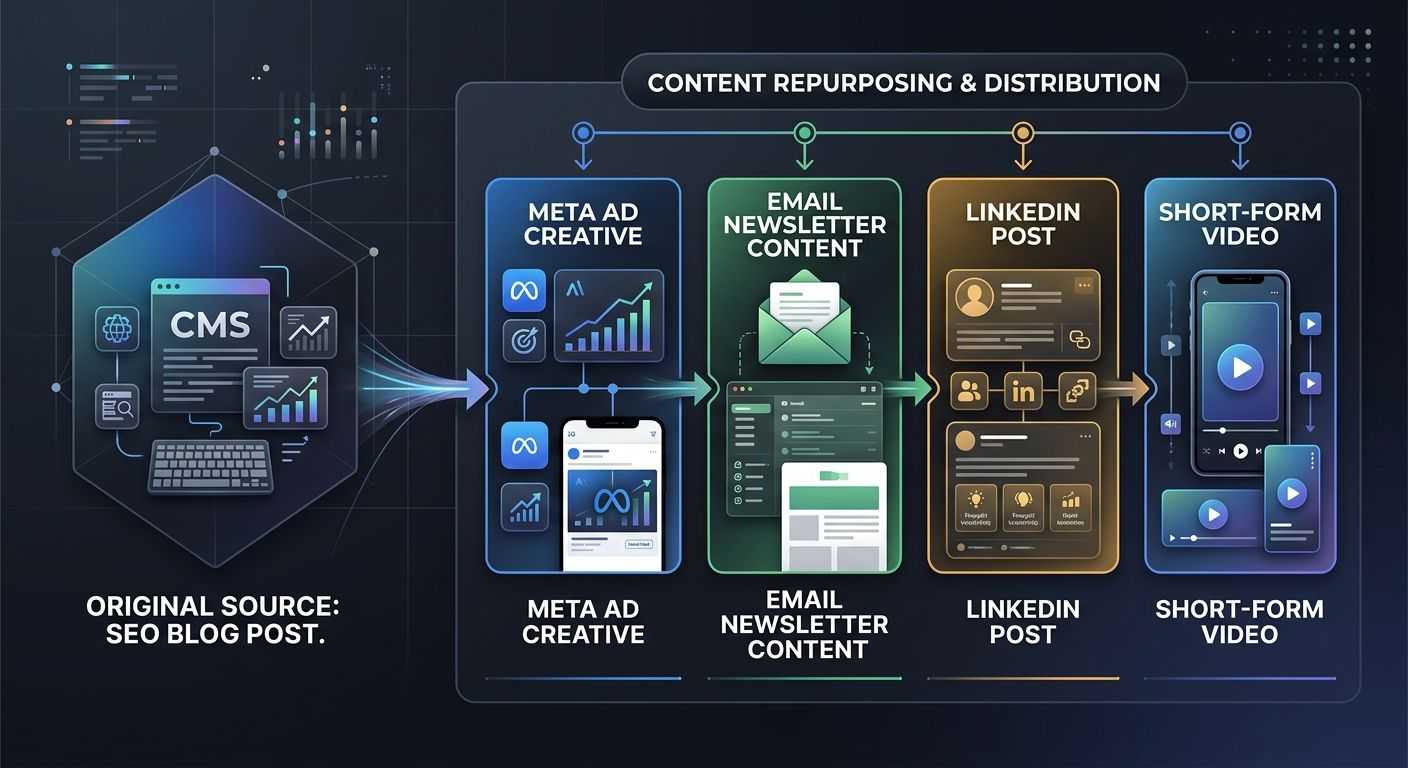
Stop creating content exclusively for organic search. Every piece should serve at least two channels. A blog post should work as an organic asset AND as source material for Meta ad copy, email campaigns, and LinkedIn posts. This is where prioritizing quality over volume becomes a budget multiplier. One excellent piece that performs across four channels beats four mediocre pieces that each serve one.
Step 4: Build Your First-Party Data Infrastructure
Google's Customer Match API sunsetting inactive tokens on April 1 was a wake-up call. Your email list, your CRM data, your customer purchase history: these are your most valuable marketing assets in a world where third-party targeting gets more restricted every quarter. Invest in cleaning and centralizing this data now.
Step 5: Set Up Cross-Channel Attribution
This is the step everyone skips, and it's the most important one. If you can't measure how channels interact, you'll over-invest in bottom-funnel paid ads and under-invest in awareness. With Google bringing back Data Studio capabilities, you now have better tools for building attribution models that capture the full picture. Use them.
How SEO Teams Should Adapt to the New Reality
I want to address SEO professionals directly, because I know this article might read like bad news. It's not. It's a reality check.
SEO still works. But it works differently now. The teams that will thrive are the ones that rebuild their strategies around AI-driven search behavior rather than clinging to the blue-link model. That means focusing on:
Branded search volume as a primary KPI rather than generic keyword rankings
E-E-A-T signals that make your content AI Overview-resistant
Internal linking architecture that drives both SEO equity and user conversion
Content that answers questions AI can't, including proprietary data, original research, and genuine expert perspectives
The organic search ROI decline is real, but it's concentrated in informational queries that AI can answer directly. Transactional and navigational queries still drive valuable traffic. Your SEO strategy should be laser-focused on those intent categories.
The Bigger Picture: Platform Diversification Is Survival
Meta advertising dominance in 2026 doesn't mean you should go all-in on Meta. That would be trading one dependency for another. The entire lesson of the organic search ROI decline is that single-channel dependence is dangerous.
A real platform diversification strategy means building marketing systems that don't collapse when one channel changes its algorithm. Your email list doesn't care about Google's core updates. Your Meta campaigns don't care about AI Overviews. Your LinkedIn content doesn't care about Facebook's organic reach algorithm. Build across all of them.
The brands that navigate this shift successfully will be the ones that move fast, test aggressively, and treat marketing budget reallocation as an ongoing optimization process rather than a once-a-year planning exercise.
Your Immediate Next Moves
Here's my short list of immediate actions:
Pull your Q1 channel-level attribution data and calculate true CPA for organic search, including content production and link building costs
If you're not running Meta Advantage+ campaigns, set up a test with $3,000 minimum budget this week
Identify your top 5 performing organic content pieces and create paid distribution plans for each across Meta and LinkedIn
Schedule a cross-functional meeting between your SEO, paid media, and content teams to discuss the overlap between content intent and conversion
Set up a 90-day review cycle for channel allocation, not a 12-month one
The Meta-Google revenue flip is the headline. But the real story is that the marketing playbook from 2023 is officially expired. The teams that rebuild their mix now, based on actual 2026 performance data rather than historical assumptions, will have a compounding advantage every quarter from here on out.
That's the move. Make it.

Alex Chen
Alex Chen is a digital marketing strategist with over 8 years of experience helping enterprise brands and agencies scale their online presence through data-driven campaigns. He has led marketing teams at two successful SaaS startups and specializes in conversion optimization and multi-channel attribution modeling. Alex combines technical expertise with strategic thinking to deliver actionable insights for marketing professionals looking to improve their ROI.
Explore more topics