
The Domain Migration SEO Playbook: Pre-Flight Checklist, Execution, and Post-Migration Recovery Timeline
Google's Change of Address tool forwards ranking signals for a hard 180-day window during domain-level moves, and 1:1 server-side 301 redirects pass full link equity to destination URLs. The mechanism that preserves SEO authority during migration is well-documented.
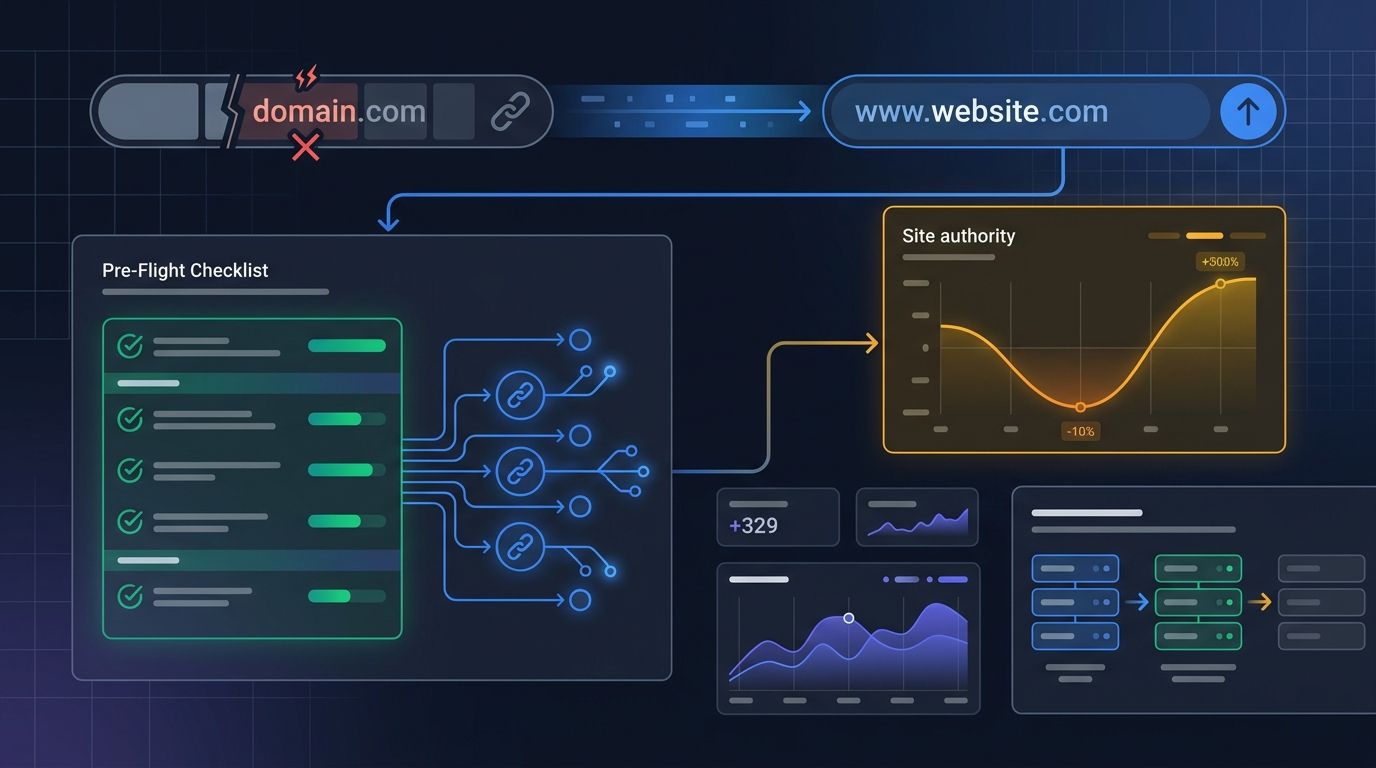
The Domain Migration SEO Playbook: Pre-Flight Checklist, Execution, and Post-Migration Recovery Timeline
Google's Change of Address tool forwards ranking signals for a hard 180-day window during domain-level moves, and 1:1 server-side 301 redirects pass full link equity to destination URLs. The mechanism that preserves SEO authority during migration is well-documented. Where teams fail is treating organic and paid channels as separate workstreams when both depend on the same URL infrastructure breaking cleanly at the same moment.
Why Paid Media Teams Can't Sit This One Out
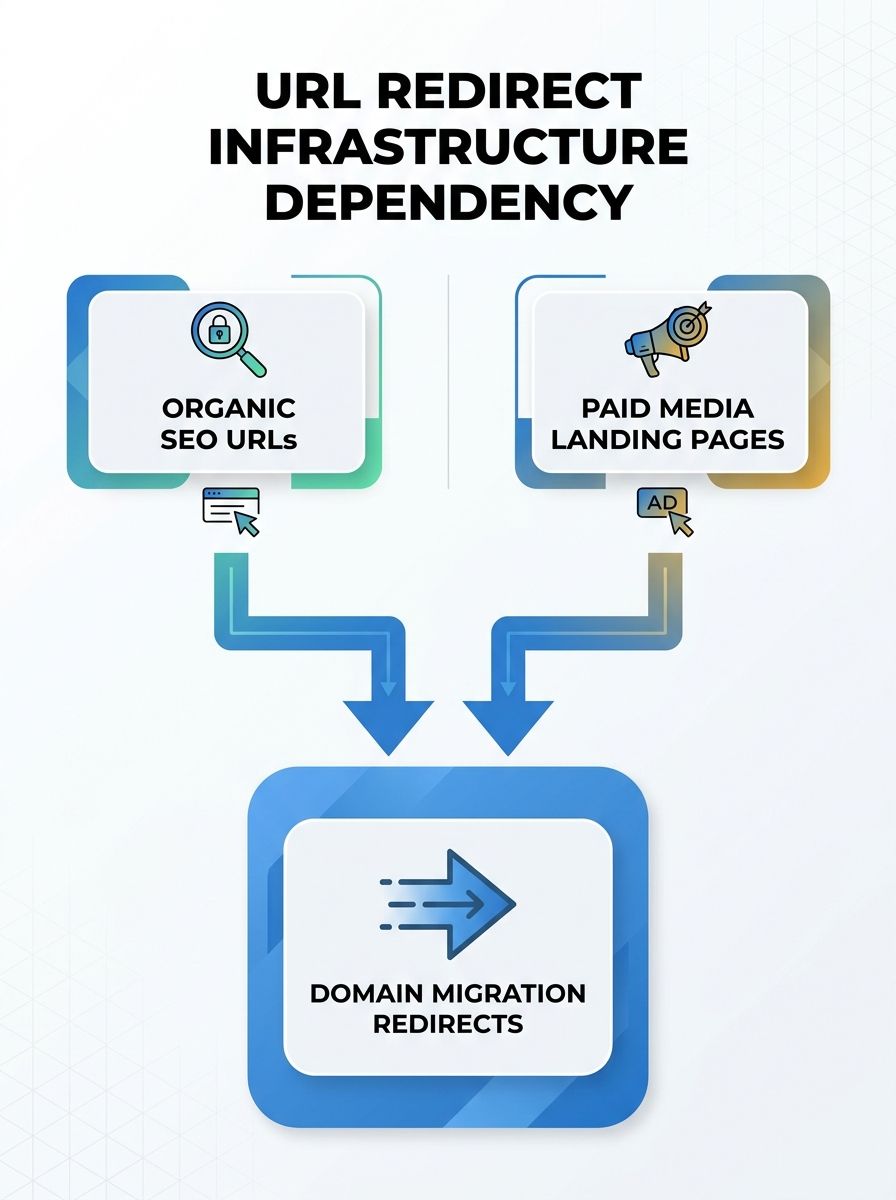
Every Google Ads landing page URL, every conversion tracking pixel firing on a thank-you page, and every remarketing audience built on domain-specific cookies lives on the infrastructure being migrated. When the domain changes, Google Ads Quality Scores recalculate based on the new landing page experience. If redirects introduce latency or 404s appear on ad destinations, your cost-per-click rises before anyone on the paid team understands why.
Semrush's editorial team states in their migration checklist that permanent ranking drops and lost traffic "aren't always caused by the migration itself" but by "preventable issues like missing redirects and undetected crawl blocks." Those same missing redirects break paid landing pages. A 301 redirect strategy needs to account for every URL receiving paid traffic, in addition to pages ranking organically.
The top 20% of pages on most sites drive 80% of organic traffic. But paid campaigns often send clicks to a different set of URLs entirely: dedicated landing pages, campaign-specific offer pages, or product pages that rank nowhere organically yet convert paid visitors at high rates. If your site migration audit checklist covers only organic performers, you're leaving paid media ROI unprotected.
The Pre-Flight Audit Mechanism
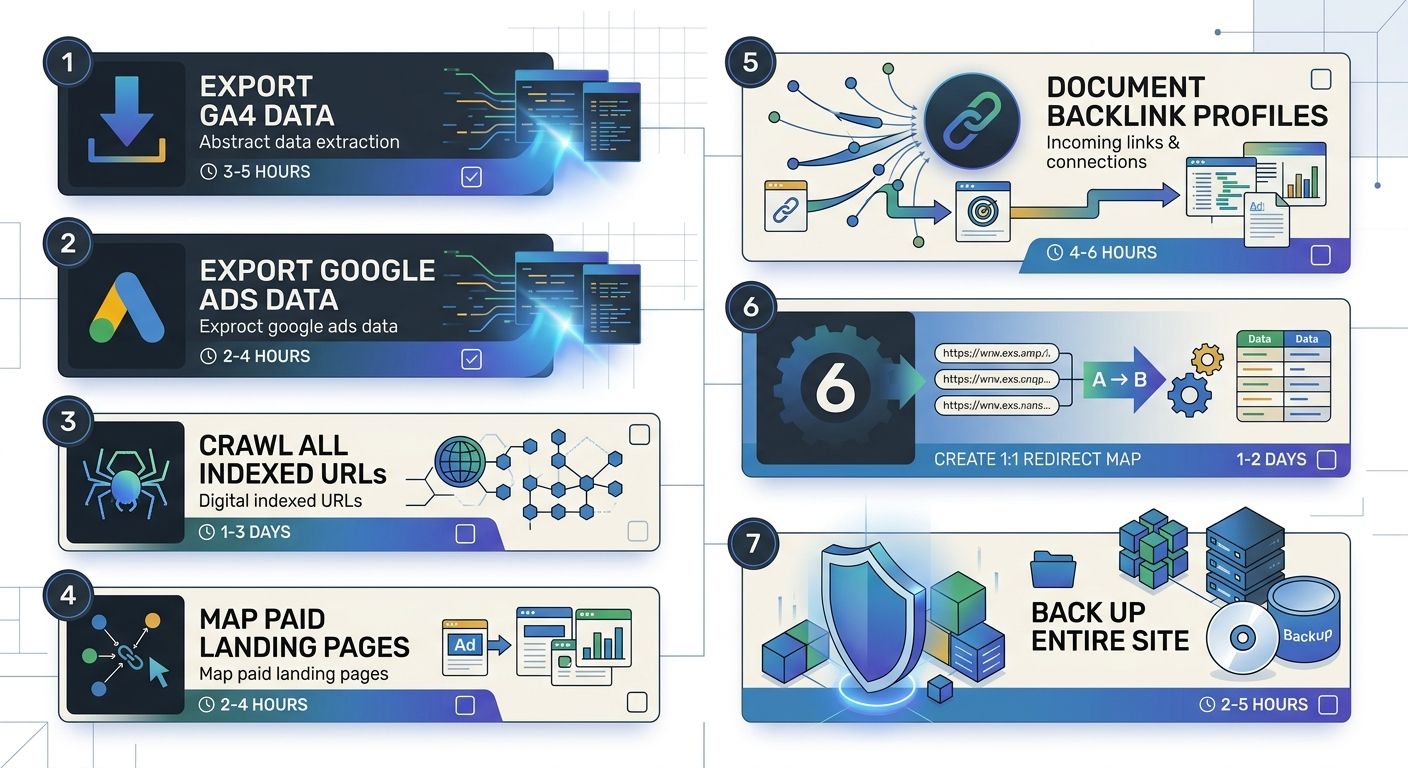
Pre-migration preparation accounts for 60-70% of migration success, according to aggregated industry benchmarks. The audit serves three functions: establishing performance baselines, identifying every URL that carries value (organic or paid), and mapping the redirect architecture before a single DNS record changes.
Export GA4 traffic data, Google Ads conversion data, and Search Console performance reports covering at least 90 days prior to migration. You need organic keyword rankings, page-level traffic, backlink counts per URL, and paid metrics including Quality Score by landing page, conversion rates, and cost-per-acquisition. These baselines become your recovery benchmarks.
Marcel Digital's SEO migration guide advises teams to "hold on to [the old domain] and keep collecting all the search engine equity you've built for it over the years" rather than letting it expire. This matters for paid campaigns too: if remarketing tags on the old domain stop functioning before audiences are rebuilt on the new domain, you lose accumulated audience segments that took months of ad spend to build.
The crawl itself should catalog every indexed URL, every page receiving Google Ads traffic in the past 180 days, every page with active Facebook or LinkedIn ad campaigns pointing to it, and every URL embedded in email automation flows. If you've already run a crawl budget audit on your existing site architecture, that data feeds directly into your redirect map.
How the Redirect Map Gets Built
Every indexed URL needs a 1:1 server-side 301 redirect to its new equivalent. Moz's redirect documentation confirms that a 301 is "best for SEO" and "passes full link equity to the target page," while a 302 signals a temporary move and does not transfer link equity. Americaneagle.com's migration guide reinforces this, noting that "a 301 redirect tells search engines and browsers that a page has permanently moved, passing most of the SEO authority from the old address to the new one."
Three common redirect failures destroy both organic and paid performance:
Mass redirecting to the homepage. Sending 500 old URLs to a single homepage URL obliterates the page-level authority each URL carried. Google interprets this as a soft 404 for each individual page. For paid media, any ad still pointing to an old URL now lands users on your homepage instead of the relevant offer page, cratering conversion rates.
Redirect chains exceeding 3 hops. Each hop adds latency. Google Search Console flags chains, and the additional load time degrades landing page experience scores in Google Ads. Keep every redirect to a single hop.
JavaScript redirects instead of server-side redirects. JavaScript redirects are invisible to Googlebot in many configurations and add rendering time that hurts Core Web Vitals. Server-side 301s execute before the page loads.
Your redirect map should be a spreadsheet with four columns: old URL, new URL, monthly organic sessions, and monthly paid clicks. Sort by combined traffic descending. The top 20% of URLs gets manual verification; the remaining 80% can follow pattern-based rules but still needs automated validation.
Redirect Type | SEO Equity Passed | Use Case | Risk to Paid Media |
|---|---|---|---|
301 (Permanent) | Full link equity | Domain moves, permanent URL changes | Low if 1:1 mapped |
302 (Temporary) | No equity transfer | Short-term A/B tests, maintenance | High (Quality Score impact) |
307 (Temporary) | No equity transfer | Method-preserving temp redirects | High (same as 302) |
JavaScript redirect | Partial or none | Never recommended | Very high (rendering delay) |
Meta refresh | Partial | Never recommended | Very high (UX degradation) |
Execution Timing and the Soft Launch Window
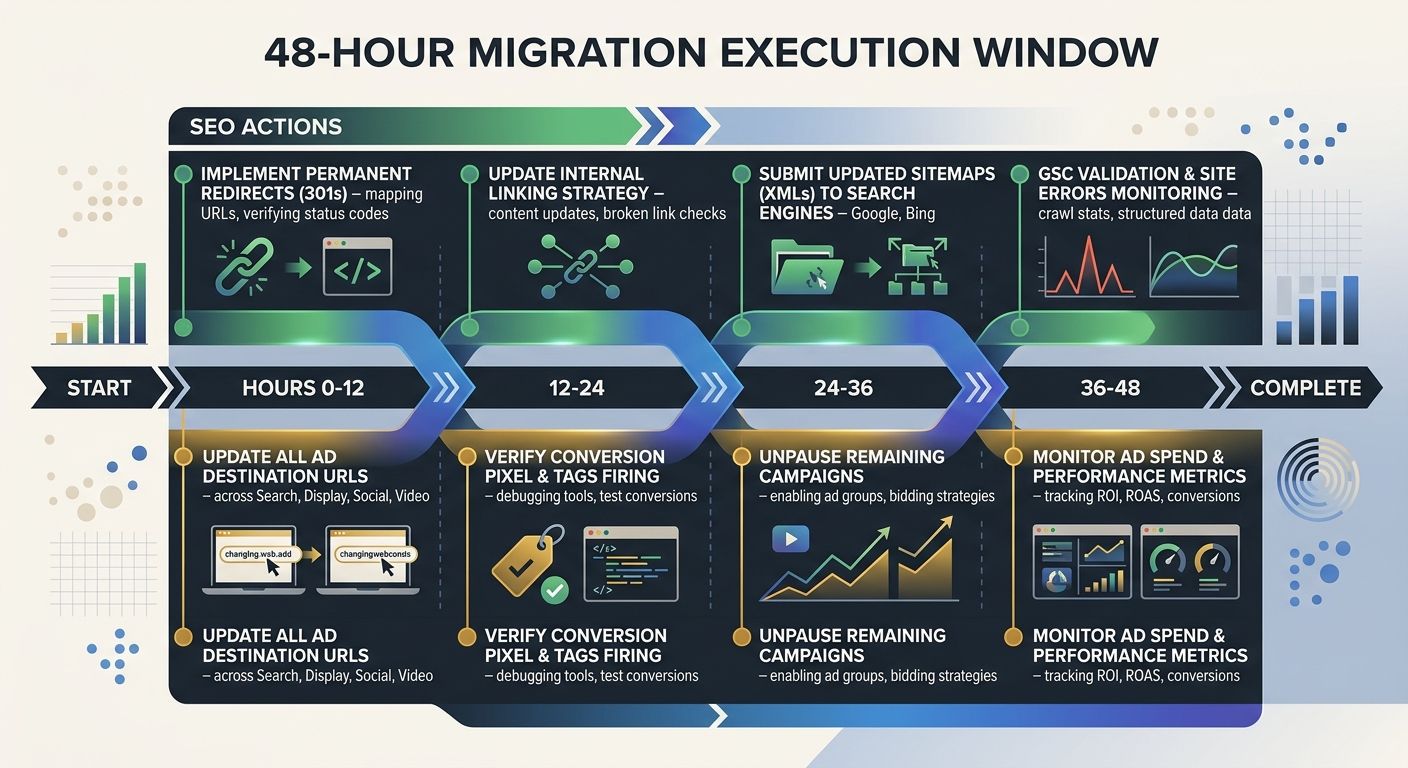
A soft launch 24-48 hours before the full switchover accelerates indexing by letting Googlebot discover the new domain while the old one still resolves. During this window, verify that staging environments have been cleared of stray noindex tags and hardcoded canonical URLs pointing to staging subdomains.
Launch-day actions happen in a specific sequence. First, activate all 301 redirects on the server. Second, submit the Change of Address request in Google Search Console, which forwards signals for 180 days on domain-level moves. Third, submit the new XML sitemap. Fourth, verify that Google Ads conversion tracking fires correctly on the new domain by running test conversions through every active campaign.
The paid media parallel requires its own execution checklist. Google Ads needs URL updates at the campaign, ad group, and ad level. Sitelink extensions, callout URLs, and structured snippet landing pages all reference the old domain. Responsive search ads may have final URLs cached. Update every ad asset, then verify in Google Ads preview mode before unpausing spend.
When prioritizing which technical fixes matter most, redirect verification ranks above sitemap submission. A missing sitemap delays discovery by days. A broken redirect on a high-traffic URL destroys authority permanently.
Post-Migration Recovery Signals and Their Timeline
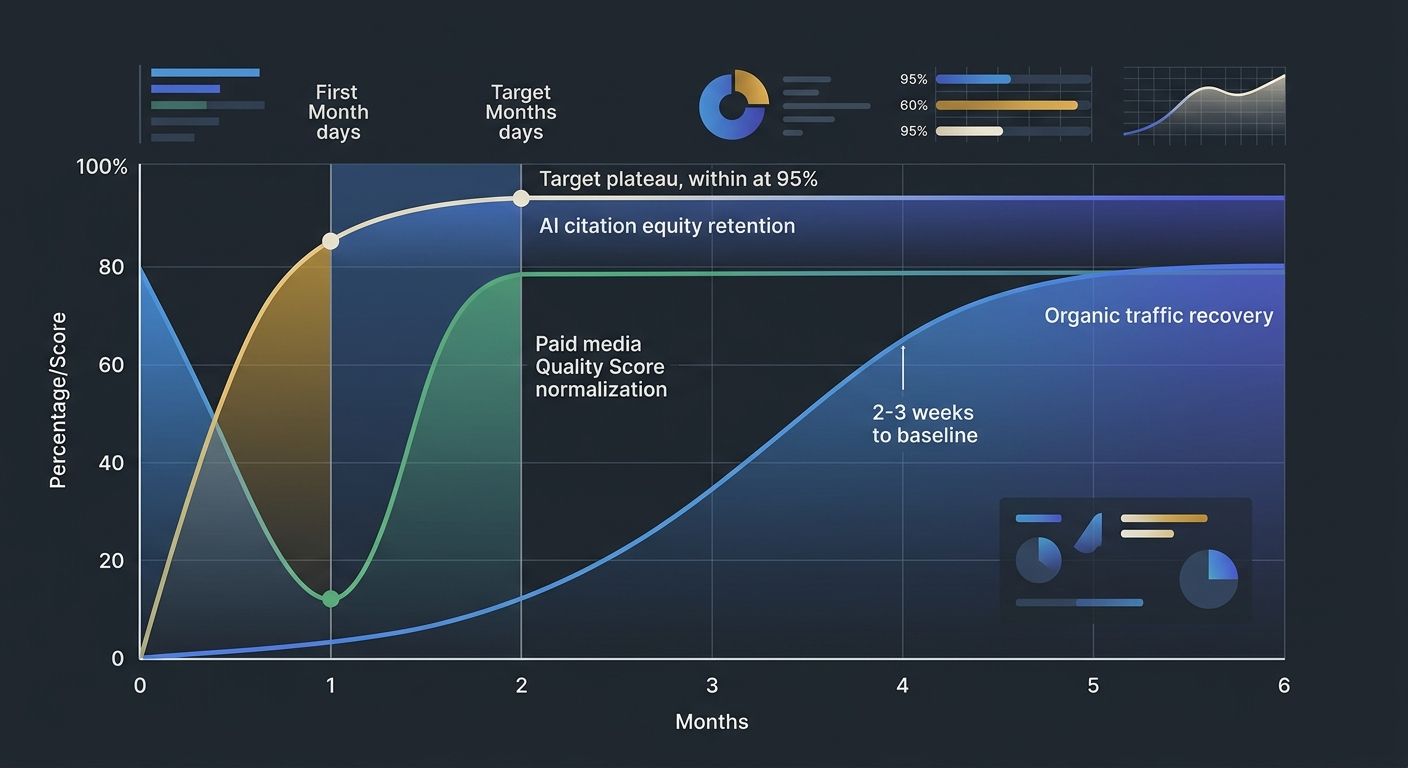
Google typically takes 2-4 weeks to process a domain change and reindex the new URLs. Full ranking recovery spans 3 to 6 months depending on site size, migration complexity, and technical execution quality. A case study documented by The 215 Guys showed recovery in about 3 months after the team addressed content parity issues by adding missing service pages and blog posts back to the new site.
The harder number: the average new domain takes 523 days to match original organic traffic levels, and 17% of migrated domains never recover to their original traffic volume after 1,000 days. These figures represent the full distribution, including poorly executed migrations. With proper 301 redirect coverage and no crawl blocks, high-authority sites have achieved full post-migration ranking recovery in 19-23 days.
For paid media, the recovery curve follows a different shape. Quality Score recalculations happen within 1-2 weeks as Google Ads re-evaluates landing page experience on the new domain. If your new site loads faster and passes Google's tightened LCP threshold of 2.0 seconds, Quality Scores can improve post-migration, lowering CPCs. If the new site is slower or has broken page elements, expect CPC increases of 15-30% until landing page scores normalize.
Monitor these five signals weekly for 90 days post-migration:
Indexed page count in Search Console should match or exceed pre-migration levels within 4-6 weeks
404 error rate should drop below 0.5% of total URLs within 2 weeks
Redirect chain count should be zero; any chain indicates a mapping error
Google Ads Quality Score by landing page should stabilize within 2-3 weeks
Conversion rate by channel should return to baseline within 30 days
Long-tail keyword rankings require the longest monitoring window. These pages carry less individual authority and depend on internal linking structures that may have shifted during migration. Your SEO benchmarking cadence needs to extend tracking for at least 90 days before declaring the migration complete.
Preserving AI Search Visibility After the Move
Schema markup preservation matters for maintaining visibility in AI Overviews and answer engines like Perplexity and ChatGPT. The target benchmark is retaining 95% of AI citation equity within 60 days of migration. If your structured data breaks during the transition, AI systems lose the signals they use to cite your content. Teams already working on dual-engine visibility strategies should audit schema markup as part of the migration validation, and those diagnosing technical issue priority should treat schema breakage with the same urgency as broken redirects.
Where the Model Breaks
This entire mechanism assumes one-to-one URL mapping is possible, and it often isn't. Site redesigns frequently consolidate pages, eliminate sections, or restructure content hierarchies. When 3 old URLs merge into 1 new URL, the redirect passes some authority, but the specificity of each original page's ranking signals dilutes. If those 3 pages each targeted different keywords with inbound backlinks from different domains, the merged destination page inherits a muddled signal profile that takes months to clarify in Google's index.
The model also breaks when organizations treat migration as a single event rather than a 6-month project. Saffron Edge's migration documentation notes that "incorrect sitemap and signal updates slow search engine reprocessing" and that "analytics and tracking configurations may break during environment changes." These breakdowns compound. A broken GA4 tag means you can't measure recovery. A misconfigured Google Ads conversion pixel means you're optimizing paid campaigns against phantom data for weeks before anyone notices.
The biggest structural risk sits with organizations running simultaneous paid campaigns across Google, Meta, LinkedIn, and programmatic display. Each platform has its own URL caching behavior, its own pixel implementation, and its own audience definition tied to domain cookies. Migrating the domain without platform-by-platform verification creates invisible failures. Your Meta pixel might keep firing on the old domain through cached ad creatives for 7-14 days after migration, building audiences you can't retarget on the new domain.
Preserving SEO authority during migration is a solved problem at the technical level. The 301 redirect, the Change of Address tool, the sitemap submission workflow: each step is documented, repeatable, and testable. The failures happen in the coordination layer, where organic and paid teams operate on different timelines, different URL inventories, and different definitions of "done." The mechanism works when both sides share the same redirect map, the same launch window, and the same 90-day monitoring cadence. When they don't, the technical execution can be flawless and the business still loses six figures in wasted ad spend and unrecoverable organic equity.

Alex Chen
Alex Chen is a digital marketing strategist with over 8 years of experience helping enterprise brands and agencies scale their online presence through data-driven campaigns. He has led marketing teams at two successful SaaS startups and specializes in conversion optimization and multi-channel attribution modeling. Alex combines technical expertise with strategic thinking to deliver actionable insights for marketing professionals looking to improve their ROI.
Related Articles

The Domain Migration SEO Audit Checklist: Preserving Rankings While Consolidating Brand Authority
The 301 redirect strategy that protects your organic rankings during a domain migration will break your paid search campaigns in ways no SEO checklist warns you about.

The Domain Migration SEO Playbook: Step-by-Step 301 Redirect Strategy to Preserve Rankings and Authority
A properly executed 301 redirect maps every old URL to its exact new equivalent, passing 90–99% of accumulated link equity to the destination page.

Website Migration Guide Establishes Expected 5% to 12% Organic Traffic Dip as Benchmark for Clean Redirects
Website migrations executed with complete URL mapping and tested 301 redirects should expect a temporary 5% to 12% organic traffic decline, while migrations without systematic redirect planning risk traffic crashes exceeding 40%, according to an SEO migration framework published by GadgetsFarms on A
Explore more topics