
Website Migration Guide Establishes Expected 5% to 12% Organic Traffic Dip as Benchmark for Clean Redirects
Website migrations executed with complete URL mapping and tested 301 redirects should expect a temporary 5% to 12% organic traffic decline, while migrations without systematic redirect planning risk traffic crashes exceeding 40%, according to an SEO migration framework published by GadgetsFarms on A

Website Migration Guide Establishes Expected 5% to 12% Organic Traffic Dip as Benchmark for Clean Redirects
Website migrations executed with complete URL mapping and tested 301 redirects should expect a temporary 5% to 12% organic traffic decline, while migrations without systematic redirect planning risk traffic crashes exceeding 40%, according to an SEO migration framework published by GadgetsFarms on August 27, 2026. The guide quantifies risk levels across six migration types and provides a pre-launch checklist covering URL inventory, redirect mapping, and technical validation.
The framework categorizes website migrations into six distinct types—domain migration, protocol change, platform migration, URL structure change, design and content rebuild, and international migration—each carrying different organic traffic risk levels. The analysis notes that migrations combining multiple change types simultaneously increase SEO vulnerability compared to phased approaches that isolate variables.
URL Inventory Process Pulls From Eight Data Sources
The published methodology requires migration teams to compile a complete URL inventory before launch by aggregating data from XML sitemaps, Google Search Console exports, 12 to 18 months of analytics landing pages, backlink tools, server logs, site crawl data, paid search landing pages, and email campaign URLs. Each URL in the master file should include current status code, organic sessions, conversions, backlink count, target keyword group, canonical URL, and planned new URL destination, according to the guide.
High-value pages require explicit flagging in the inventory system to ensure redirect accuracy. The framework warns that high-performing URLs redirected to generic category pages or homepages lose topical relevance signals that supported their original rankings.
Redirect Map Establishes One-to-One Matching Rules
The guide mandates 301 redirects mapping each old URL to its closest matching new destination rather than consolidating multiple pages onto single targets. Product pages should redirect to identical products when available, or to the nearest category or replacement item for discontinued products. Blog posts redirect to the same article or closely related content. The framework permits 410 status codes for genuinely deleted low-value pages with no useful replacement.
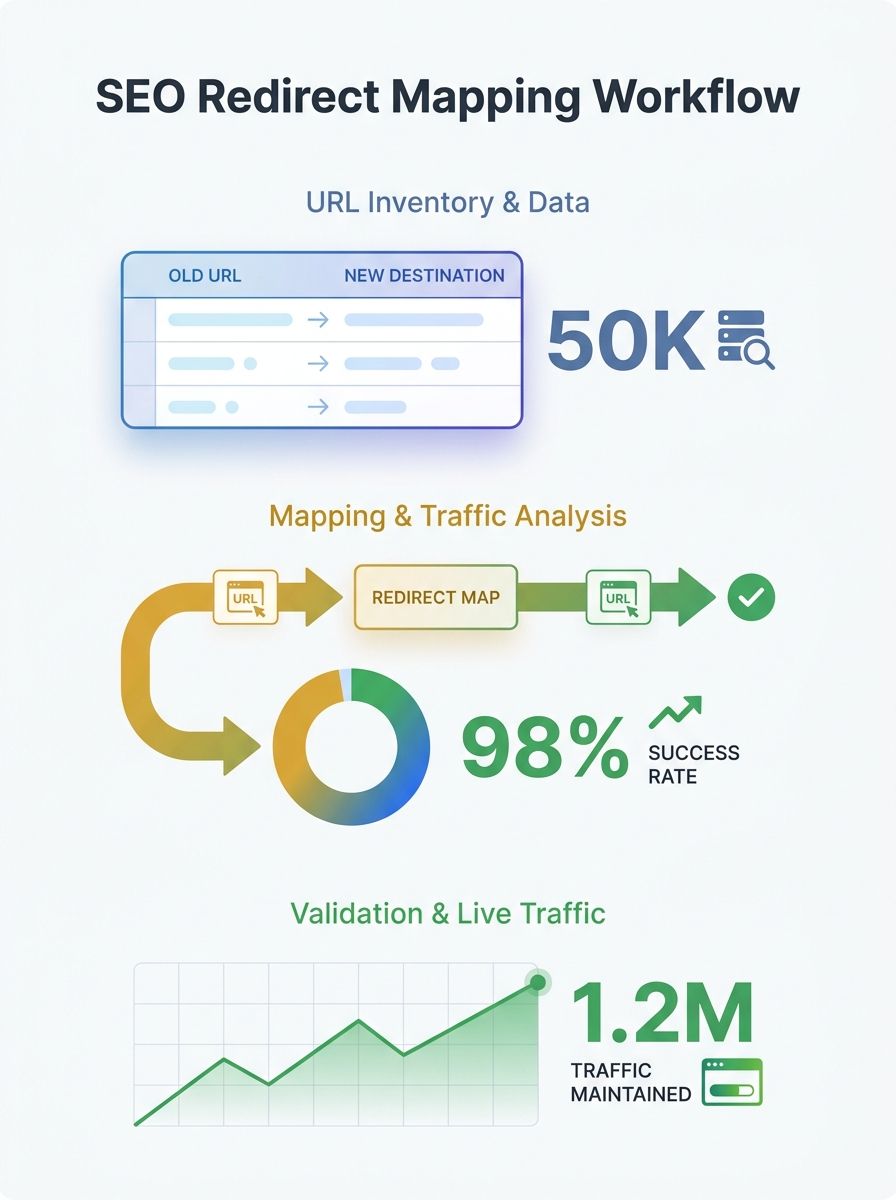
Redirect chains—where one URL points through intermediate staging or temporary URLs before reaching the final destination—appear "after many launches" despite being avoidable through proper testing, according to the guide. Search engines can follow some redirect chains, but signal transmission weakens and crawl budget gets wasted across multiple hops.
Technical Validation Targets Core Web Vitals Before Launch
Pre-launch staging site crawls should verify indexability, status codes, canonical tags, pagination, hreflang, robots directives, and mobile rendering across every key template, the framework states. The new XML sitemap should include only final indexable URLs, and robots.txt files must not block critical sections—a "staging disallow all rule still active" has damaged organic visibility in prior migrations.
Core Web Vitals require explicit review during migration because new designs introducing heavy scripts, large hero images, or slow third-party tags can degrade both user experience and search performance. Speed testing should cover real page templates beyond the homepage to identify render-blocking resources before they reach production.
The guide recommends testing redirects before launch to catch redirect loops and validate that old URLs resolve to correct new destinations without chains. Post-launch monitoring should track rankings, crawl errors, and organic traffic daily in the first week, then weekly for three months.
Six-Step Framework Covers Inventory Through Post-Launch Monitoring
The published framework sequences migration tasks through six stages: defining the migration type, building a full URL inventory, creating the one-to-one redirect map, preserving on-page SEO signals, preparing technical SEO checks, and launching with a controlled checklist. Each stage includes specific deliverables and validation criteria.
On-page signal preservation requires comparing old and new templates to verify that title tags, meta descriptions, H1 tags, body content, internal links, canonical tags, structured data, and image alt text transfer correctly. The guide advises against changing copy and URLs simultaneously because ranking shifts become harder to diagnose when multiple variables move at once. The recommendation is to keep high-performing content stable during launch, then improve it after the site stabilizes.
Launch day tasks include confirming DNS, hosting, SSL, and CDN settings; pushing final redirect rules; removing staging noindex directives from the live site; uploading the final XML sitemap; and verifying robots.txt configuration. The guide positions these as "boring" tasks executed by named owners following a clear sequence—boring being the goal because it indicates proper preparation.
What This Means for Marketing Managers
Website migrations carry quantified organic traffic risk that systematic planning can reduce from 40% crash scenarios to 5-12% temporary dips. The 5-12% benchmark applies only to migrations with complete URL inventories, tested one-to-one redirect maps, and validated technical configurations—three deliverables that require weeks of preparation before launch day.
Marketing managers should recognize that combining multiple migration types simultaneously—changing domains, platforms, URL structures, and content together—boosts risk beyond what the 5-12% benchmark assumes. Phased migrations that isolate variables allow teams to diagnose traffic decline root causes with greater precision when issues emerge post-launch.
The framework's emphasis on preserving on-page signals during migration aligns with the finding that changing content and URLs at the same time obscures attribution when rankings shift. Keeping high-performing landing pages stable through the migration window, then optimizing them afterward, maintains baseline performance while reducing diagnostic complexity during the critical first 90 days.

Sarah Chen
SEO strategist and web analytics expert with over 10 years of experience helping businesses improve their organic search visibility. Sarah covers keyword tracking, site audits, and data-driven growth strategies.
Related Articles

The Domain Migration SEO Playbook: Step-by-Step 301 Redirect Strategy to Preserve Rankings and Authority
A properly executed 301 redirect maps every old URL to its exact new equivalent, passing 90–99% of accumulated link equity to the destination page.

The Domain Migration SEO Playbook: Pre-Flight Checklist, Execution, and Post-Migration Recovery Timeline
Google's Change of Address tool forwards ranking signals for a hard 180-day window during domain-level moves, and 1:1 server-side 301 redirects pass full link equity to destination URLs. The mechanism that preserves SEO authority during migration is well-documented.

The Domain Migration SEO Audit Checklist: Preserving Rankings While Consolidating Brand Authority
The 301 redirect strategy that protects your organic rankings during a domain migration will break your paid search campaigns in ways no SEO checklist warns you about.
Explore more topics