
The Domain Migration SEO Playbook: Step-by-Step 301 Redirect Strategy to Preserve Rankings and Authority
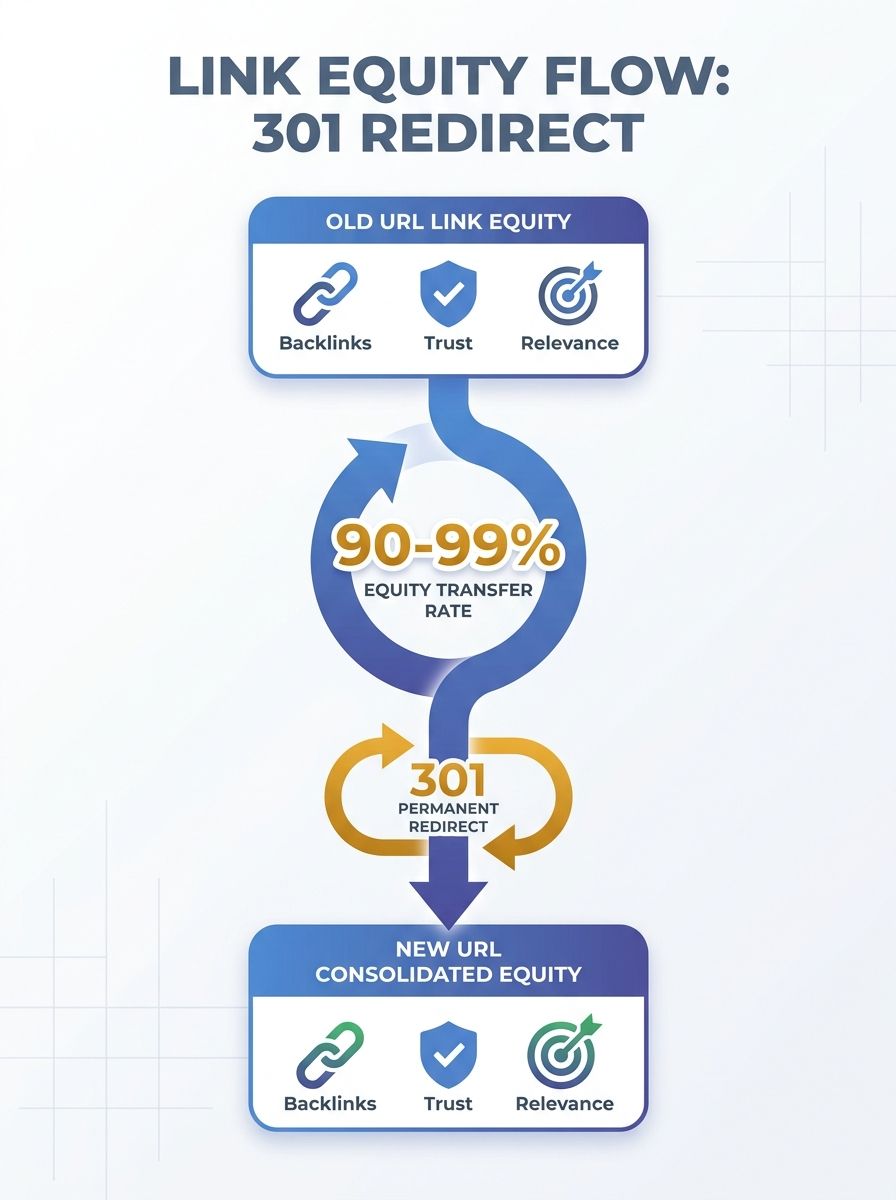
A properly executed 301 redirect maps every old URL to its exact new equivalent, passing 90–99% of accumulated link equity to the destination page.

The Domain Migration SEO Playbook: Step-by-Step 301 Redirect Strategy to Preserve Rankings and Authority
A properly executed 301 redirect maps every old URL to its exact new equivalent, passing 90–99% of accumulated link equity to the destination page. Botch the implementation or redirect everything to the homepage, and you're staring at 20–40% organic traffic loss with an average recovery window of 523 days.
How Link Equity Actually Moves Through a 301
When Googlebot encounters a 301 status code, it interprets the response as a permanent instruction to transfer all accumulated ranking signals from the source URL to the destination URL. This includes backlink authority, page-level trust metrics, and topical relevance signals that the original page earned over months or years. According to Moz's redirect documentation, permanent redirects (301s) are definitively better for SEO than temporary 302 or 307 redirects, which do not reliably pass authority.
The transfer isn't instantaneous. Google's crawler needs to discover the redirect, process it, update its index, and re-associate all inbound links with the new URL. A properly configured 301 redirect passes between 90% and 99% of the original page's link equity, according to analysis from WolfPack Advising's domain authority research. The remaining 1–10% loss is an inherent friction cost of the redirect itself.
For paid media teams, this mechanism has a direct parallel: Google Ads assigns Quality Scores partly based on landing page experience. When your ad's destination URL returns a 301 redirect, the ad platform has to follow that chain to evaluate the final landing page. Each redirect hop adds latency, and landing pages that load more than 3 seconds slower see Quality Score penalties of 1–2 points, which translates directly to higher cost-per-click.
The URL Mapping Layer: Why 1:1 Precision Is Non-Negotiable
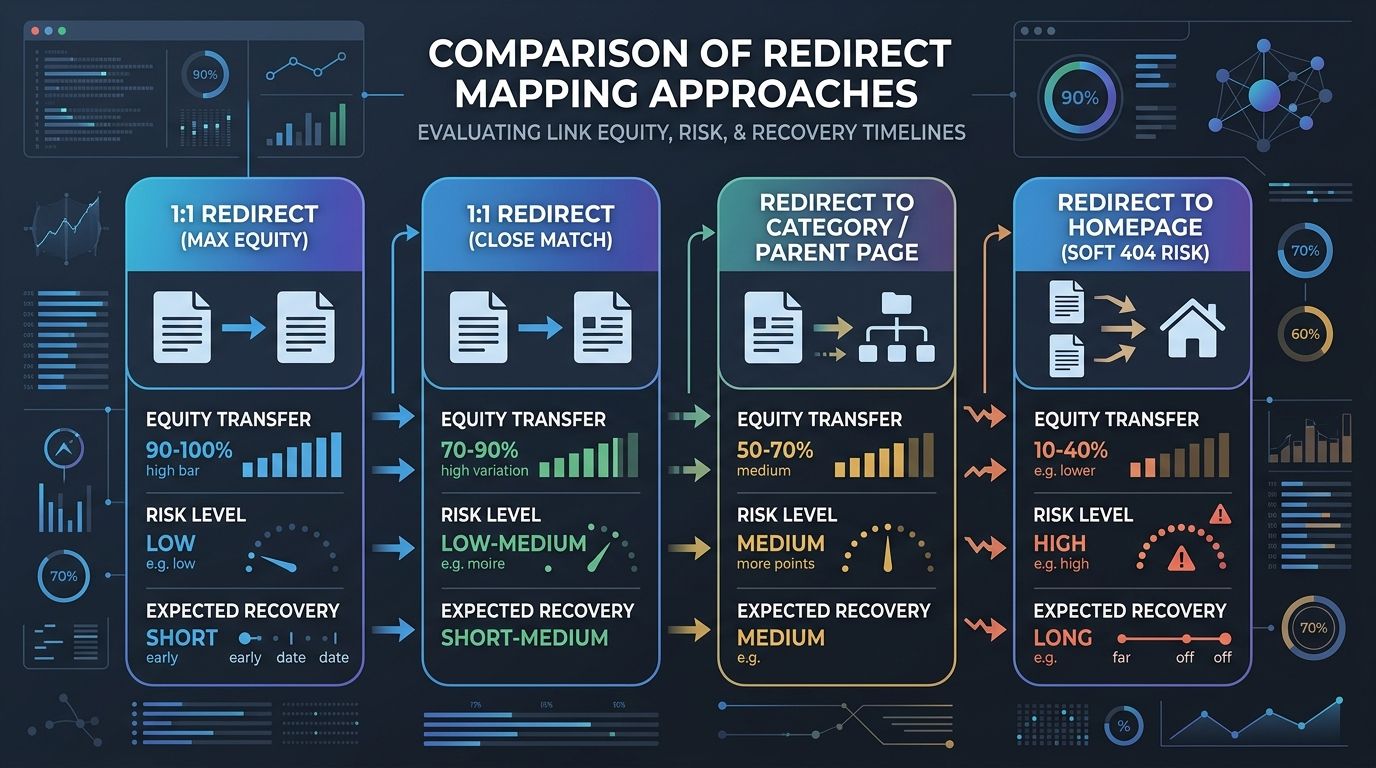
The most common migration failure is lazy mapping. Teams redirect all old URLs to the new site's homepage instead of matching each source page to its corresponding destination. This creates what Google Search Console flags as "soft 404" warnings, because the content the user (or crawler) expected doesn't exist at the redirect target.
A proper website migration checklist starts with a full crawl of the old domain. Tools like Screaming Frog export every indexed URL, including pages you may have forgotten: old blog posts, PDF assets, image URLs, and paginated archive pages. The crawl for a mid-size site (5,000–15,000 pages) typically surfaces 20–35% more URLs than the team expected to migrate.
Each old URL gets mapped to exactly one new URL where the content lives. If a page has no equivalent on the new domain, the correct choice is a 410 (Gone) status code rather than a redirect to an unrelated page. Forcing mismatched redirects dilutes the topical signals Google associates with the destination, which hurts both URLs.
If you've already built out your site architecture for ranking purposes, the mapping exercise becomes dramatically easier because you have a documented hierarchy to match against.
Redirect Approach | Equity Passed | Risk Level | Recovery Time |
|---|---|---|---|
1:1 page-to-page 301 | 90–99% | Low | 4–8 weeks |
Category-to-category 301 | 60–75% | Medium | 3–6 months |
All pages to homepage | 10–20% | Critical | 12–18+ months |
No redirects (404) | 0% | Catastrophic | Often never |
Redirect Chains and the Latency Tax
A redirect chain occurs when URL A redirects to URL B, which redirects to URL C, which finally reaches URL D. Each hop in the chain costs you in two measurable ways: latency (100–500ms per hop, depending on server response time) and equity leakage (each additional redirect loses a small percentage of the authority being passed).
Google's John Mueller has stated that Googlebot will follow up to 5 redirect hops before giving up, but the practical ceiling is lower. After 3 hops, the cumulative latency typically exceeds 1 second, and the equity loss compounds. If your old domain already had redirects in place from a previous migration or URL restructuring, the new migration stacks on top of them.
For paid media campaigns, chains are particularly dangerous. Google Ads performs real-time landing page evaluations, and redirect chains that add 500ms+ of latency directly impact ad rank calculations. Facebook's ad system is even less tolerant, occasionally flagging redirect chains as "broken destination URLs" and pausing ads automatically.
The solution is straightforward: every redirect rule should point from the original source directly to the final destination. No intermediate stops. When you're running a subdomain to root domain migration, this means rewriting all existing redirect rules on the subdomain so they point to the root domain URLs, not to other subdomain URLs that themselves redirect.
Signal Preservation Beyond the Redirect
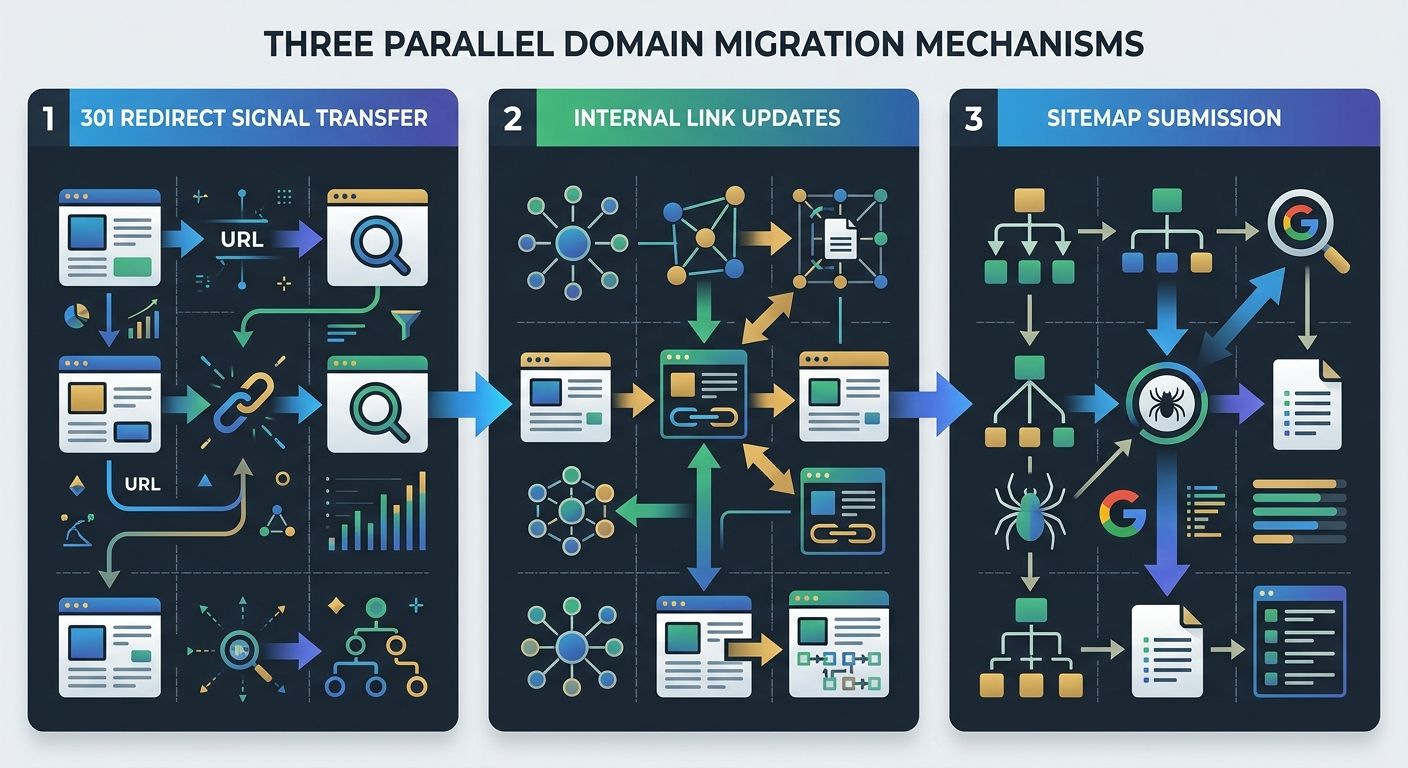
A 301 redirect handles the URL-level signal transfer, but domain migration SEO involves several parallel mechanisms that redirects alone don't solve.
Google Search Console ownership transfer requires verifying the new domain and using the Change of Address tool before the migration goes live. This tells Google explicitly that you're moving, which accelerates re-indexing. Without it, Google treats the new domain as an entirely separate entity and takes significantly longer to associate old signals with new URLs. The minimum recommended window for Google to re-crawl and update its index is 6 months of active 301 redirects, and the redirects should remain in place permanently.
XML sitemaps on the new domain need to be submitted immediately after migration. The old domain's sitemap should be updated to reference only the redirect URLs, which signals to crawlers that the old pages have moved. I've written about using sitemaps to signal crawl priority, and the principles apply with extra urgency during migration.
Internal links are the piece most teams miss entirely. Even after 301 redirects are in place, every internal link on the new site that still points to old domain URLs forces Google to follow a redirect instead of landing directly on the page. This wastes crawl budget and introduces unnecessary latency. Update all internal links to reference the new URL structure directly.
The Paid Media Collision Point
Domain migrations create a specific crisis for paid media campaigns that most website migration checklists ignore completely. Every active Google Ads campaign, Meta ad set, and programmatic display buy contains hardcoded destination URLs. When those URLs start returning 301 redirects, several things break simultaneously.
Conversion tracking is the first casualty. Google Ads conversion tags, Meta Pixel events, and any third-party attribution pixels are installed on specific pages at specific URLs. After migration, the old URLs redirect to new ones, but the tracking code on those new pages may not match the conversion actions configured in your ad platforms. If you're already dealing with data collection gaps in your analytics, a migration will multiply those problems.
Quality Score degradation follows within 48–72 hours. Google Ads re-evaluates landing page experience when URLs change, and the temporary latency from 301 redirects (even properly configured single-hop ones) triggers a recalculation. Ads that previously held Quality Scores of 7–8 often drop to 5–6 during migration, increasing CPC by 15–30% until Google's systems re-evaluate the new landing pages.
Attribution model disruption is the longest-lasting effect. Multi-touch attribution models built on historical URL data lose their chain of evidence when URLs change. A user who first visited old-domain.com/pricing via a paid search click and later converted on old-domain.com/signup now has a broken attribution path if those pages moved to new-domain.com with different URL structures.
The fix: pause non-essential campaigns 24 hours before migration, update all destination URLs in your ad platforms to point directly to new domain URLs (not through redirects), and rebuild conversion actions against the new URL structure before reactivating campaigns.
Monitoring the Decay Curve
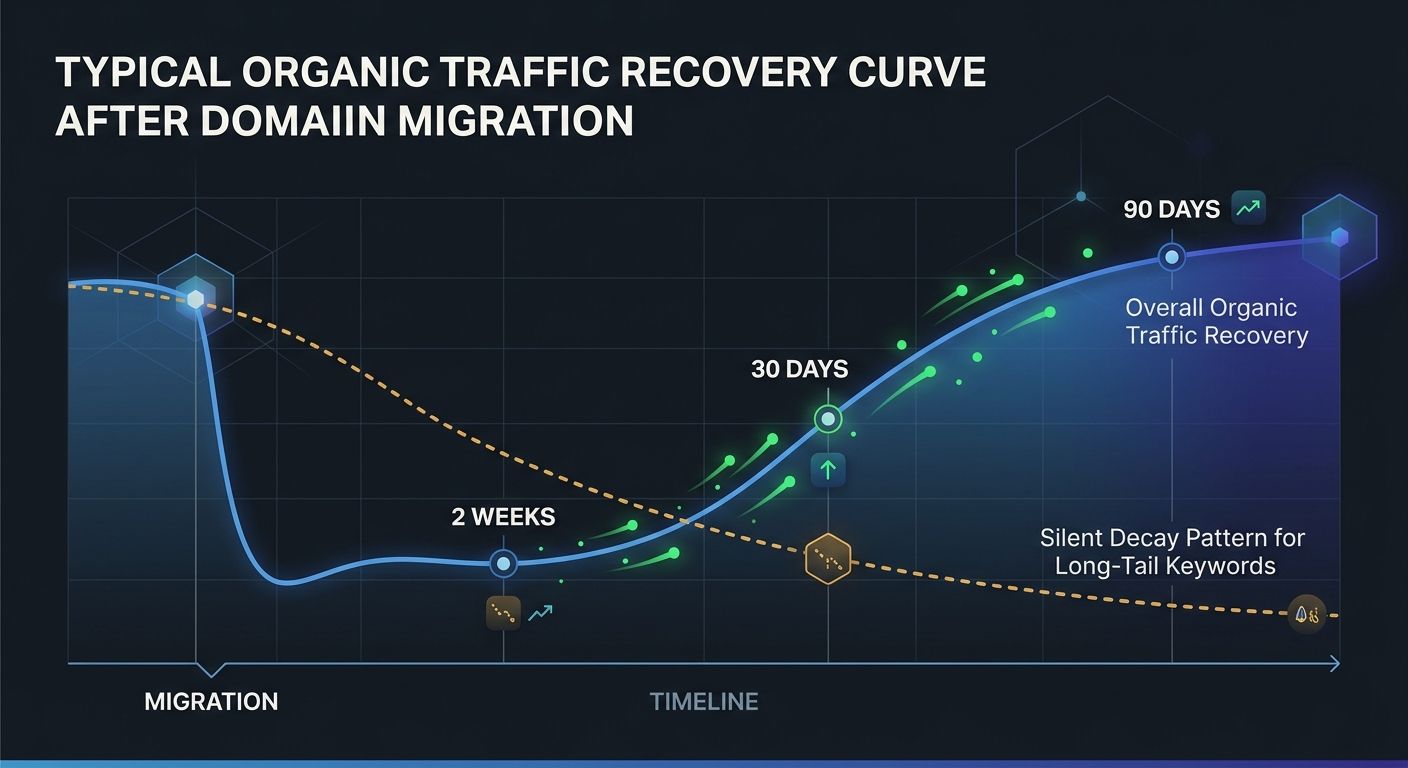
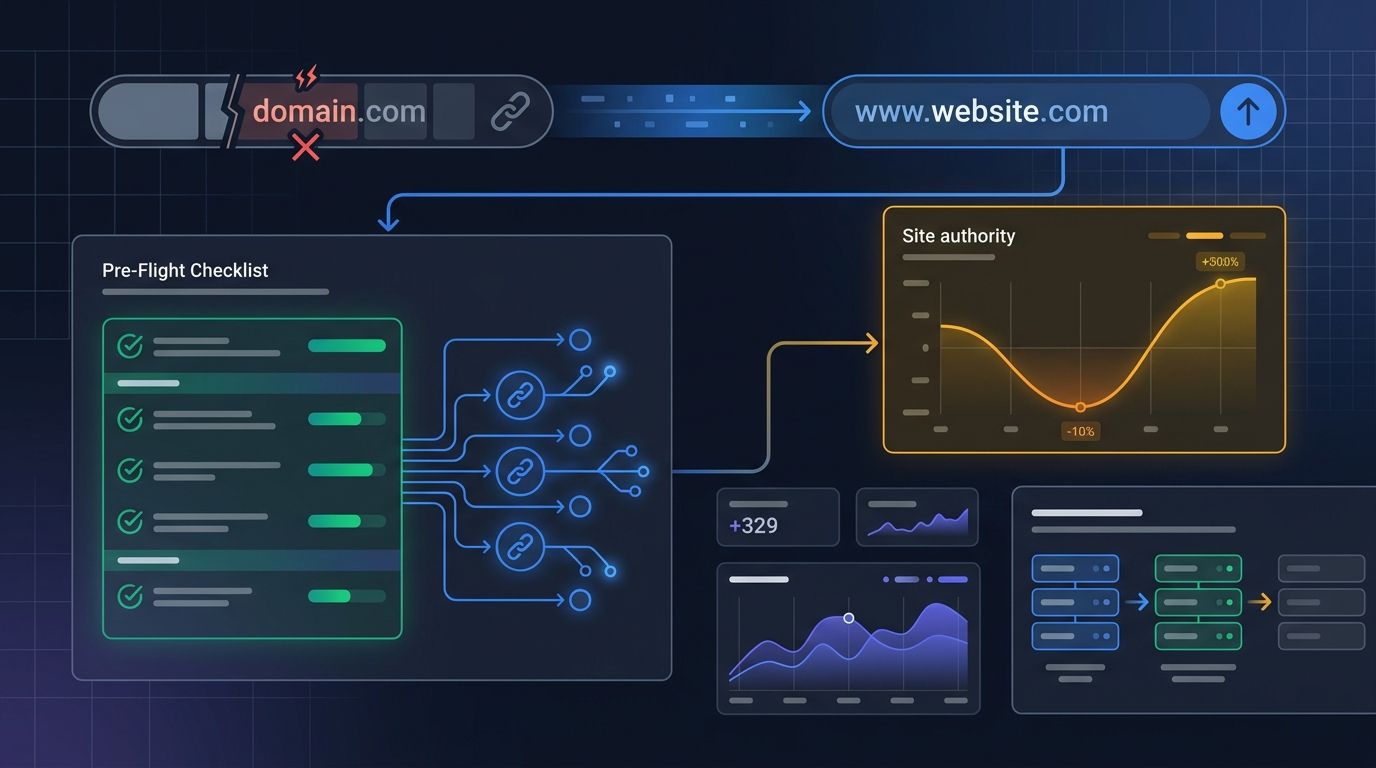
Post-migration, organic traffic follows a predictable pattern. Rankings dip 10–25% in the first 2 weeks as Google processes the redirect signals, then gradually recover over 4–12 weeks for well-executed migrations. The danger zone is "silent decay," where core branded keywords recover quickly (masking the problem in aggregate dashboards) while long-tail pages and conversion-critical landing pages continue losing rankings for months.
Track these 5 signals weekly for the first 90 days:
Indexed page count in Google Search Console (should match pre-migration levels within 30 days)
Crawl stats showing redirect response codes decreasing as Google updates its index
Core Web Vitals on the new domain, since server-level changes during migration often introduce performance regressions
Referring domain count in your backlink monitoring tool, confirming external links are resolving to the new URLs
Quality Score trends across all active paid campaigns, flagging any landing pages that dropped 2+ points
The domain migration audit checklist covers the full monitoring protocol in detail. For paid media specifically, watch your cost-per-conversion metric. A 20%+ increase in the first week post-migration signals that conversion tracking or landing page evaluation broke during the transition.
Where the Three-Layer Migration Stack Breaks
Even a perfectly executed 301 redirect strategy has structural limitations. Understanding these failure modes prevents false confidence.
International domains resist clean migration. Moving from country-code TLDs (example.co.uk, example.de) to a single global domain with subdirectories creates hreflang complexity that 301 redirects alone can't resolve. Google's hreflang processing is notoriously fragile, and migrations that change both the domain and the URL structure simultaneously have a 17% chance of never recovering pre-migration traffic levels.
High-authority backlinks from government and educational domains (.gov, .edu) re-crawl slowly. These sites' crawl rates are low, meaning Google may take 6–12 months to discover that a .edu backlink's destination now redirects. During that window, the link equity sits in limbo.
Sites with more than 50,000 URLs hit crawl budget ceilings. Google allocates a finite crawl budget per domain, and processing 50,000+ 301 redirects on the old domain while simultaneously crawling the new domain's pages creates competition for crawler attention. Large migrations benefit from a phased approach, moving sections of the site sequentially rather than all at once.
And the hardest constraint: you can preserve domain authority through redirects, but you can't preserve brand recognition signals. If users bookmarked old URLs, saved them in documents, or shared them in Slack channels, those references become redirect-dependent forever. Removing the old domain or letting it expire breaks every one of those paths permanently. Semrush's domain migration guide is explicit on this point: 301 redirects should stay in place for as long as you use the new domain name.
The three-layer migration stack — URL mapping, signal transfer, and monitoring — accounts for the mechanisms you can control. What it can't account for is the 1–10% of traffic that relies on human behavior patterns no redirect can replicate. Budget for that loss. Plan your paid media spend to compensate for 4–8 weeks of organic softness. And keep the old domain renewed, because the moment it lapses, every redirect you built becomes a dead end.

Alex Chen
Alex Chen is a digital marketing strategist with over 8 years of experience helping enterprise brands and agencies scale their online presence through data-driven campaigns. He has led marketing teams at two successful SaaS startups and specializes in conversion optimization and multi-channel attribution modeling. Alex combines technical expertise with strategic thinking to deliver actionable insights for marketing professionals looking to improve their ROI.
Related Articles

The Domain Migration SEO Audit Checklist: Preserving Rankings While Consolidating Brand Authority
The 301 redirect strategy that protects your organic rankings during a domain migration will break your paid search campaigns in ways no SEO checklist warns you about.
The Domain Migration SEO Playbook: Pre-Flight Checklist, Execution, and Post-Migration Recovery Timeline
Google's Change of Address tool forwards ranking signals for a hard 180-day window during domain-level moves, and 1:1 server-side 301 redirects pass full link equity to destination URLs. The mechanism that preserves SEO authority during migration is well-documented.

Website Migration Guide Establishes Expected 5% to 12% Organic Traffic Dip as Benchmark for Clean Redirects
Website migrations executed with complete URL mapping and tested 301 redirects should expect a temporary 5% to 12% organic traffic decline, while migrations without systematic redirect planning risk traffic crashes exceeding 40%, according to an SEO migration framework published by GadgetsFarms on A
Explore more topics