
AI Content Refresh Framework Published for Funding Industry SEO Maintenance
A five-part AI content refresh framework published June 25 by DistilledFunding targets funding-industry articles losing search rankings through outdated claims, weak meta descriptions, and broken conversion paths, according to the methodology post. The framework automates identification of stale fin

AI Content Refresh Framework Published for Funding Industry SEO Maintenance
A five-part AI content refresh framework published June 25 by DistilledFunding targets funding-industry articles losing search rankings through outdated claims, weak meta descriptions, and broken conversion paths, according to the methodology post. The framework automates identification of stale financial content before compliance gaps and trust erosion compound ranking declines.
The framework addresses a maintenance problem specific to finance-adjacent content: articles that quietly lose search visibility through incremental decay rather than sudden algorithm penalties. Unlike recipe blogs or lifestyle content, funding articles carry compliance risk when outdated product language or expired requirements remain live, the guide notes.
Five-Component Diagnostic System
The automation framework structures refresh decisions through five sequential audits: performance data analysis identifying high-impression low-click articles, intent mismatch diagnosis comparing current rankings to title positioning, freshness scanning for year references and expired offers, internal-link mapping for orphaned spoke content, and CTA validation checking conversion path integrity.
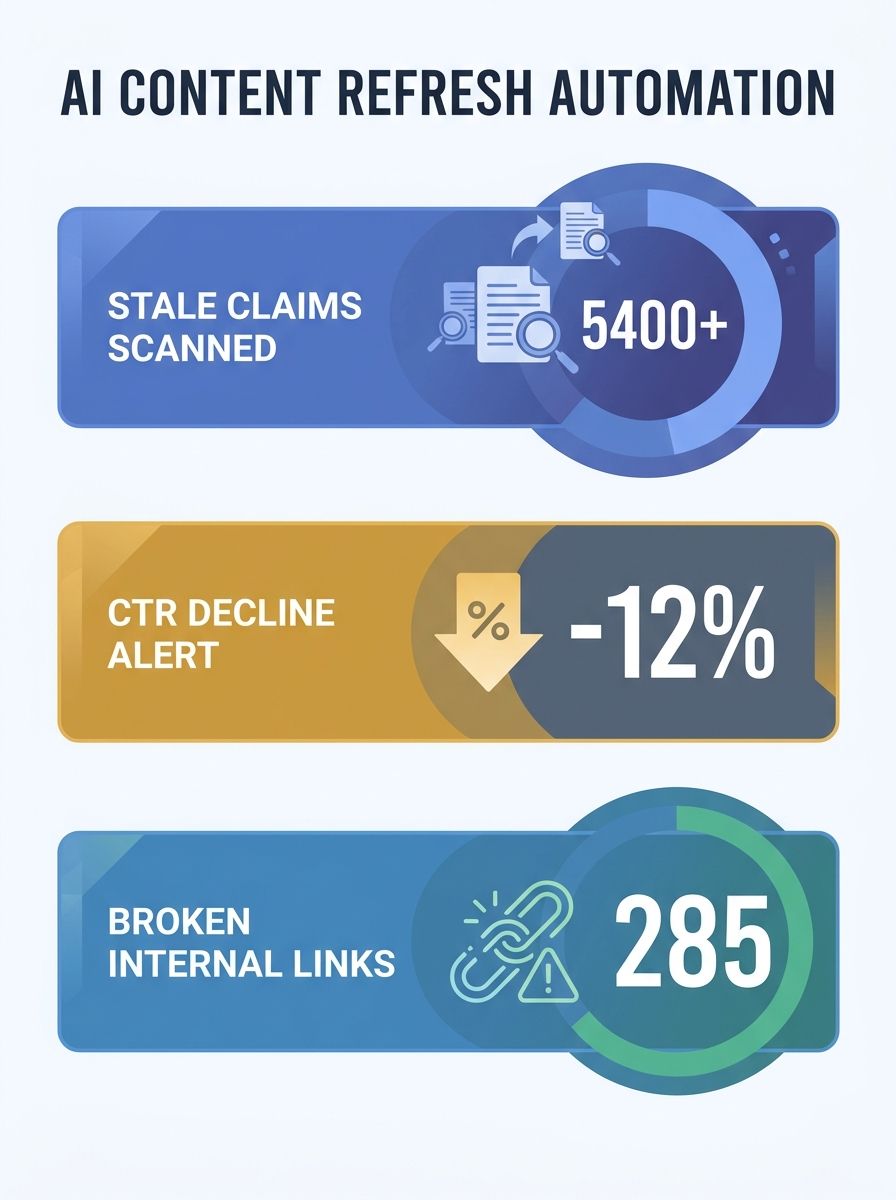
The first component prioritizes articles showing "signs of life", pages holding impressions but losing clicks, maintaining near-page-one rankings with weak click-through rates, or declining traffic over three to six months, according to the methodology. The system targets pages where improvement carries use rather than attempting comprehensive library refreshes.
Funding-specific examples the guide highlights include articles on "AI tools for loan brokers," "same-day business funding," and "business credit builder" that maintain search visibility while conversion paths deteriorate. The framework treats these pages as repair candidates rather than replacement targets.
Compliance and Trust Layer
The second and third framework components address finance content's unique trust requirements. The intent diagnosis identifies title-to-query mismatches where current rankings no longer align with article positioning, a page ranking for "business funding requirements" while titled as a product comparison, for instance.
The freshness audit scans for year references marking content as dated, outdated product terminology, expired promotional language, and what the guide terms "unsupported fast-funding claims" that create regulatory exposure. In finance-adjacent content, the methodology argues, credibility drives conversion more directly than in most verticals.
"A stale funding article can create real trust problems," the guide states, distinguishing compliance risk from pure SEO decay. The framework treats year-stamped claims and expired requirement language as priority fixes above structural optimization.
Structure and Citation Preparation
The fourth and fifth components address technical SEO and AI visibility. The internal-link audit identifies missing connections to pillar content, orphaned spoke articles, and weak anchor text, strengthening what the methodology describes as topical authority signals. The CTA validation checks for broken links, vague conversion language, and mismatched offers that turn search traffic into "digital window shopping."
A diagnostic table in the guide maps six refresh areas, search performance, snippet quality, claim freshness, internal links, funding CTAs, and AI citation gaps, to specific problems AI can surface and business impacts each creates. The AI citation component specifically targets definition absence, missing FAQ schema, and weak structural signals that reduce answer-engine extractability.
The framework explicitly excludes certain pages from refresh candidacy: brand-new sites with no content history, articles with zero impressions and no strategic role, pages requiring consolidation rather than updates, and content suffering from what the guide calls "bad positioning, bad offers, or bad underwriting language" that updates cannot remedy. "AI is a power tool. It is not a priest," the methodology notes, positioning automation as triage assistance rather than content strategy replacement.
Implementation and Tracking
The six-step implementation workflow pulls current performance data, identifies problem patterns, runs AI audits for freshness and structural gaps, makes refresh-versus-redirect decisions, applies updates with human review, and tracks reindexing results. The methodology emphasizes decision clarity over universal refresh, determining whether each article should be updated, merged, redirected, noindexed, or left unchanged.
The framework positions against what it terms "generic refresh advice" that recommends updating old posts without specifying which articles to prioritize, how to diagnose root causes, or how to connect maintenance to revenue outcomes. The guide distinguishes between articles needing title optimization, intent realignment, freshness updates, structural fixes, CTA repairs, or trust restoration.
For funding blogs, the methodology targets broker sites with outdated AI-tool posts, fintech brands preparing for AI citation opportunities, and WordPress or Webflow libraries with inconsistent metadata. The framework treats content refresh as a repeatable prioritization system rather than one-off audits, similar to how technical SEO triage frameworks rank fix urgency when multiple issues compete for resources.
The Takeaway
The DistilledFunding framework surfaces an automation use case distinct from content generation: using AI to audit and prioritize existing assets systematically rather than writing new material. For funding brands managing aging content libraries, the approach offers structure around a maintenance problem that compounds slowly, old articles don't typically lose rankings overnight, but incremental trust erosion and compliance drift create compounding risk over quarters.
The methodology's finance-specific angle addresses a credibility dimension most refresh frameworks skip: outdated product claims and expired requirement language carry regulatory exposure beyond pure SEO decay. As answer engines increasingly extract structured content, the framework's emphasis on definition blocks, FAQ schema, and direct-answer structure aligns refresh work with AI citation preparation rather than treating them as separate initiatives.

Alex Chen
Alex Chen is a digital marketing strategist with over 8 years of experience helping enterprise brands and agencies scale their online presence through data-driven campaigns. He has led marketing teams at two successful SaaS startups and specializes in conversion optimization and multi-channel attribution modeling. Alex combines technical expertise with strategic thinking to deliver actionable insights for marketing professionals looking to improve their ROI.
Related Articles

AI Content Production Guide Published Emphasizing Workflow Audit Over Tool Selection
TrySight.ai published a three-step framework on August 2, 2026, for scaling content operations with AI tools, positioning workflow auditing and strategic oversight ahead of technology implementation, according to the 2,400-word guide targeting marketing directors, solo founders, and agency teams.

Content Frameworks Built for 2019 Featured Snippets Now Reduce AI Overview Click-Through
Content frameworks optimized for featured-snippet extraction in 2019 now undermine click-through from AI Overviews appearing in 2.5 billion users' search results, according to a June 20 analysis published on Search Engine Journal examining how "answer the query in 40 words at the top" strategies lea

AI Systems Recommend Brands Based on Third-Party Mentions, Not Direct SEO Signals, Agency Founder Says
Kris Jones, founder of LSEO and former CEO of Pepper Jam, stated that AI search systems recommend brands based on third-party mentions and brand signals rather than direct optimization efforts, according to a Search Engine Journal podcast published August 3, 2026.
Explore more topics