
Google's August 2026 Algorithm Update Triggers Ranking Volatility Across 45% of Tracked Websites
Google's August 2026 algorithm update triggered ranking volatility across 45% of tracked websites beginning August 8, 2026, according to SEO Vendor's analysis published the same day, with sites demonstrating weak originality and thin evidence reporting steeper traffic declines than pages offering cl
Google's August 2026 Algorithm Update Triggers Ranking Volatility Across 45% of Tracked Websites
Google's August 2026 algorithm update triggered ranking volatility across 45% of tracked websites beginning August 8, 2026, according to SEO Vendor's analysis published the same day, with sites demonstrating weak originality and thin evidence reporting steeper traffic declines than pages offering clear value propositions.
The broad core ranking recalibration marks the third major algorithmic shift in 2026, following updates in March and June. SEO Vendor characterized the rollout as targeting pages with "vague intent" and insufficient evidence, distinguishing it from previous updates that focused more narrowly on spam patterns or experience signals. The firm's analysis drew on Search Console performance data and comparative metrics spanning four prior core updates.
Sites With Strong Technical Performance Gained Traffic
Sites maintaining strong Core Web Vitals scores gained between 12% and 28% more traffic during the rollout, according to the analysis. The disparity between winners and losers widened compared to earlier 2026 updates, with pages demonstrating "scaled AI abuse and expired domains" losing visibility at accelerated rates.
The December 2025 core update affected 52% of e-commerce sites, 67% of health sites, and 71% of affiliate sites, SEO Vendor reported, with top-three ranking churn reaching 66.8%. The August update's 45% volatility rate suggests a moderately lower but still substantial reshuffling of search results.
Rollout Duration and Volatility Patterns Diverge From Recent Updates
March 2025's core update lasted 14 days, June ran 17 days, and December extended to 18 days, the analysis noted. The August 2025 spam update—distinct from core updates—required 27 days to complete. SEO Vendor cautioned that judging the August 2026 core update's full impact before rollout completion would be premature, given historical patterns of mid-rollout reversals.
Google's June 2025 core update increased the weighting of Experience, Expertise, Authoritativeness, and Trustworthiness (E-E-A-T) signals, according to the timeline comparison. The August 2025 spam update targeted link spam and manipulative content specifically. The current update appears to blend quality thresholds with technical performance requirements, widening the gap between optimized and underperforming properties.
The March 2024 core update reduced low-quality content in search results by 45%, SEO Vendor stated, establishing a baseline for subsequent quality recalibrations. That earlier cut represented one of Google's most aggressive content-quality interventions before the helpful-content system integration.
Diagnostic Framework Identifies Query-Level Losses
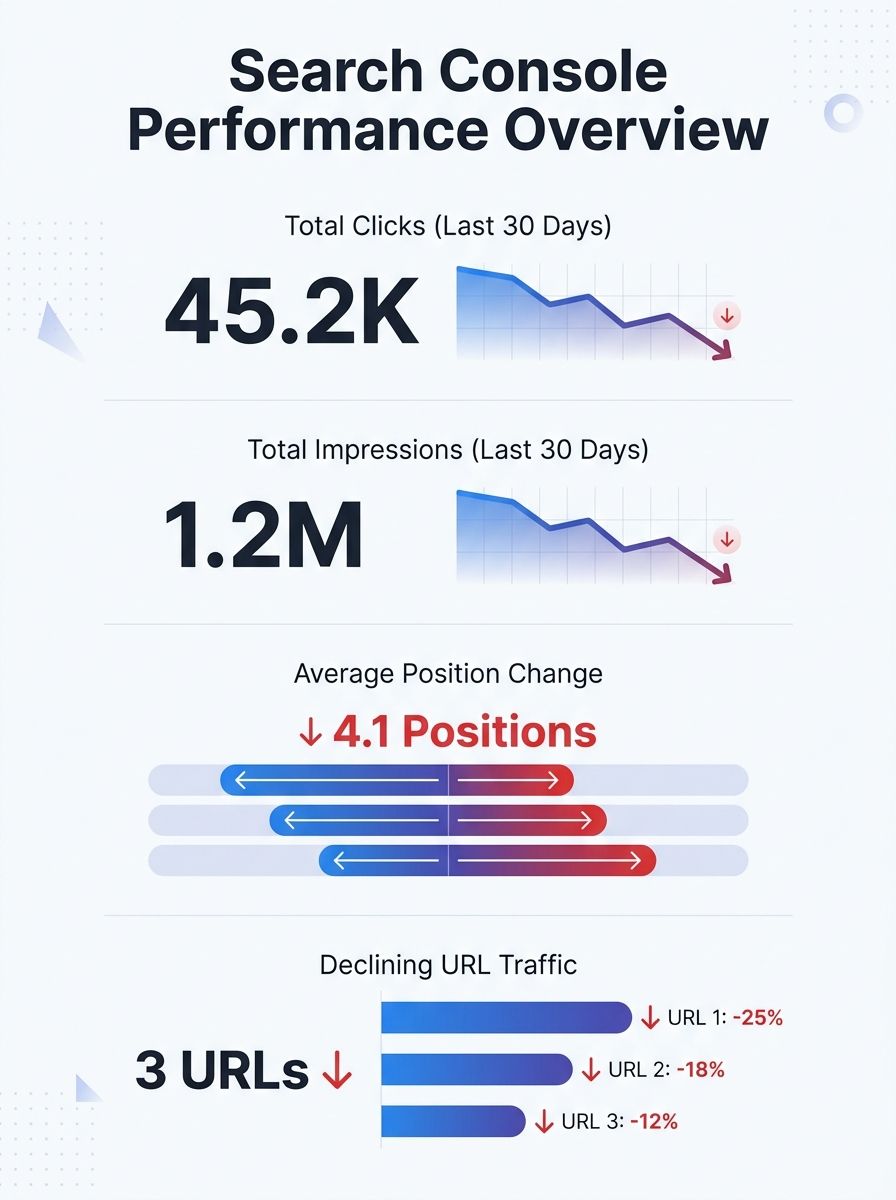
The analysis outlined a five-step diagnostic protocol using Google Search Console. The recommended approach compares 28-day performance windows to isolate URLs with the steepest position and click declines, then examines query-level data to identify whether lost rankings cluster around specific content themes or intent categories.
"If you move from position 2 to 4, it is often small, but if you fall from the top 5 to page two, you need a closer look," the analysis stated. The framework emphasizes pattern recognition across page groups rather than URL-by-URL fixes, acknowledging that Google uses over 200 ranking signals.
Pages requiring fresh results under Google's Query Deserves Freshness (QDF) protocol may have lost positions to newer content, the analysis noted. Export and categorization by topic or template helps agencies prioritize recovery work where multiple pages serving similar intents suffered simultaneous declines. SEO practitioners diagnosing traffic drops have increasingly relied on Search Console's query filtering to separate algorithmic penalties from seasonal or competitive shifts.
Recovery Recommendations Emphasize Evidence and Consolidation
SEO Vendor advised waiting for full rollout completion before implementing site-wide changes, citing the June 2025 core update's partial reversals during its 17-day window. Rewriting affected pages to include "firsthand proof" and merging thin pages chasing identical topics ranked among the five primary recovery steps.
The guidance warned against "scope creep" and premature verdicts, listing these among the five most common agency mistakes during recovery efforts. "Google Analytics, Google Search Console, Semrush, and Google's Core Web Vitals Report often show that you need to give the update more time," the analysis stated.
Agencies should remove spam, weak automation, and stale claims across entire sites rather than isolated fixes, the guidance continued. Google made 4,725 search changes in 2022 and 4,781 in 2023, the analysis noted, leaving "little room for weak pages" in competitive verticals.
Reading Between the Lines
Google's August 2026 update arrives as the search industry navigates a dual challenge: algorithmic quality bars continue rising while AI-generated answer features command growing query share. The 45% volatility rate—lower than December 2025's sector-specific impacts but higher than March 2025's moderate rollout—suggests Google is refining rather than revolutionizing its quality signals. Sites that survived previous core updates by maintaining E-E-A-T compliance and technical hygiene appear positioned to weather this recalibration, while properties relying on scaled content or expired-domain authority face compounding penalties.
The 12-28% traffic advantage for Core Web Vitals-compliant sites reinforces that technical performance now functions as a prerequisite rather than a differentiator. As rollout completes over the coming weeks, the gap between sites offering substantive evidence and those presenting generic assertions will likely widen further, accelerating the pattern established in the March 2024 update's 45% low-quality content reduction. Marketing teams tracking both traditional rankings and AI Overview citation rates must now optimize for two parallel quality thresholds that increasingly reward depth over breadth.

Alex Chen
Alex Chen is a digital marketing strategist with over 8 years of experience helping enterprise brands and agencies scale their online presence through data-driven campaigns. He has led marketing teams at two successful SaaS startups and specializes in conversion optimization and multi-channel attribution modeling. Alex combines technical expertise with strategic thinking to deliver actionable insights for marketing professionals looking to improve their ROI.
Related Articles
Google March 2026 Core Update Shifted 79.5% of Top-Three Search Results, SE Ranking Data Shows
Nearly four in five URLs ranking in Google's top-three positions changed during the March 2026 Core Update, according to volatility data published by SE Ranking on June 7, 2026. The 79.5% shift rate marks the highest positional volatility Google has produced in years, exceeding the 66.8% movement re

Google Rolls Out June 2026 Spam Update Targeting Low-Quality Content and Manipulative SEO Tactics
Google launched its June 2026 Spam Update on June 24, 2026, deploying automated systems designed to reduce search rankings for websites that violate the company's spam policies, according to Advait Technology Labs. The global update affects all languages and regions and is expected to take several d
Google Assigns Two-Week Rollout to September 2026 Spam Update, Adds Image Search Filter to Search Console
Google began rolling out its September 2026 spam update on September 24 with a two-week completion window, the longest rollout timeframe the company has assigned to any spam update this year, according to Search Engine Journal. The update applies globally across all languages.
Explore more topics