
The Organizational SEO Siloing Problem: Why Your Best Technical Work Gets Lost Between Teams
Technical SEO execution fails at the org chart, not at the codebase. Industry analysis shows 67% of organizations cite non-SEO development tasks as the primary barrier to implementing technical SEO changes, a bottleneck costing an estimated $35.9 million in unrealized annual revenue per enterprise.

The Organizational SEO Siloing Problem: Why Your Best Technical Work Gets Lost Between Teams
Technical SEO execution fails at the org chart, not at the codebase. Industry analysis shows 67% of organizations cite non-SEO development tasks as the primary barrier to implementing technical SEO changes, a bottleneck costing an estimated $35.9 million in unrealized annual revenue per enterprise. The fixes are identified. The deployment pipeline is what's broken.
I've spent 8 years watching technically sound SEO recommendations die in Confluence pages nobody reads. The pattern repeats across organizations of every size: an SEO team identifies a fix, documents it thoroughly, submits a ticket, and then watches it rot in a backlog for 6 to 14 months while developer sprints prioritize feature work. The diagnosis is always framed as a resourcing problem. But the actual disease is structural. Your teams aren't failing to execute because they lack talent. They're failing because the organization's incentive architecture treats SEO as someone else's problem at every handoff point.
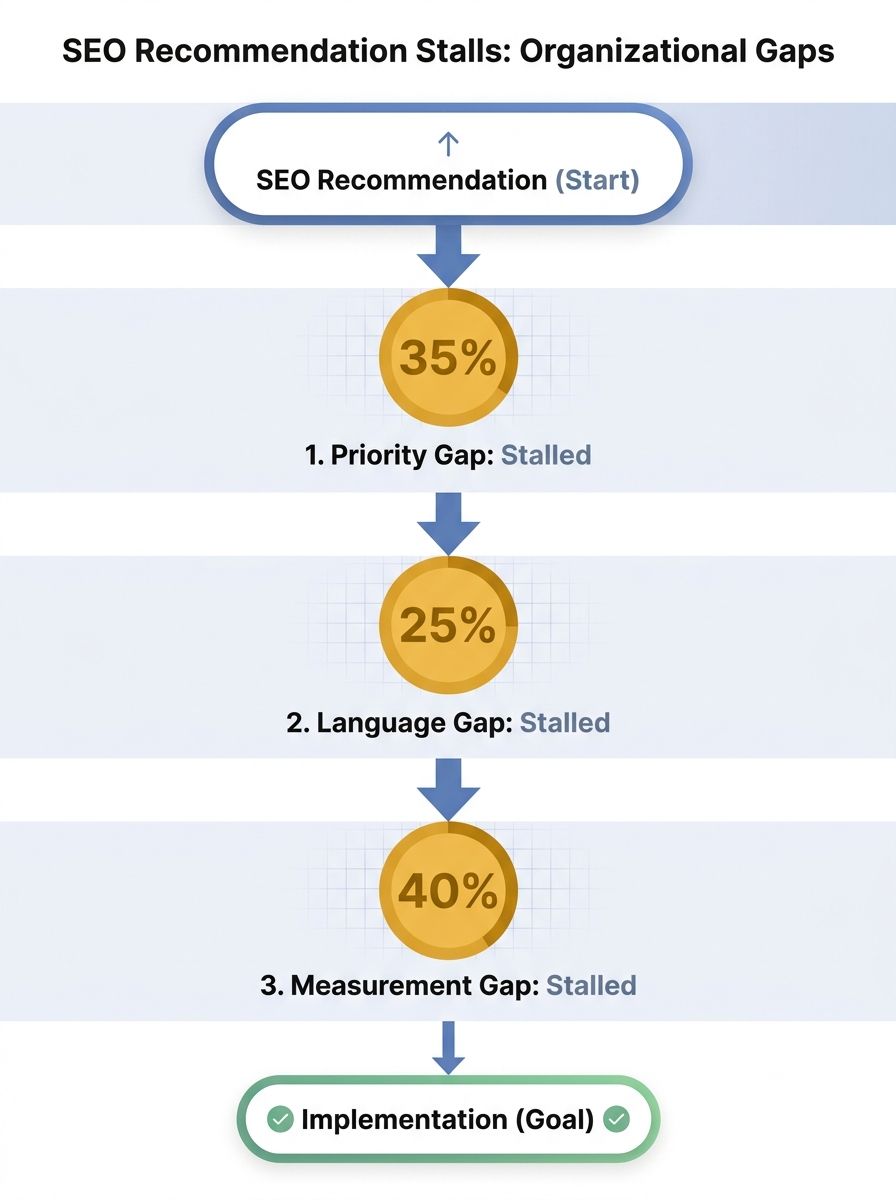
I call this the Three-Gap Model for diagnosing organizational SEO bottlenecks: the Priority Gap, the Language Gap, and the Measurement Gap. Each gap represents a specific point where technically excellent SEO work dies between teams. Understanding where your organization bleeds is the first step toward fixing the pipeline.
SEO and Paid Search Actively Compete for the Same Dollar
The Priority Gap is the most visible and the most expensive of the three. It shows up when teams that should be coordinating instead compete for the same resources, keywords, and executive attention.
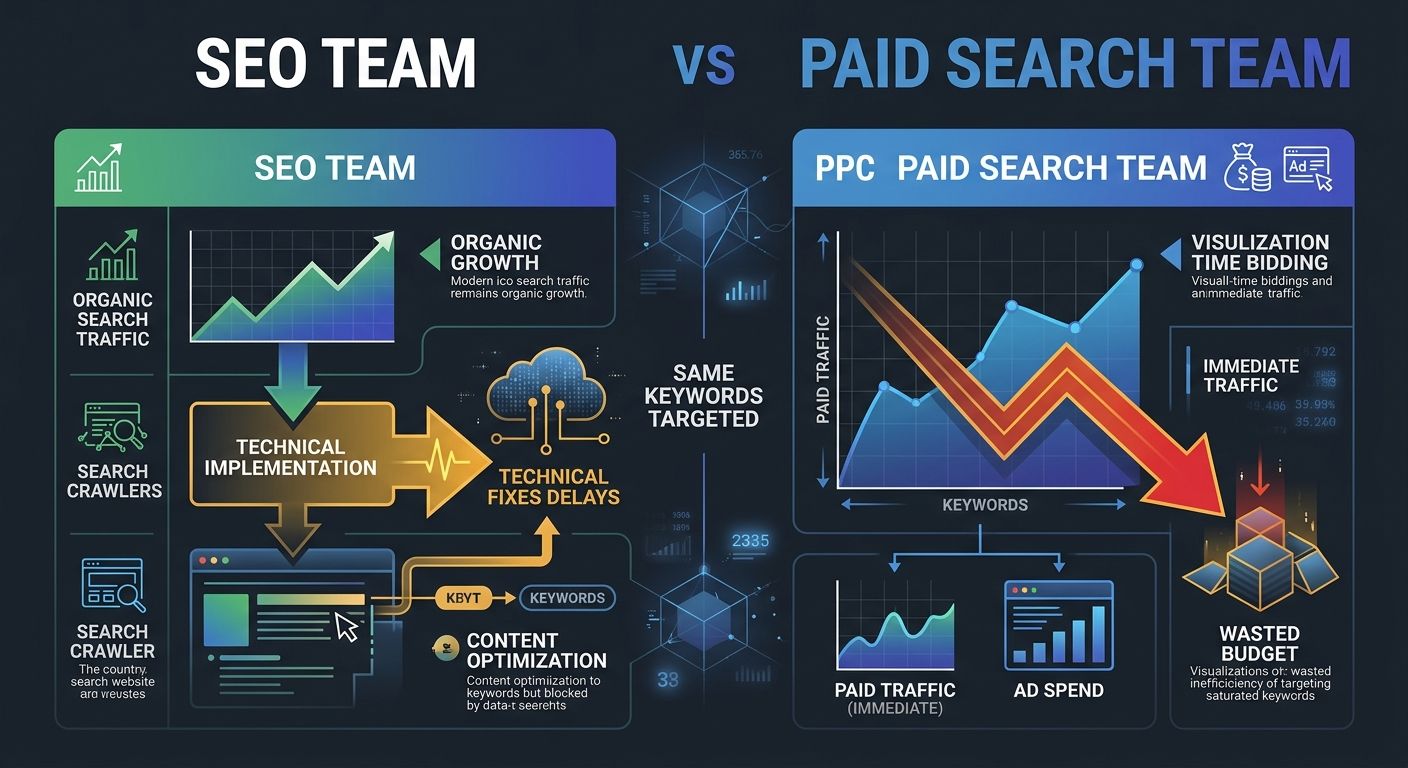
As Monday.com's breakdown of marketing silos describes it, "the SEO team optimizes pages while the paid search team bids on the same keywords, competing against each other instead of working together." This cannibalization is shockingly common. I've audited organizations where the paid search team was spending $14,000 per month bidding on branded terms that already held the #1 organic position, while the SEO team's request to fix crawl errors on 2,300 product pages sat unaddressed in the development queue.
The cost model here is straightforward. Every dollar spent on paid search for a keyword you already rank organically for is a dollar that could fund the developer hours your SEO backlog needs. But the paid search team's KPIs reward spend efficiency and conversion volume. The SEO team's KPIs reward organic traffic growth. Neither team is incentivized to look at the combined picture, and the VP of Marketing often doesn't have the attribution infrastructure to see the overlap.
This is where the attribution configuration problems we've documented before become operational killers. When your attribution model can't distinguish between a user who would have clicked the organic result from one who clicked the ad, you're flying blind on budget allocation between channels.
The Priority Gap also surfaces in developer sprint planning. Product engineering teams typically run 2-week sprints with capacity allocated across feature development, bug fixes, and infrastructure work. SEO requests compete against product roadmap items for the same engineering hours. When a product manager weighs "implement schema markup on 4,000 product pages" against "ship the checkout flow redesign that will increase conversion by 0.3%," the SEO ticket loses every time. The work has clear revenue impact, but the pathway from implementation to revenue is longer, less direct, and harder to attribute with the tools the PM uses to justify sprint priorities.
Organizations that treat technical SEO triage as a systematic practice can partially solve this by connecting each fix to a projected revenue number. But even the best-documented business case falls flat when it lands in a sprint planning meeting where nobody present understands what "render-blocking JavaScript on 40% of indexable URLs" actually means for the bottom line.
Translation Failures Kill More Fixes Than Technical Debt
The Language Gap is subtler than the Priority Gap but equally destructive. Different departments operate with entirely different vocabularies, mental models, and definitions of success. An SEO team's ticket that reads "implement hreflang tags across the /de/ subdirectory for 1,847 pages" is technically precise and completely meaningless to a front-end engineer whose mental model centers on component architecture and build pipelines.
Growth Minded Marketing's research on cross-functional SEO teams captures this dynamic precisely: "When we talk about a product manager, a designer, and an engineer and they can't agree, struggling to align, they haven't integrated their perspectives. They're each relying on unique knowledge that they haven't shared with each other."
The same research identifies that this integration failure is the default state. Teams don't naturally converge on shared understanding. They maintain their own frameworks, and every cross-team handoff requires active translation work that nobody's job description accounts for.
I've found that SEO knowledge silos persist even in organizations that hold regular cross-functional meetings. The meetings become status updates rather than translation sessions. The SEO lead reports that "Core Web Vitals scores dropped 12% on mobile product pages after the last deployment," and the engineering lead nods, notes it, and moves on to the next agenda item. Neither party walks away with a shared understanding of what caused the regression, what the fix involves from an engineering perspective, or how to prevent it from recurring. The information crosses the boundary between teams without actually transferring knowledge.
Cross-functional marketing execution breaks down at exactly this translation layer. According to research on cross-functional collaboration challenges, the primary barriers include "misaligned goals between teams, siloed communication, unclear workflows, and conflicting team incentives." Notice that none of those four barriers are technical. They're all organizational.
The fix requires what I'd describe as bilingual roles: people who sit between SEO and engineering (or SEO and content, or SEO and product) and can translate requirements in both directions. Some organizations call these "SEO liaisons" or "technical product marketers." The title matters less than the function. Without someone whose explicit job is to translate SEO requirements into the language and workflow of the receiving team, recommendations pile up in ticket systems and die of neglect.

Every Department Declares Victory While Revenue Stalls
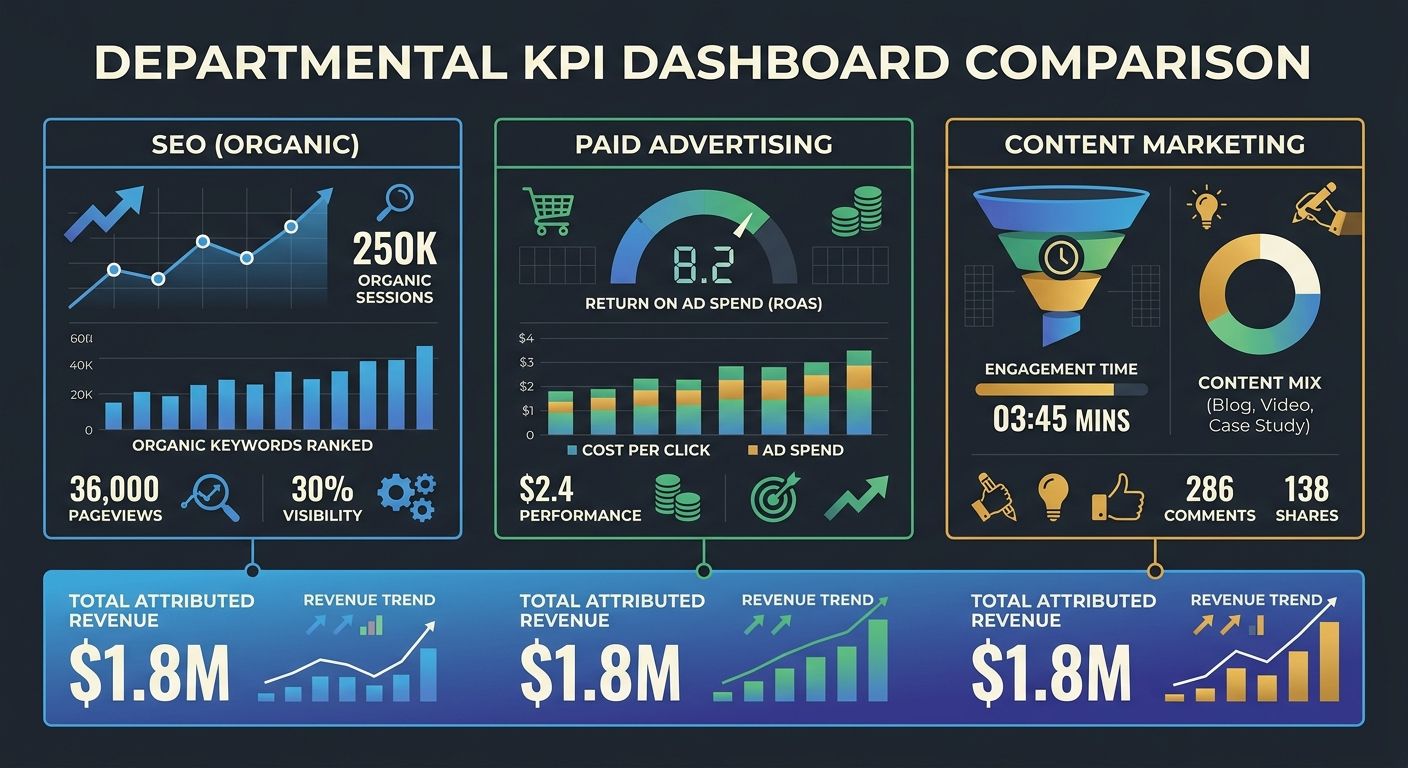
The Measurement Gap is the most structurally entrenched of the three. When the SEO team measures organic sessions, the paid team measures ROAS, the content team measures engagement time, and the product team measures feature adoption, each group can report positive numbers in the same quarter that overall revenue growth flatlines.
MarTech's analysis of marketing team silos recommends that organizations adopt shared metrics precisely because siloed measurement "helps identify bottlenecks that might not be visible from their siloed view." The argument to team leads is that shared metrics "provide a clearer understanding of their team's impact on overall business success, justifying their budget and resources more effectively."
This framing matters because it reframes shared measurement from a threat ("your numbers will be scrutinized") to an advantage ("you'll be able to prove your value more convincingly"). In my experience running cross-functional marketing execution programs, the teams most resistant to shared KPIs are the ones whose isolated metrics look the best. They have the most to lose from transparency.
The SEO planning breakdowns that happen at scale are almost always measurement problems in disguise. An enterprise SEO team that can't demonstrate how its work contributes to pipeline revenue will always lose sprint capacity to teams that can. And most SEO teams measure traffic, not revenue, because the attribution infrastructure to connect organic search visits to closed deals doesn't exist in their analytics stack.
Building shared dashboards is necessary but insufficient. The real structural fix is aligning incentive structures so that the SEO team, the content team, and the development team share at least one common KPI that they're all evaluated against. Revenue influenced by organic search is one option. Organic-sourced pipeline value is another. The specific metric matters less than the fact that multiple teams are accountable to it simultaneously.
When you run a multi-channel visibility audit, the measurement gap becomes visible almost immediately. You'll see channels performing in isolation with no connective tissue between them. And Search Engine Land's argument that organizations need to "kill the channel silo and let the SEO team act as the strategic quarterback for brand authority" only works if that quarterback has access to measurement systems that span the full field.
The Silo Survives Until Incentives Change
The Three-Gap Model points to a conclusion that's uncomfortable for anyone hoping a new project management tool or a better meeting cadence will fix SEO team alignment: organizational SEO bottlenecks are incentive problems, and incentive problems require structural intervention from leadership. No amount of cross-functional Slack channels or shared Notion databases will close the Priority Gap when the engineering team's bonus structure rewards feature velocity and says nothing about search performance. No documentation standard will close the Language Gap when nobody's job description includes the word "translation." No dashboard redesign will close the Measurement Gap when each team's budget justification depends on metrics that only they control.
The organizations I've seen actually solve this problem share three characteristics. They assign a named person (or small team) whose explicit role is to sit across departmental boundaries, translate requirements, and track implementation through the full lifecycle from SEO recommendation to production deployment. They create at least one shared KPI that spans SEO, content, paid, and product. And they give the SEO function a formal seat in sprint planning, not as a guest who presents requests, but as a stakeholder who participates in prioritization decisions.
That structural shift is what separates organizations that produce excellent SEO audits from organizations that produce excellent SEO results. The audit is the easy part. Getting crawl budget issues fixed requires engineering time. Getting content gaps filled requires editorial alignment. Getting technical debt addressed requires product buy-in. Every one of those dependencies crosses a team boundary, and every one of those boundaries is a place where good work goes to stall. The org chart is the constraint. Redesigning how teams share priorities, language, and measurement is the only intervention that actually moves the needle.

Alex Chen
Alex Chen is a digital marketing strategist with over 8 years of experience helping enterprise brands and agencies scale their online presence through data-driven campaigns. He has led marketing teams at two successful SaaS startups and specializes in conversion optimization and multi-channel attribution modeling. Alex combines technical expertise with strategic thinking to deliver actionable insights for marketing professionals looking to improve their ROI.
Related Articles

The SEO Mistake Triage System: Diagnosing Root Causes Instead of Treating Symptoms
Automated SEO audit tools flag hundreds of issues per crawl but assign equal visual severity to missing alt text and accidental noindex tags on revenue pages.
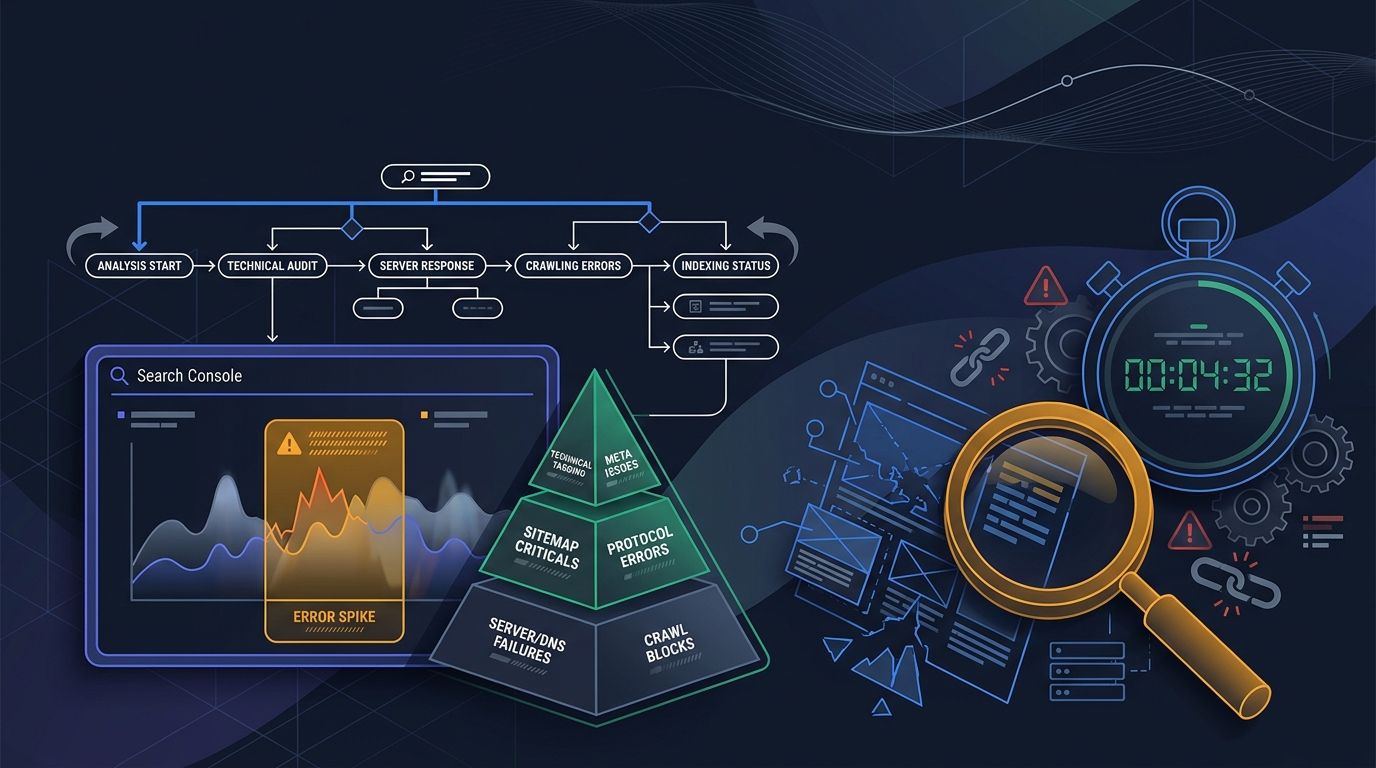
The SEO Triage Protocol: Prioritizing Technical Fixes When Everything Is Broken
Fixing technical SEO issues in the order your audit tool ranks them guarantees the slowest possible recovery. Automated severity scores ignore your traffic patterns, your social promotion calendar, and which pages generate revenue.

The SEO Workflow Breakdown: Building a Repeatable System That Scales With Your Team
Switching from ad-hoc SEO execution to a structured workflow system reduced time-to-publish from over two weeks to three to five days per content asset, while cutting brief creation time from two to three hours down to 30 minutes. These gains compound across every piece of content a team produces.
Explore more topics