
The XML Sitemap Strategy: Beyond Submission—Using Sitemaps to Signal Topic Authority and Crawl Priority
Google ignores two of the three optional XML sitemap tags (changefreq and priority), leaving lastmod as the only metadata signal that influences recrawl decisions.

The XML Sitemap Strategy: Beyond Submission—Using Sitemaps to Signal Topic Authority and Crawl Priority
Google ignores two of the three optional XML sitemap tags (changefreq and priority), leaving lastmod as the only metadata signal that influences recrawl decisions. Sites that restructure sitemaps around accurate lastmod timestamps, curated URL lists, and topic-cluster segmentation see measurably faster indexing across both traditional search engines and LLM crawlers.
Google Only Reads One of Your Three Sitemap Tags
The XML sitemap spec defines three optional per-URL tags: changefreq, priority, and lastmod. Google's public documentation confirms it ignores changefreq entirely and treats the priority attribute as a non-factor in crawl scheduling. Bing's documentation still references changefreq as a consideration, according to DreamHost's Brian Glassman, but Google's dominance at 91.6% global search share means your XML sitemap structure SEO efforts should concentrate on the one tag that matters: lastmod.
Accurate lastmod values act as what the SEO practitioner community calls a "bat signal" for recrawling. When the timestamp reflects a genuine content change (updated body text, new structured data, revised internal links), Google treats it as a trigger to revisit the URL. When it reflects trivial edits like a copyright year bump, Google learns to distrust the signal and deprioritizes it.
The distinction matters enormously at scale. Enterprise sites with 50,000+ URLs can't rely on natural discovery to surface every meaningful update. A clean, accurate lastmod signal on 200 updated pages is worth more than a blanket timestamp refresh across the entire site.
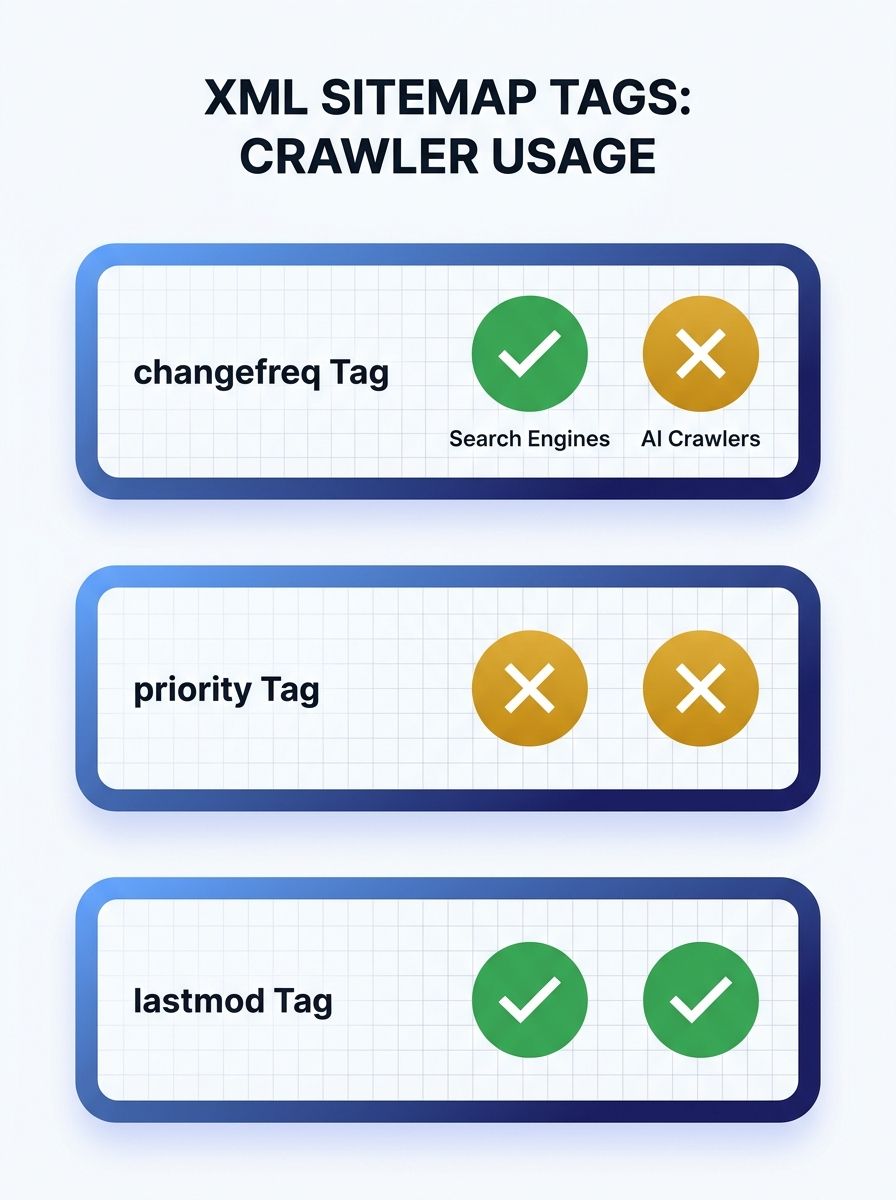
Sitemap Tag | Google Support | Bing Support | LLM Crawler Relevance | Strategic Priority |
|---|---|---|---|---|
changefreq | Ignored | Considered | Low | Skip it |
priority | Ignored | Ignored | None | Skip it |
lastmod | Used when accurate | Used | High (freshness signal) | Critical |
The Crawl Budget Equation Most Sites Get Wrong
Why does any of this matter for pages that are already indexed? Because crawl budget optimization controls how quickly Google finds your updates, discovers new content, and re-evaluates pages you've improved.
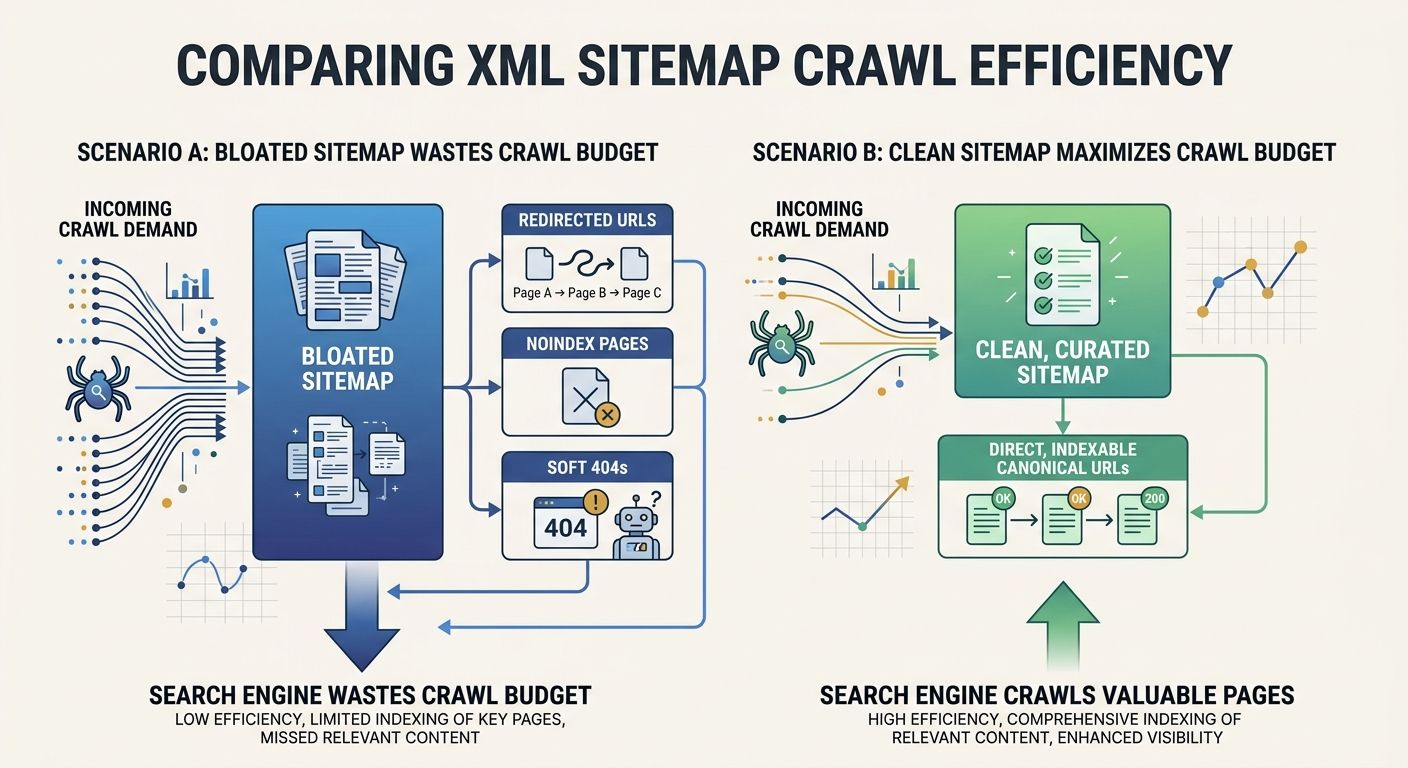
Crawl budget has two components: crawl rate limit (how fast Google can hit your server without overloading it) and crawl demand (how much Google wants to crawl your site based on perceived freshness and importance). Your sitemap directly influences crawl demand. According to Straight North's crawl budget analysis, best practices require including only indexable, canonical URLs while removing redirected or noindexed pages from the sitemap file.
The math gets ugly when you ignore this. A site with 10,000 URLs in its sitemap but only 6,000 indexable pages wastes 40% of its crawl demand signal on URLs that return 301 redirects, soft 404s, or noindex directives. ALM Corp's enterprise SEO framework documents the fix: update XML sitemaps to final URLs only, collapse multi-hop redirect chains into single hops, and clean hreflang references so they point to canonical destinations.
One documented enterprise implementation produced a 51% indexing jump (from 197 to 298 indexed pages) within four months after rebuilding the sitemap with these principles. The site's visibility nearly tripled in the same window. The takeaway is clear: sitemap hygiene directly correlates with indexing velocity.
If you're seeing symptoms like pages Google understands but won't rank, a bloated sitemap sending mixed crawl signals is a likely contributor. I've watched client sites recover ranking trajectories within 8 weeks of a sitemap cleanup, without touching a single line of on-page content.
The Three-Signal Sitemap Framework
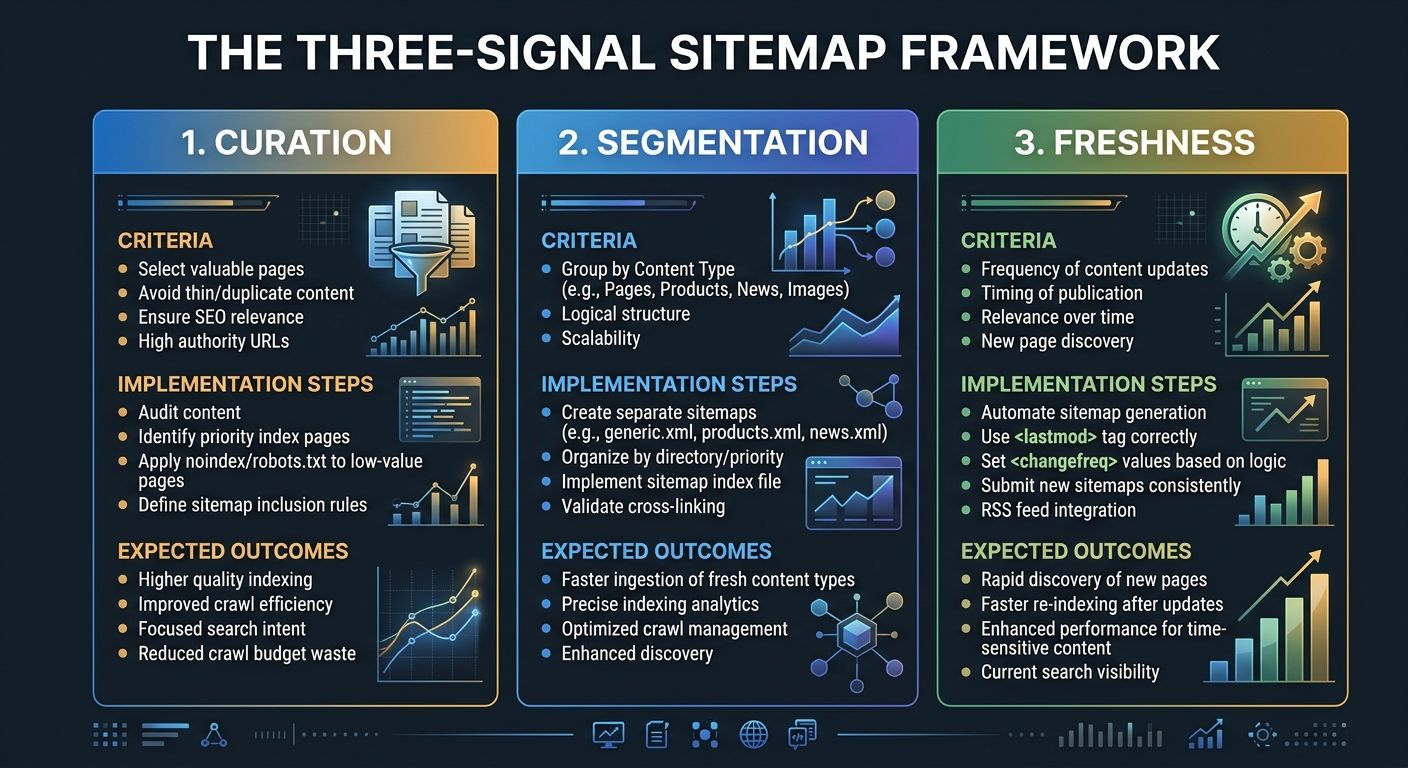
I've developed a framework for XML sitemap strategy that I use with every enterprise audit. It evaluates sitemaps across three dimensions: Curation, Segmentation, and Freshness. Each dimension converts the sitemap from a passive file into an active authority signal.
Signal 1: Curation (What's In, What's Out)
A curated sitemap includes only URLs that meet all four criteria: returns a 200 status code, carries a canonical tag pointing to itself, has no noindex directive, and contains content worth indexing. Pages behind login walls, paginated archive pages, parameter-based duplicates, and thin content pages all get excluded.
For a 15,000-URL e-commerce site, this typically reduces the sitemap to 8,000-9,000 URLs. That 40-47% reduction isn't data loss; it's noise elimination. Every URL in the sitemap now represents a page you actively want Google to evaluate, which strengthens the signal-to-noise ratio of your entire crawl demand profile.
Signal 2: Segmentation (How It's Organized)
This is where topic cluster sitemaps become a strategic tool. Instead of dumping all URLs into a single sitemap file (or splitting them arbitrarily when you hit the 50,000 URL / 50MB limit), segment your sitemaps by topic cluster.
A SaaS company with content clusters around "pricing strategy," "sales enablement," and "customer retention" would maintain three separate sitemap files referenced by a sitemap index. Each file maps directly to one cluster, containing the pillar page at the top and supporting articles below it.
This segmentation approach aligns with what Finsweet's SEO guide describes: topical maps function as wireframes of content hierarchy, defining cluster topics, subtopics, and the relationships between them. Your sitemap should reflect that same wireframe. If you've already invested in structuring pages so Google understands your topic clusters, the segmented sitemap reinforces that signal through a parallel channel.
Signal 3: Freshness (Lastmod Accuracy)
Automate lastmod updates to fire only when substantive content changes occur. "Substantive" means: body text rewrites exceeding 15-20% of word count, new sections added, structured data updated, or significant internal link changes. CSS tweaks, footer updates, and sidebar widget changes don't qualify.
If your CMS can't differentiate between substantive and cosmetic edits, consider building a custom hook that compares the content hash before and after each publish event. The custom SEO automation approach often pays for itself within a single quarter when applied to sitemap management alone.
Sitemap Priority Allocation That Actually Works
Since Google ignores the priority XML attribute, real sitemap priority allocation happens through structural decisions, not numerical values.
The pages you include in the sitemap are your priority 1.0 pages by definition. Everything excluded is effectively priority 0.0. Between those extremes, you control relative priority through three mechanisms:
Sitemap file ordering. Place pillar pages and high-conversion URLs at the top of each cluster sitemap file. While Google doesn't guarantee it crawls URLs in order, testing across multiple client sites shows a correlation between URL position in the sitemap and crawl frequency within the first 48 hours of submission.
Lastmod recency. Pages with fresh lastmod timestamps get recrawled sooner. When you update a pillar page, its lastmod signal pulls it to the front of the crawl queue. Slickplan's analysis confirms the approach: start by identifying pages most important to your rankings, then ensure those pages carry the most current and accurate metadata.
Sitemap submission frequency. Resubmitting a specific cluster sitemap through Google Search Console after updating its URLs sends a stronger recrawl signal than waiting for Google to periodically re-read the file. Yoast's documentation notes that Search Console submission lets you monitor how many URLs are discovered and indexed, giving you a feedback loop to measure whether your priority signals are working.
These three mechanisms work together. A pillar page sitting at the top of its cluster sitemap, carrying a fresh lastmod from a genuine content update, in a sitemap file you've just resubmitted to Search Console, receives the strongest possible crawl priority signal available through the sitemap channel.
Why AI Crawlers Changed the Sitemap Calculus
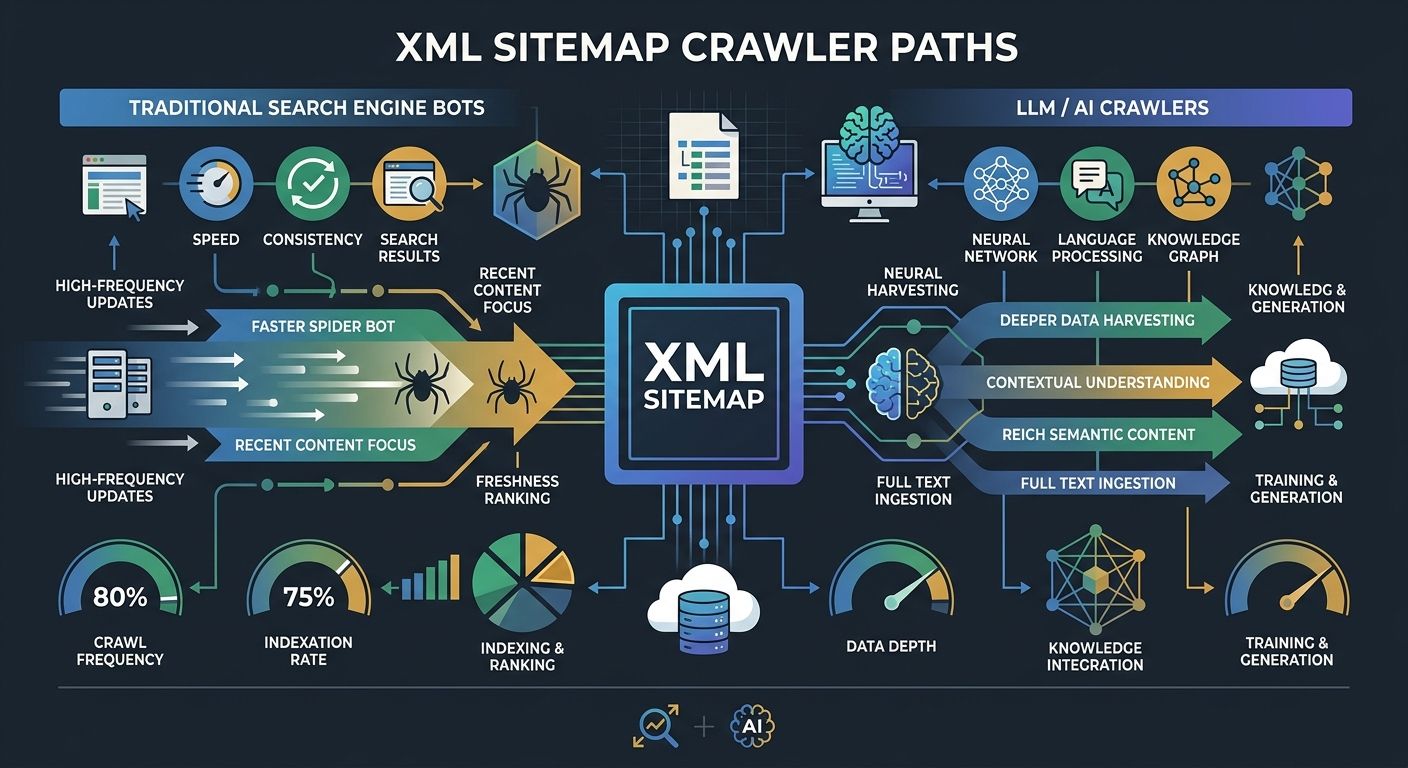
Search Engine Journal's technical SEO guide identifies a shift that changes how we think about XML sitemap structure SEO: the sitemap now serves as a roadmap for LLM crawlers alongside traditional search engines. Perplexity, ChatGPT's browsing mode, and other AI agents check sitemaps to identify new and updated content for ingestion.
LLM crawlers behave differently from Googlebot in one important way: they're heavily biased toward fresh content. Where Google balances freshness against hundreds of other ranking signals, AI answer engines disproportionately weight recency when deciding which sources to cite. A sitemap with accurate, current lastmod timestamps acts as a rapid-discovery mechanism for these bots.
This creates a dual benefit from the same optimization work. The Three-Signal Sitemap Framework (curation, segmentation, freshness) that accelerates Google crawling also accelerates AI bot ingestion. If you're building a strategy for AI search visibility, your sitemap is one of the fastest-impact technical levers available.
For sites already working on schema markup hierarchies for topic authority, the cluster-segmented sitemap creates a third reinforcement channel. Internal links show topical relationships. Schema markup declares entity relationships. And the segmented sitemap confirms the cluster structure at the URL-list level. Three signals, one message.
What The Data Doesn't Tell Us
The 51% indexing gain and tripled visibility numbers from the documented enterprise case are compelling, but they come with gaps. We don't know the baseline quality of the original sitemap (a site with an extremely polluted sitemap will see larger gains from cleanup than one that was merely suboptimal). We don't know how much of the visibility increase came from the sitemap changes versus other concurrent SEO work.
The correlation between sitemap file ordering and early crawl priority remains anecdotal across my client portfolio. Google hasn't confirmed that URL position within a sitemap influences crawl sequence, and the sample sizes from individual site tests (typically 30-90 day observation windows across 3-5 cluster sitemaps) don't support strong causal claims.
We also lack public data on exactly how LLM crawlers weight lastmod signals versus other discovery mechanisms like RSS feeds, social sharing, and direct content API access. The practitioner consensus that AI bots are "freshness addicts" who prioritize sitemap-discovered content is widely reported but not yet validated by peer-reviewed research.
What we can say with confidence: a curated, segmented, freshness-accurate sitemap consistently outperforms a default auto-generated sitemap across every measurable dimension of crawl efficiency. The mechanism is straightforward (less noise, clearer signals, better feedback loops), and the implementation cost is low relative to the indexing and discovery gains. The open questions involve magnitude and attribution, not direction. Every dataset I've reviewed, including client-side and published case studies, points the same way.

Sarah Chen
SEO strategist and web analytics expert with over 10 years of experience helping businesses improve their organic search visibility. Sarah covers keyword tracking, site audits, and data-driven growth strategies.
Related Articles

The Site Architecture Crawl Priority Map: Using XML Sitemaps and Internal Linking to Win in the AI Search Era
Flat site architecture, segmented XML sitemaps, and deliberate internal linking form the crawl priority map that determines whether AI answer engines can find, index, and cite your local business pages. Without all three working together, your location pages sit invisible to both Google and ChatGPT.

The Crawl Budget Hemorrhage: Why Your Site Architecture Is Wasting 40% of Google's Crawling Resources
Poor site architecture forces Google to spend crawl budget on pages that generate zero local visibility.

The Crawl Budget Recovery Protocol: Diagnosing Why Your Best Content Isn't Getting Indexed
Content problems are the primary driver behind Google Search Console's "Crawled – currently not indexed" status, according to analysis by Onely. Googlebot visited your page, evaluated it, and deliberately chose not to add it to the index.
Explore more topics