
SEO Guide: Site Architecture & Search Engine Success Factors
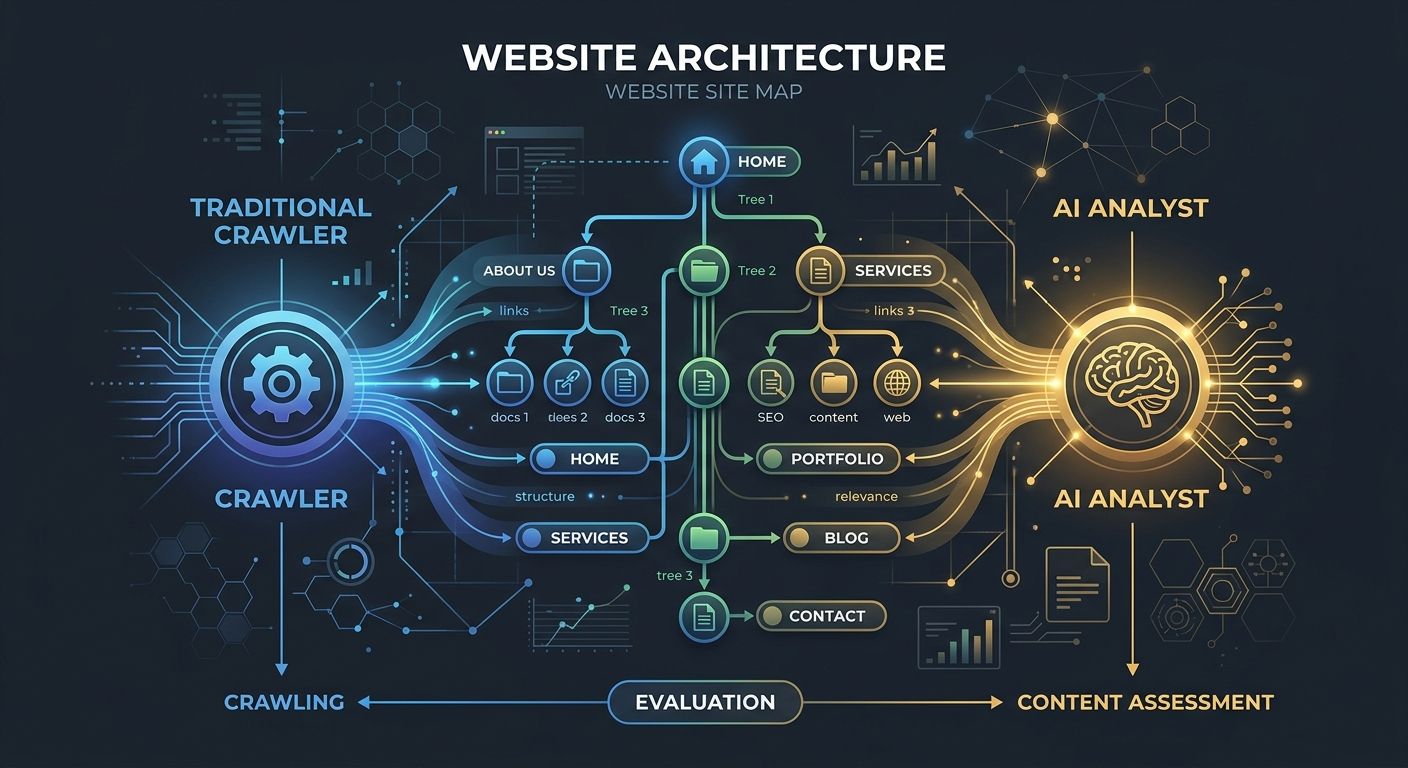
Every URL on your site carries three architectural signals that determine its search visibility: click depth from the homepage, subfolder grouping within a topic cluster, and internal link connectivity to related pages.
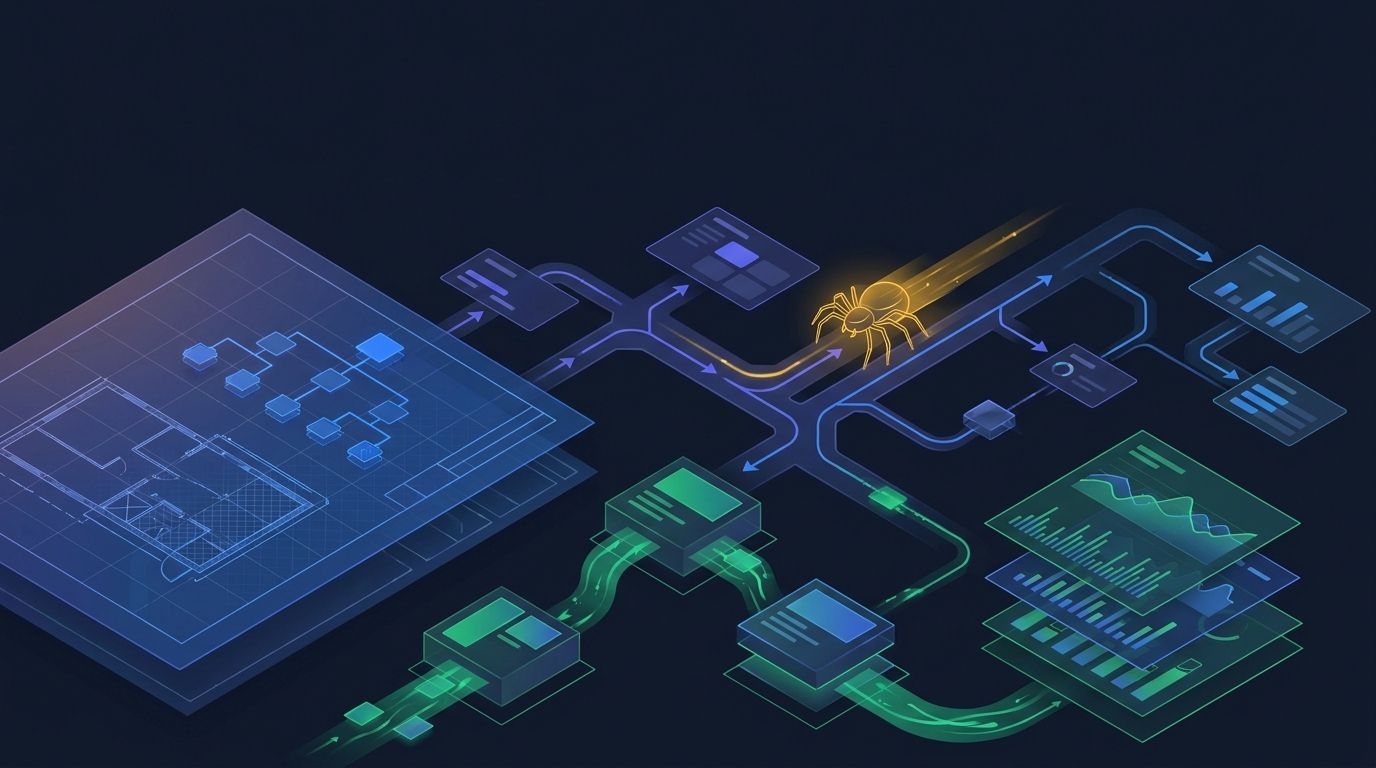
Site Architecture Is the Search Engine Success Factor That AI Changed First
Every URL on your site carries three architectural signals that determine its search visibility: click depth from the homepage, subfolder grouping within a topic cluster, and internal link connectivity to related pages. These signals now serve double duty, guiding both traditional crawlers and AI extraction systems toward the content they choose to surface.
How Flat Hierarchy Became an AI Requirement
Why does click depth matter more now than it did five years ago? Because AI Overviews and answer engines don't browse your site the way a human does. They pull from pages that Google has already crawled, indexed, and ranked within the top 20 organic results. According to current research data, 97% of AI Overview citations come from pages already in those top 20 positions, meaning the same architectural decisions that govern traditional crawl efficiency now control whether your content enters the AI citation pool at all.
The math on depth is stark. An Ahrefs index analysis found that 95% of all published pages receive zero organic traffic from Google, and burial beyond five clicks from the homepage is a consistent predictor of that invisibility. Sites that restructured from deep hierarchies to flat ones, keeping priority pages within two to three clicks of the homepage, saw organic traffic increases between 40% and 75%. One e-commerce case study documented a 76% increase in category page traffic and an 18% drop in bounce rates after reorganizing its architecture around keyword research rather than internal product taxonomy.
Backlinko's technical SEO guide for 2026 reinforces this with a practical detail: placing pages under consistent, logical subfolder paths (like /hub/seo or /blog/marketing) gives Google additional context about each page's topical relationship to its neighbors. That context matters for traditional ranking. It matters even more for AI systems that need to understand topical scope before deciding which page to cite in a generated answer. When you think about the search engine success factors IT teams and SEO strategists need to align on, architecture sits at the foundation. I've worked with enterprise clients who had thousands of indexed pages and almost no AI Overview presence, and the diagnosis was consistently the same: their important content lived four or five levels deep, unreachable by the lightweight crawl patterns that feed AI systems.
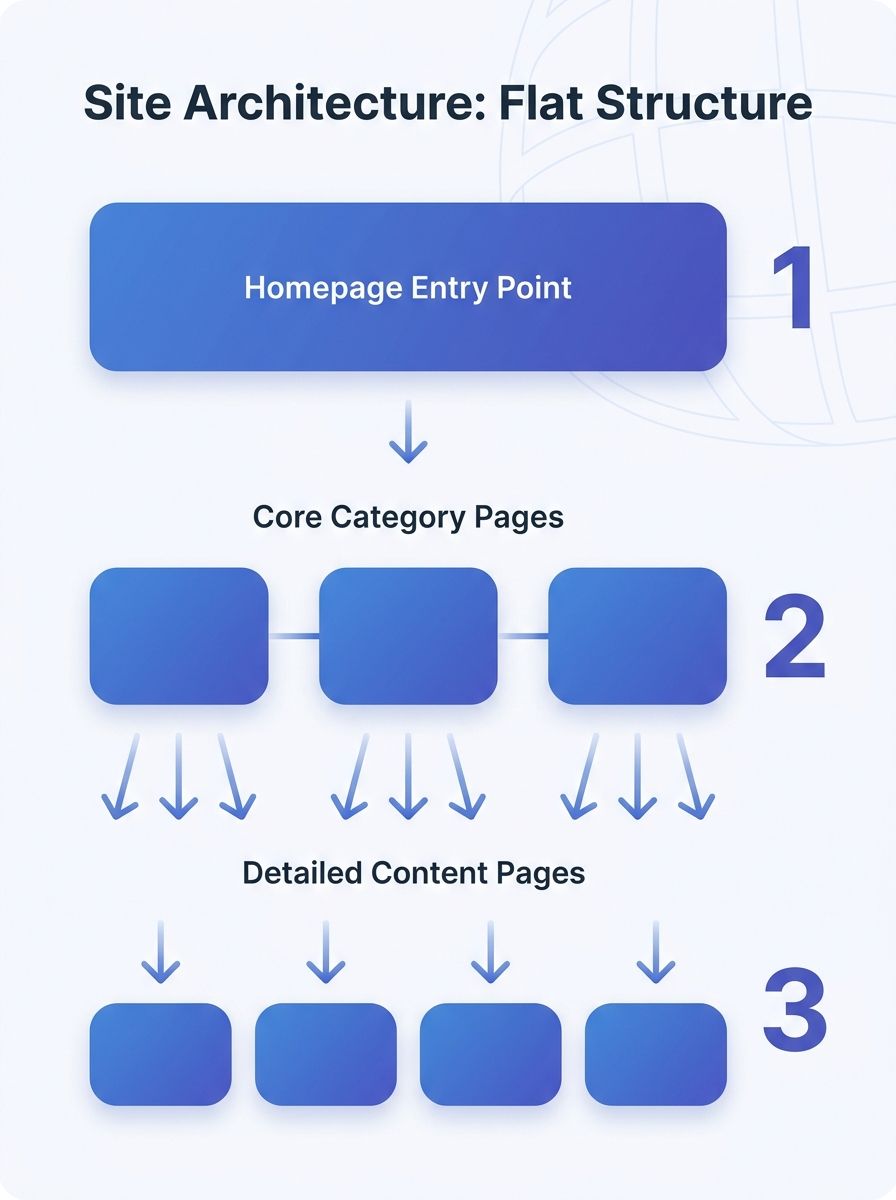
The internal linking density that supports flat architecture has its own benchmarks. Current best practices suggest three to ten contextual internal links per thousand words of content, concentrated around thematic hubs that reinforce topic authority. If you've been examining how link equity flows through your site structure, the architectural choices you make about depth and clustering determine where that equity accumulates and where it dissipates entirely.
The Cluster-Hub Model as an AI Extraction Signal
"When content is grouped into clusters under a hub or parent page, search engines can understand the topical depth available on the site," explains Search Engine Land's guide to website structure. They recognize that you haven't published a single isolated page on a subject. You've built an ecosystem of related content that collectively demonstrates authority. This principle, well established in traditional SEO, has gained new weight as AI systems use cluster signals to determine source reliability for generated answers.
Semrush's blog provides a clean example of this in practice. Their architecture groups posts under broad categories like "SEO," "Marketing," and "News & Research," with each category broken into subcategories like "Keyword Research" and "On-Page SEO." This hierarchical grouping supports both users and crawlers, mirroring how AI extraction works: the system identifies a topic cluster, evaluates the depth and breadth of coverage within that cluster, and selects the most authoritative page to cite.
I've started thinking about site architecture evaluation through what I call the Depth-Cluster-Connectivity model, covering three axes that predict how well a given architecture will perform in both traditional search and AI citation contexts. Depth measures how many clicks separate a page from the homepage. Cluster coherence measures whether pages on related topics are grouped under shared parent URLs and connected through internal links. Connectivity measures the density and relevance of internal links pointing to and from a given page. A page that scores well on all three axes tends to rank in traditional search, get crawled efficiently, and appear in AI-generated answers. A page that fails on even one axis often falls out of the AI citation pool entirely, even if it ranks decently in organic results.
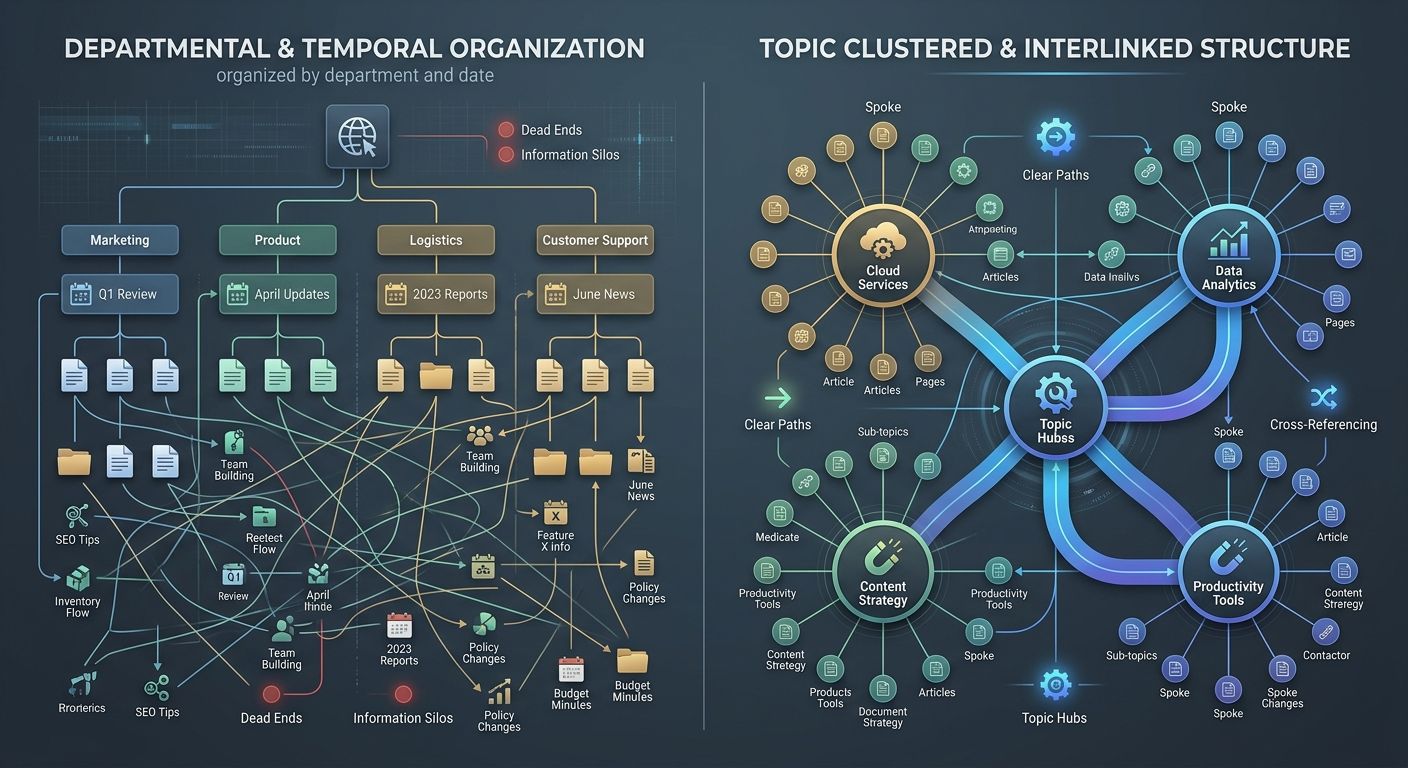
The relationship between clustering and AI visibility also explains why content architecture audits have become more urgent. Teams that built their site structures around internal organizational logic (product lines, department names, publication dates) rather than topical relationships find their content scattered across unrelated URL paths. AI systems interpret that scattering as a lack of topical depth, even when the raw content quality is high. Sites demonstrating strong topical authority signals through well-structured clusters have a 30% higher chance of ranking in the top three positions, and that advantage compounds when AI systems use those same ranking signals to select citation sources.
Duplicate Content Costs More When AI Systems Are Choosing
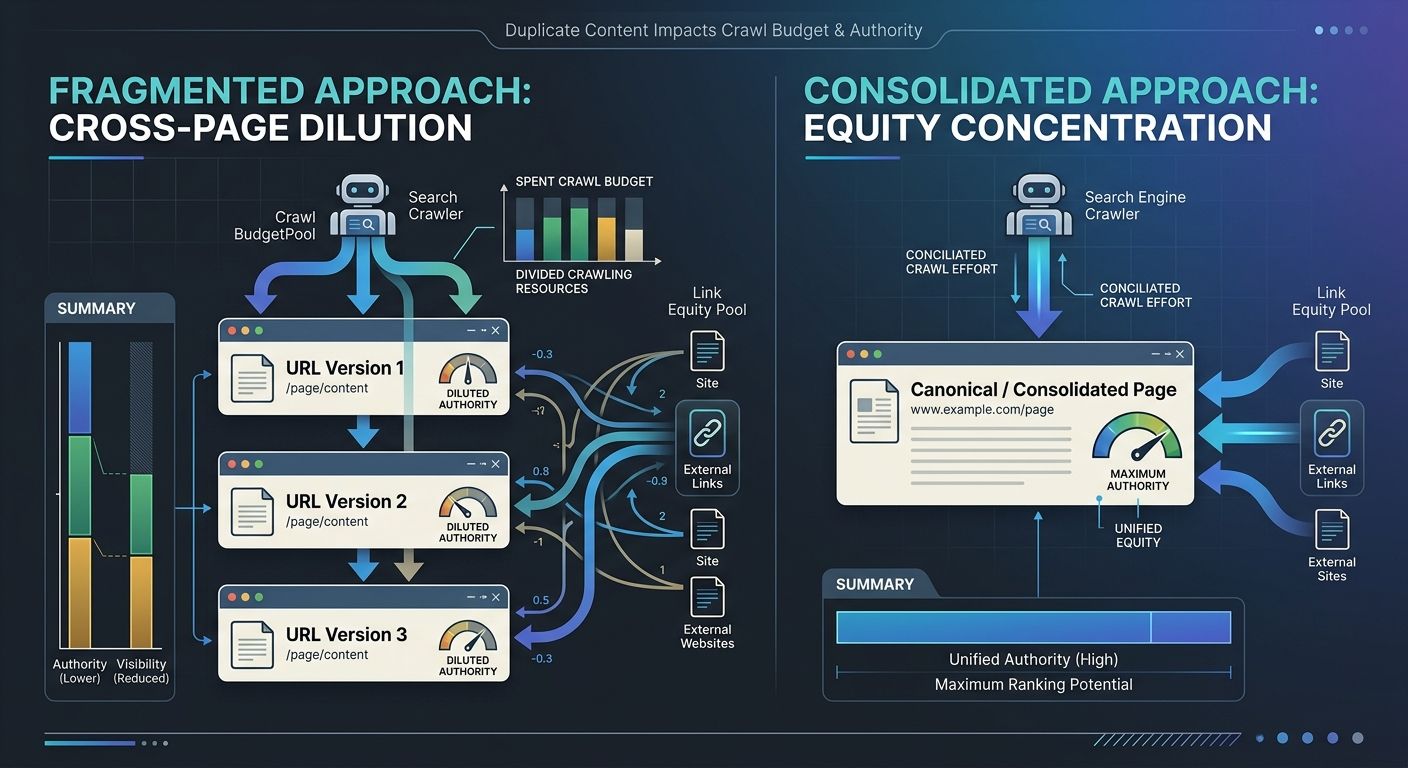
Duplicate content has always been an SEO problem, but the penalty structure changes when AI systems enter the equation. "Duplicate content can wreak havoc on your search engine rankings," warns Search Engine Land's duplicate content guide. Search engines face difficulty deciding which version to show when multiple identical pages exist, and the result is often lower rankings across all duplicates rather than a single page absorbing the combined authority. Search Engine Land news editor Barry Schwartz has covered this dynamic repeatedly, documenting cases where sites lost significant visibility after Google consolidated duplicate URLs in ways the site owners didn't intend.
The AI citation layer adds a second penalty mechanism. When Google's systems encounter duplicate content across your site, they waste crawl budget on redundant pages, budget that could have been spent discovering and indexing your unique, high-value content. Search Engine Journal's crawlability guide recommends eliminating duplicate content as a direct crawl budget optimization, alongside using robots.txt to block unimportant pages and implementing canonical tags to consolidate signals. For AI Overviews specifically, the stakes are higher: the system draws from a narrower pool of pages than traditional organic results, so any indexing confusion caused by duplicate content reduces your chances of being selected as a citation source.
The practical fixes remain canonical tags, 301 redirects, and consistent URL parameter handling, but the diagnostic process has grown more complex. Faceted navigation on e-commerce sites, paginated content, HTTP/HTTPS and www/non-www variations, and language-specific versions of pages all create duplicate content signals that compound across large sites and tank traffic. I've seen enterprise sites with over 40% of their indexed URLs classified as duplicates by Google Search Console, silently draining crawl budget and diluting the topical authority signals their architecture was designed to create. The fix isn't always technical. Sometimes the site architecture itself needs restructuring so that content naturally lives in one canonical location rather than being duplicated across multiple navigation paths.
Sites with poor Core Web Vitals compound the architecture problem. When Interaction to Next Paint (INP) exceeds 200 milliseconds, the threshold Google defined when INP replaced First Input Delay in March 2024, the site signals poor user experience, which correlates with reduced crawl frequency. Sites with INP scores above 300 milliseconds experienced 31% more traffic drops during Google's December 2025 core update. Architecture and performance interact in ways that matter: a well-structured site with poor load times still underperforms, and a fast site with buried content still goes uncited. Improving Core Web Vitals from "Poor" to "Good" correlates with a 25% increase in conversion rates and a 35% reduction in bounce rates, making performance optimization a direct revenue lever alongside architectural improvements.
Where the Architecture-AI Relationship Remains Uncertain
The relationship between site architecture and AI citation is clear at the extremes. A flat, well-clustered, duplicate-free site with strong Core Web Vitals will outperform a deep, disorganized, duplicate-heavy site in both traditional rankings and AI Overviews. The uncertain territory lies in the middle: how much architectural improvement is enough to cross the threshold from "indexed but ignored by AI" to "actively cited"?
Google hasn't published specific architectural criteria for AI Overview source selection beyond the general requirement of ranking in the top 20. The 97% citation rate from top-20 pages tells us where the floor is, but not what distinguishes the pages that get cited from those that don't. My working hypothesis, based on patterns across client sites, is that cluster coherence, the second axis of the Depth-Cluster-Connectivity model, carries disproportionate weight in AI source selection. Pages embedded in well-structured topic clusters get cited more often than isolated pages with equivalent rankings and content quality in the cases I've observed. But observation across a few dozen client sites isn't a controlled study, and I haven't seen published research that isolates this variable with statistical rigor.
The other open question concerns the speed of architectural feedback loops. Traditional SEO changes to site architecture often take weeks or months to produce measurable ranking changes, because Google needs to recrawl and reprocess affected pages. AI Overview citations appear to update on a different cadence, sometimes reflecting architectural changes faster than organic rankings do, sometimes slower. If you're rethinking how your XML sitemaps signal crawl priority or reconsidering how your content architecture supports internal linking, the feedback timeline for AI citation impact remains genuinely unpredictable.
What I'm confident about is this: the technical foundation of site architecture, covering flat hierarchy, topic clustering, duplicate content elimination, clean URL structures, and strong performance metrics, has become the prerequisite layer for visibility across every search surface that exists today. Traditional organic results, AI Overviews that now trigger on nearly half of Google searches, and third-party answer engines all draw from the same indexed content pool, and they all favor pages that are easy to discover, easy to categorize, and unambiguous in their canonical authority. The architectural decisions you make today determine your eligibility for citation channels that are evolving faster than most teams' site restructuring timelines can keep pace with. Whether the Depth-Cluster-Connectivity model holds up as AI search matures is something I'll be tracking closely, and I'd expect the weighting across those three axes to shift as these systems grow more sophisticated in how they select and attribute sources.

Sarah Chen
SEO strategist and web analytics expert with over 10 years of experience helping businesses improve their organic search visibility. Sarah covers keyword tracking, site audits, and data-driven growth strategies.
Related Articles

Site Architecture for SEO: How to Structure Your Website for Maximum Rankings
PageRank flows downhill through your site's link graph, losing equity at every click away from the homepage.

Beyond Traditional Rankings: How to Optimize for Both Google Search and AI Answer Engines in 2026
Google AI Overviews now appear in over 60% of searches, but only 17% of sources cited in those AI-generated answers also rank in the traditional organic top 10.
Internal Linking Architecture for AI Search: Building Topic Authority When ChatGPT Replaces Google
Internal linking strategies built for Google's PageRank model damage your visibility inside ChatGPT, Perplexity, and AI Overviews.
Explore more topics